


A Second-order Inertial Edge-flow Competition Model for Constrained Resource Competition: Conservation, KKT Equilibria, and Bounded Dominant Concentration
-
摘要: 针对现有一阶赢者通吃竞争模型难以同时刻画惯性效应、状态约束与严格优化解释, 本文研究资源总量守恒与箱体约束下的分布式非凸资源分配问题. 为此, 针对 Hill 型效用函数引入对数障碍正则化, 并以图边流动量为中间状态构建二阶惯性边流竞争模型. 所建模型能够利用局部边际效用信息实现分布式交互. 随后, 通过构造能量函数并运用 LaSalle 不变性原理, 证明可行内点集具有正不变性、系统能量单调耗散, 且系统轨迹收敛至平衡点集合. 在此基础上, 进一步建立动力学平衡点与正则化问题 KKT 条件之间的对应关系, 并证明当障碍参数趋于零且相关对偶变量保持有界时, 平衡点极限能够恢复原问题的 KKT 结构. 此外, 针对智能体处于 Hill 边际效用饱和区的情形, 给出能力参数与稳态资源分配之间的条件排序性质. 数值结果表明, 所建模型能够在保持约束的同时形成有界优势资源集聚. 其中, 惯性环节在收敛速度与峰值边流强度之间提供可调折中, 网络拓扑主要影响边际效用一致化速度, 而总资源规模则改变优势资源集聚强度.
-
关键词:
- 二阶惯性边流资源竞争模型 /
- 非凸资源分配 /
- 资源守恒
Abstract: This paper studies distributed nonconvex resource allocation under total-resource conservation and box constraints, addressing the difficulty of existing first-order winner-take-all competition models cannot simultaneously characterize inertial effects, state constraints, and a rigorous optimization interpretation. To this end, logarithmic barrier regularization is introduced for the Hill-type utility function, and a second-order inertial edge-flow competition model is constructed by using graph edge-flow momentum as an intermediate state. The proposed model can realize distributed interactions based on local marginal utility information. Then, by constructing an energy function and applying LaSalle's invariance principle, it is proved that the feasible interior set is positively invariant, the system energy is monotonically dissipative, and the system trajectory converges to the equilibrium set. On this basis, the correspondence between the dynamical equilibria and the KKT conditions of the regularized problem is further established, and it is proved that, when the barrier parameter tends to zero and the associated dual variables remain bounded, the limiting equilibria can recover the KKT structure of the original problem. In addition, for the case where agents lie in the saturation region of the Hill marginal utility, a conditional ordering property between capability parameters and steady-state resource allocations is derived. Numerical results show that the proposed model can form bounded advantageous resource concentration while preserving the constraints. Specifically, the inertial term provides a tunable tradeoff between convergence speed and peak edge-flow intensity, the network topology mainly affects the marginal-utility consensus speed, and the total resource scale changes the intensity of advantageous resource concentration. -
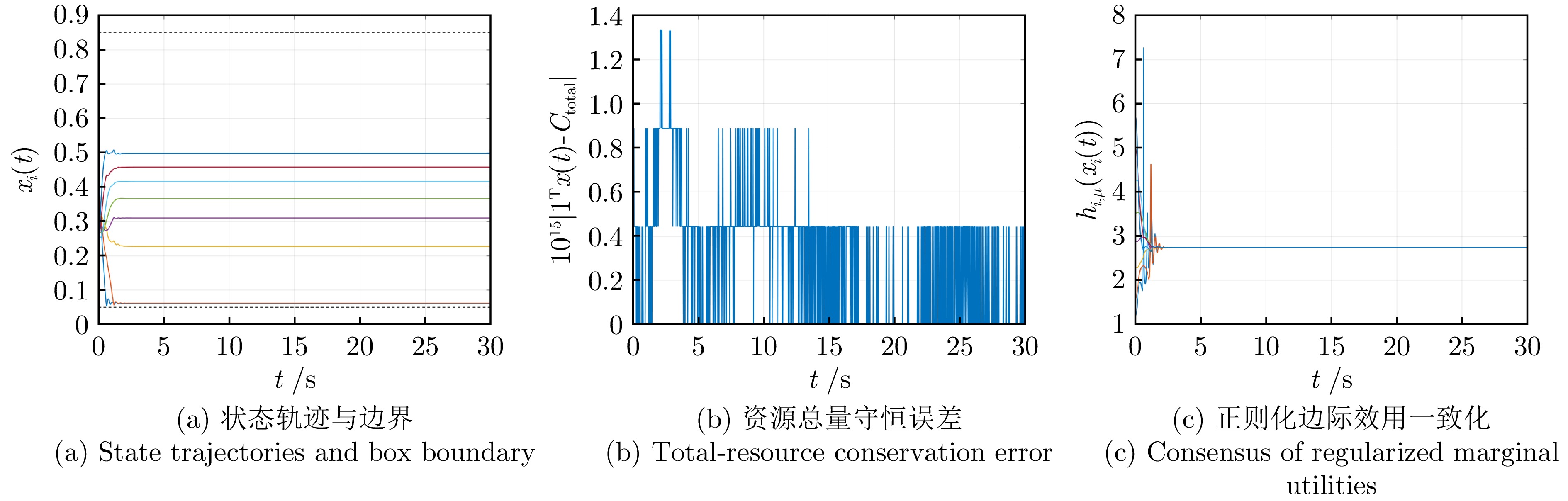
图 1 固定障碍参数下的状态演化与约束保持
Fig. 1 State evolution and constraint preservation for a fixed barrier parameter
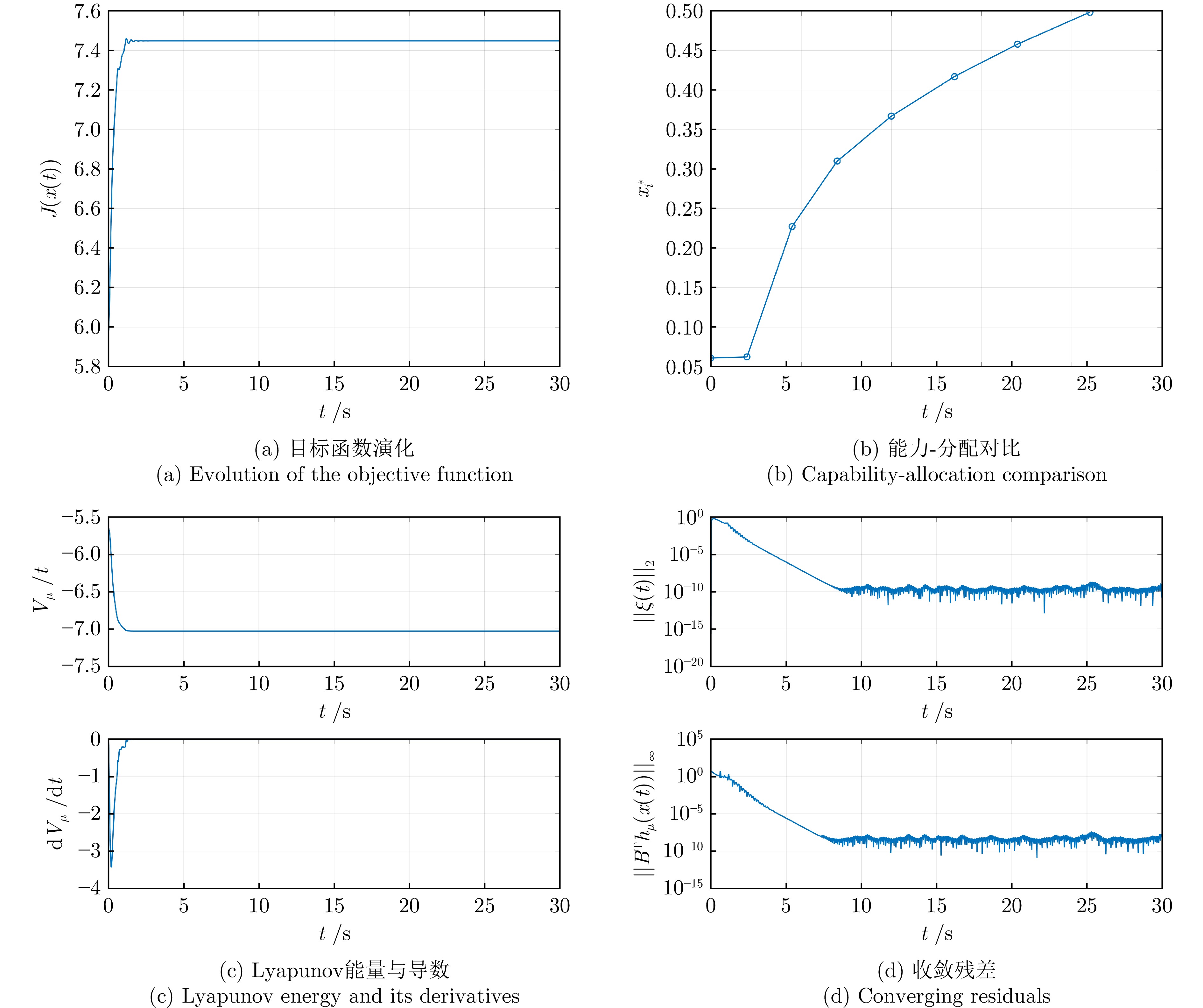
图 2 固定障碍参数下的性能指标与收敛行为
Fig. 2 Performance metrics and convergence behavior for a fixed barrier parameter
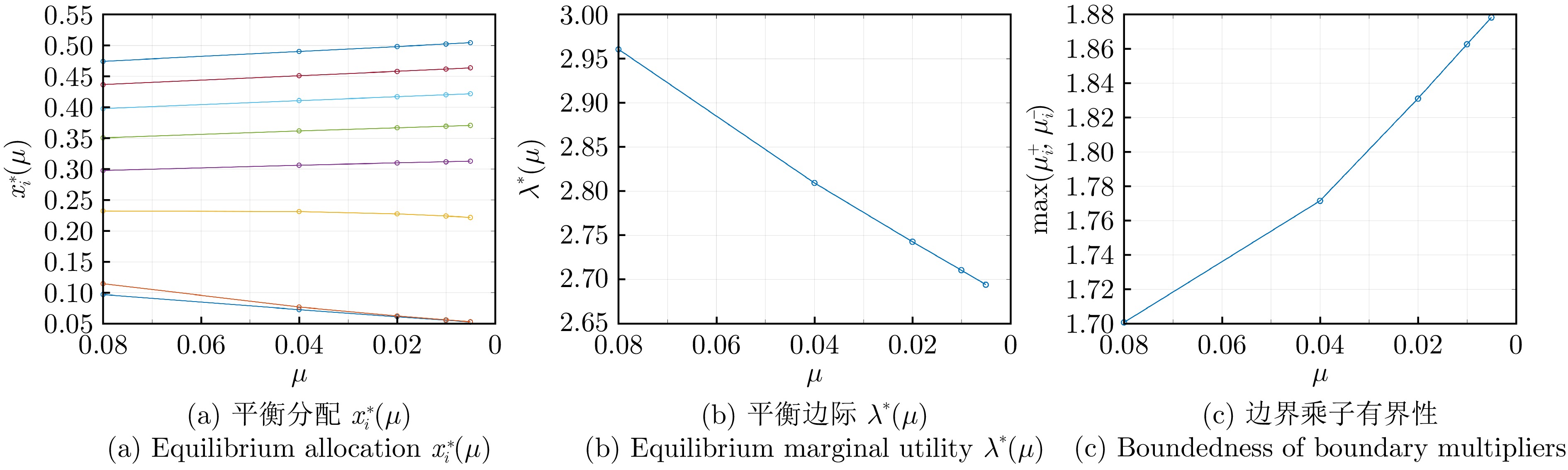
图 3 障碍参数扫描下的平衡分配与乘子趋势
Fig. 3 Equilibrium allocations and multiplier trends under a barrier-parameter sweep
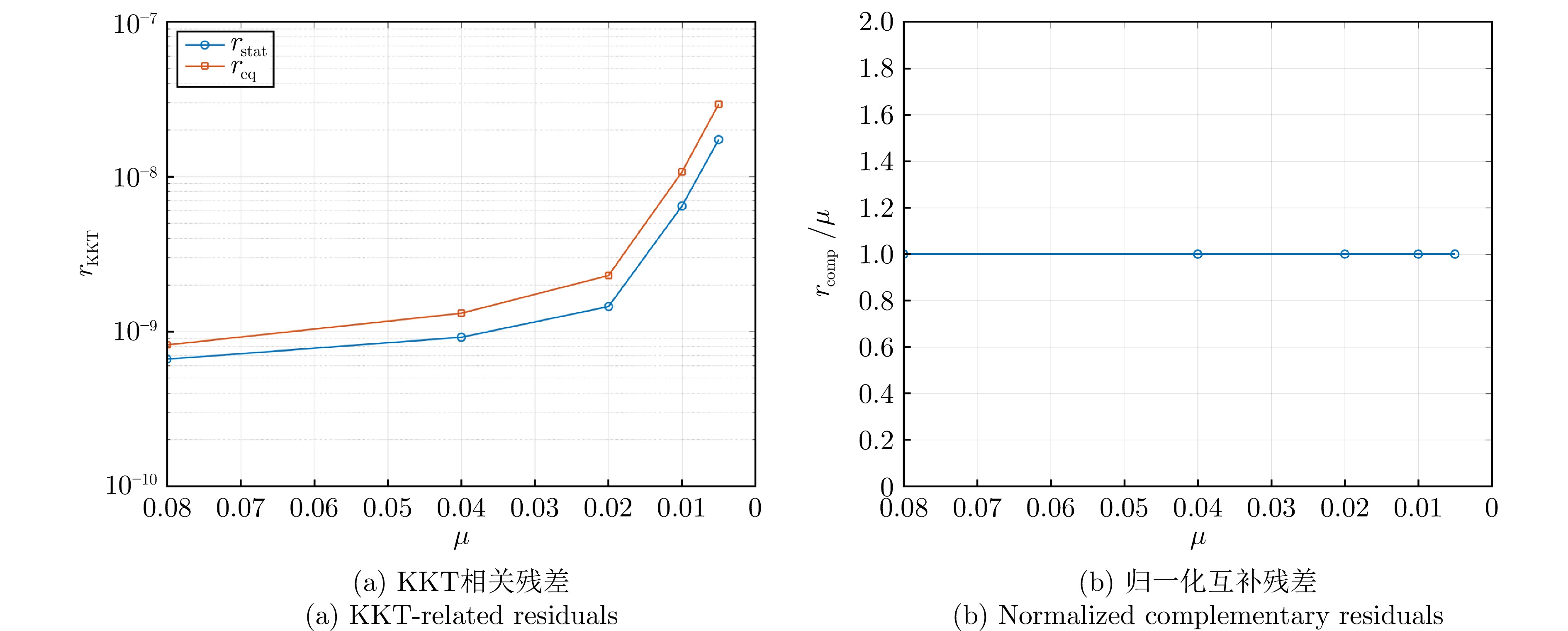
图 4 障碍参数趋零时的KKT残差验证
Fig. 4 Verification of KKT residuals as the barrier parameter approaches zero
表 1 初值与稳态资源分配对比($ \mu=0.02 $)
Table 1 Comparison of initial and steady-state resource allocations ($ \mu=0.02 $)
智能体$ i $ 能力参数$ c_i $ 初始资源$ x_i(0) $ 稳态资源$ x_i^\ast $ 1 1.00 0.41 0.060 9 2 1.20 0.38 0.062 3 3 1.45 0.32 0.227 3 4 1.70 0.29 0.309 9 5 2.00 0.27 0.366 7 6 2.35 0.25 0.416 8 7 2.70 0.24 0.458 0 8 3.10 0.24 0.498 0  下载: 导出CSV
表 3 随机初始条件和模型参数扰动下的统计结果
Table 3 Statistical results under random initial conditions and model-parameter perturbations
扰动类型 有效比例 $ J(x^\ast) $ $ t_s $ 峰值边流 排序一致率 随机初值 1.00 $ 7.452\,10\pm0.010\,11 $ $ 1.97\pm0.28 $ $ 0.332\,19\pm0.080\,14 $ $ 1.000\pm0.000 $ 能力参数组 1.00 $ 7.437\,15\pm0.256\,18 $ $ 2.78\pm1.07 $ $ 0.355\,16\pm0.034\,15 $ $ 1.000\pm0.000 $ Hill参数 1.00 $ 7.256\,15\pm1.653\,11 $ $ 2.87\pm1.30 $ $ 0.336\,19\pm0.035\,19 $ $ 1.000\pm0.000 $
下载: 导出CSV
表 2 $ \mu $扫描下的平衡与残差指标
Table 2 Equilibrium and residual metrics under the $ \mu $ sweep
$ \mu $ $ \lambda^\ast(\mu) $ $ \max|{\rm{stat}}| $ $ \max|{\rm{comp}}| $ $ \max|B^{{\rm{T}}} h_\mu| $ $ \max(\mu_i^+,\mu_i^-) $ 0.08 2.960 625 $ 6.61\times 10^{-10} $ $ 8.0\times 10^{-2} $ $ 8.17\times 10^{-10} $ 1.700 7 0.04 2.809 298 $ 9.16\times 10^{-10} $ $ 4.0\times 10^{-2} $ $ 1.31\times 10^{-9} $ 1.771 5 0.02 2.742 712 $ 1.45\times 10^{-9} $ $ 2.0\times 10^{-2} $ $ 2.29\times 10^{-9} $ 1.831 0 0.01 2.710 407 $ 6.44\times 10^{-9} $ $ 1.0\times 10^{-2} $ $ 1.07\times 10^{-8} $ 1.862 6 0.005 2.694 130 $ 1.73\times 10^{-8} $ $ 5.0\times 10^{-3} $ $ 2.94\times 10^{-8} $ 1.878 3
下载: 导出CSV
表 4 一阶/二阶模型与阻尼参数比较
Table 4 Comparison of the first- and second-order models under different damping parameters
模型 $ \alpha $ $ J(x^\ast) $ $ t_s $ 峰值边流强度 一阶约化流 0 7.447 979 3.06 0 二阶惯性流 4 7.475 509 2.78 0.487 5 二阶惯性流 8 7.447 979 2.00 0.357 0 二阶惯性流 12 7.447 979 4.12 0.279 5 二阶惯性流 20 7.447 979 7.40 0.192 7
下载: 导出CSV
表 5 不同网络拓扑和随机边权的平衡与敏感度分析
Table 5 Equilibrium and sensitivity analysis under different network topologies and random edge weights
拓扑 $ J(x^\ast) $ $ t_s $ 活跃分量数 边际失配 链式图 7.447979 35.04 1 $ 2.19\times 10^{-10} $ 环形图 7.447979 11.74 1 $ 3.04\times 10^{-9} $ 加边环形图 7.447979 2.00 1 $ 1.16\times 10^{-9} $ 完全图 7.447979 1.50 1 $ 6.04\times 10^{-9} $ 星形图 7.447979 6.32 1 $ 6.46\times 10^{-9} $ 随机边权加边环 7.447979 2.40 $ \pm $ 0.59 1 $ 1.73\times10^{-15} $
下载: 导出CSV
表 6 总资源变化对优势集聚结构的影响
Table 6 Effect of total resource variation on the structure of advantageous resource concentration
$ C_{{\rm{total}}} $ $ J(x^\ast) $ 下边界节点数 活跃节点数 前3节点资源占比 1.8 5.826 937 0 8 0.690 1 2.4 7.447 979 0 8 0.572 0 3.0 8.831 312 0 8 0.516 9 3.6 9.982 043 0 8 0.474 7
下载: 导出CSV
表 7 20个智能体完全图稳态资源排序
Table 7 Steady-state resource ranking for complete graph of 20 agents
排名 节点$ i $ 能力参数$ c_i $ 稳态资源$ x_i^\ast $ 1 20 3.400 0 0.389 7 2 19 3.273 7 0.377 6 3 18 3.147 4 0.364 8 4 17 3.021 1 0.351 1 5 16 2.894 7 0.336 3
下载: 导出CSV
-
[1] Lotka A J. Elements of Physical Biology. Baltimore: Williams and Wilkins, 1925. [2] Volterra V. Variations and Fluctuations in the Number of Individuals in Animal Species Living Together. New York: McGraw-Hill, 1927. [3] Grossberg S. Competition, decision, and consensus. Journal of Mathematical Analysis and Applications, 1978, 66(2): 470−493 doi: 10.1016/0022-247X(78)90249-4 [4] Hirsch M W. Systems of differential equations which are competitive or cooperative: I. Limit sets. SIAM Journal on Mathematical Analysis, 1982, 13(2): 167−179 doi: 10.1137/0513013 [5] Maass W. On the computational power of winner-take-all. Neural Computation, 2000, 12(11): 2519−2535 doi: 10.1162/089976600300014827 [6] Maurer S M, Huberman B A. Competitive dynamics of web sites. Journal of Economic Dynamics and Control, 2003, 27(11-12): 2195−2206 doi: 10.1016/S0165-1889(02)00121-5 [7] Noe T, Parker G. Winner take all: Competition, strategy, and the structure of returns in the internet economy. Journal of Economics & Management Strategy, 2005, 14(1): 141−164 doi: 10.2139/ssrn.250371 [8] Liu S B, Wang J. A simplified dual neural network for quadratic programming with its KWTA application. IEEE Transactions on Neural Networks, 2006, 17(6): 1500−1510 doi: 10.1109/TNN.2006.881046 [9] Liu Q S, Wang J. Two k-winners-take-all networks with discontinuous activation functions. Neural Networks, 2008, 21(2): 406−413 doi: 10.1016/j.neunet.2007.12.044 [10] Li S, Li Y M, Wang Z. A class of finite-time dual neural networks for solving quadratic programming problems and its k-winners-take-all application. Neural Networks, 2013, 39: 27−39 doi: 10.1016/j.neunet.2012.12.009 [11] 杨涛, 柴天佑. 分布式协同优化的研究现状与展望. 中国科学: 技术科学, 2020, 50(11): 1414−1425 doi: 10.1360/SST-2020-0040Yang Tao, Chai Tian-You. Research status and prospects of distributed collaborative optimization. SCIENCE CHINA Information Sciences, 2020, 50(11): 1414−1425 doi: 10.1360/SST-2020-0040 [12] Li S, Zhou M C, Luo X, You Z H. Distributed winner-take-all in dynamic networks. IEEE Transactions on Automatic Control, 2017, 62(2): 577−589 doi: 10.1109/TAC.2016.2578645 [13] 陈刚, 李志勇. 集合约束下多智能体系统分布式固定时间优化控制. 自动化学报, 2022, 48(9): 2254−2264 doi: 10.16383/j.aas.c190416Chen Gang, Li Zhi-Yong. Distributed fixed-time optimization control for multi-agent systems with setconstraints. Acta Automatica Sinica, 2022, 48(9): 2254−2264 doi: 10.16383/j.aas.c190416 [14] Zhang Y Y, Li S, Xu B, Yang Y. Analysis and design of a distributed k-winners-take-all model. Automatica, 2020, 115: Article No. 108868 doi: 10.1016/j.automatica.2020.108868 [15] 时侠圣, 林志赟. 基于固定时间的二阶智能体分布式优化算法. 北京航空航天大学学报, 2023, 49(11): 2951−2959 doi: 10.13700/j.bh.1001-5965.2022.0060Shi Xia-Sheng, Lin Zhi-Yun. Fixed-time distributed convex algorithm over second-order multi-agent systems under bounded disturbances. Journalof Beijing University of Aeronautics and Astronautics, 2023, 49(11): 2951−2959 doi: 10.13700/j.bh.1001-5965.2022.0060 [16] Zhang Y, Li S, Weng J. Distributed k-winners-take-all network: An optimization perspective. IEEE Transactions on Cybernetics, 2023, 53(8): 5069−5081 doi: 10.1109/TCYB.2022.3170236 [17] 吴庆涛, 朱军龙, 葛泉波, 张明川. 一种基于条件梯度的加速分布式在线学习算法. 自动化学报, 2024, 50(2): 386−402Wu Qing-Tao, Zhu Jun-Long, Ge Quan-Bo, Zhang Ming-Chuan. An accelerated distributed online learn-ing algorithm based on conditional gradient. Acta Automatica Sinica, 2024, 50(2): 386−402 [18] 时侠圣, 孙长银, 穆朝絮. 扰动线性多智能体系统的分布式资源分配算法. 中国科学: 信息科学, 2024, 54(4): 911−926 doi: 10.1360/SSI-2023-0093Shi Xia-Sheng, Sun Chang-Yin, Mu Chao-Xu. Distributed resource allocation algorithms for linear multi-agent systems with disturbances. SCIENCE CHINA Information Sciences, 2024, 54(4): 911−926 doi: 10.1360/SSI-2023-0093 [19] Huang Y, Fang W T, Chen Z Y, Li Y G, Yang C H. Flocking of multiagent systems with nonuniform and nonconvex input constraints. IEEE Transactions on Automatic Control, 2023, 68(7): 4329−4335 doi: 10.1109/tac.2022.3206117 [20] Huang Y, Duan M M, Mo L P. Multiagent containment control with nonconvex states constraints, nonuniform time delays, and switching directed networks. IEEE Transactions on Neural Networks and Learning Systems, 2019, 31(11): 5021−5028 doi: 10.1109/tnnls.2019.2955678 [21] Chen Z Y. Winners take all: A reverse consensus model. arXiv preprint arXiv: 2409.12407, 2024. [22] Cao X W, Yang Y G, Li S, Stanimirović P S, Katsikis V N. A novel competition model for dynamic winner-take-all. International Journal of Systems Science, 2025. DOI: 10.1080/00207721.2025.2568717 -

 下载:
下载:

计量
- 文章访问数: 16
- HTML全文浏览量: 10
- 被引次数: 0
