


-
摘要: 面向工程系统运行安全的分析技术对于提升风险感知、预防潜在安全事故发生、保障系统安全可靠运行具有重要意义. 然而, 随着工程系统功能与结构的复杂化、内部组件之间非线性相互作用的日益增强, 其运行过程中的安全分析往往面临着安全事件难以系统识别、评估指标难以准确选取、风险传播机制难以清晰刻画、安全边界难以有效量化等诸多挑战. 为此, 本文系统地梳理复杂工程系统运行过程中安全的定义及其内涵, 阐述安全分析的整体实施框架, 全面回顾和总结有关安全事件分析、评估指标选取、事故模型构建及安全区域刻画等方面的研究进展, 并对该领域未来的发展趋势与研究方向进行探讨.Abstract: Safety analysis plays a pivotal role in enhancing risk perception, preventing potential accidents, and assuring the reliability and safety of the entire engineering system. However, with the progressive increase in complexity and integration of modern engineering systems, the interactions within their components are inherently intensifying. The examination of risk accidents, selection of evaluation metrics, identification of risk transmissions, and characterization of safety boundaries for complex engineering systems all pose significant challenges. For these challenges, this paper presents an introductory overview on the development of safety analysis for complex engineering systems. The definition and connotation of safety are elucidated, along with the specific implementation process of quantitative assessment. Afterward, key references are provided for which interested readers can obtain more detailed information on risk analysis, metric determination, accident modeling, safety region representation, and so forth. Finally, some critical issues are discussed as open problems for future research directions in this emerging field.
-
Key words:
- operational safety /
- safety analysis /
- complex engineering systems /
- risk assessment /
- safety control
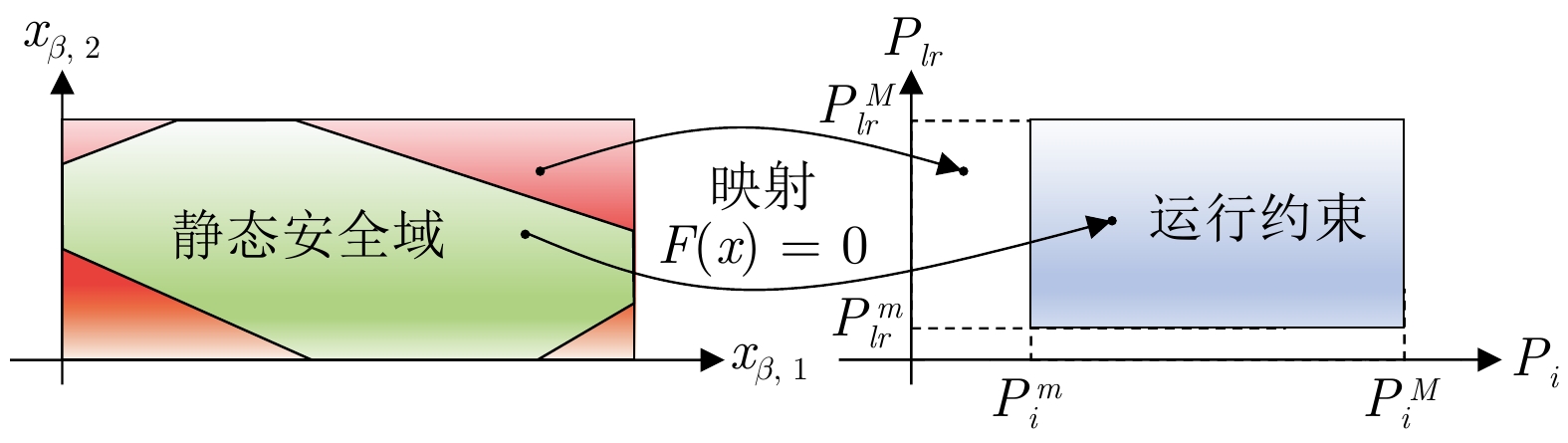
1)1 1 在一些英文文献中安全域也被称为safety domain或security region2)2 2 图中的$ x_{\beta,\;1} $和$ x_{\beta,\;2} $表示从状态向量$ \boldsymbol{x}_{\beta} $中任意选取的两个互不相同的分量 -
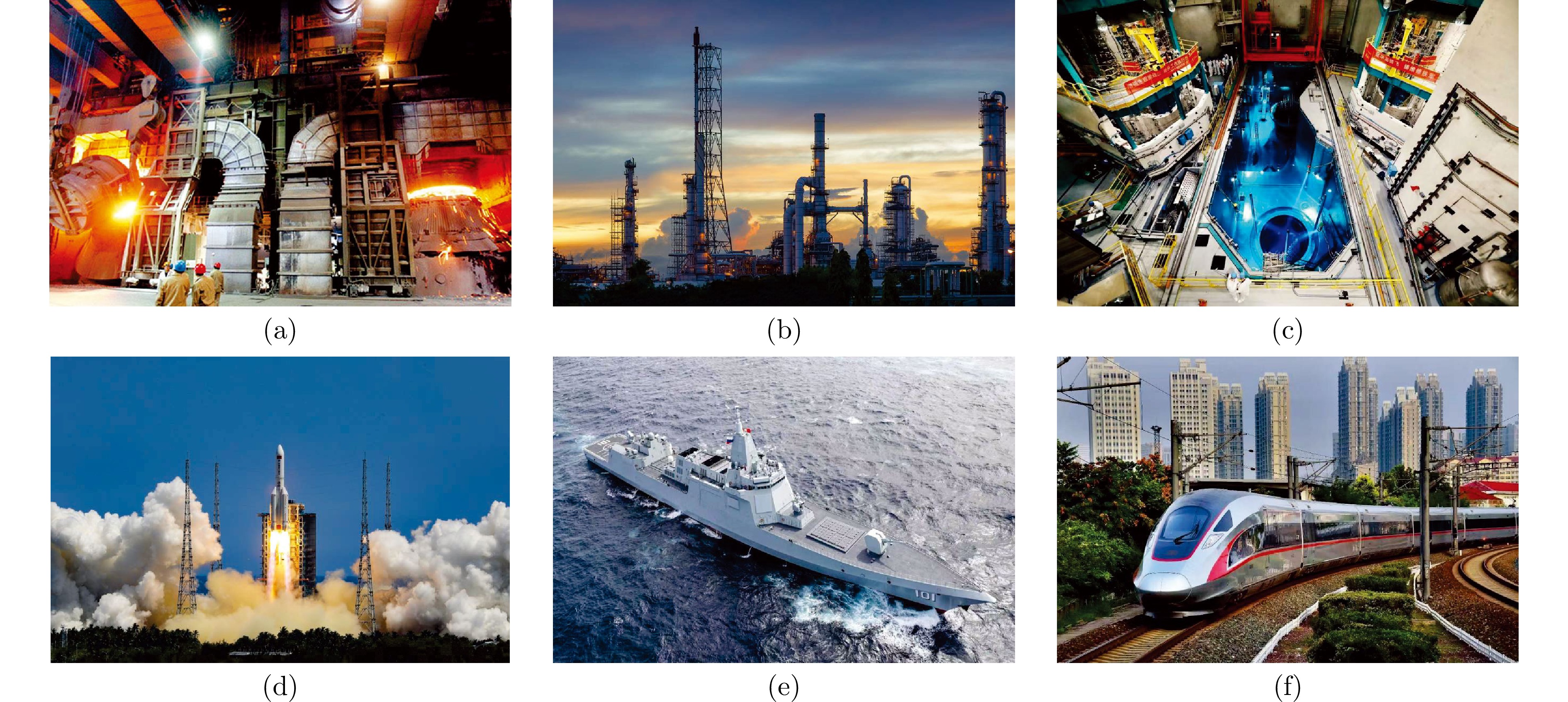
图 1 典型的复杂工程系统((a)冶金系统; (b)化工系统; (c)核电系统; (d)运载火箭; (e)大型远洋舰船; (f)高速列车)
Fig. 1 Typical complex engineering systems ((a) Metallurgical systems; (b) Chemical industry systems; (c) Nuclear power systems; (d) Rockets; (e) Large ocean-going vessels; (f) High-speed trains)
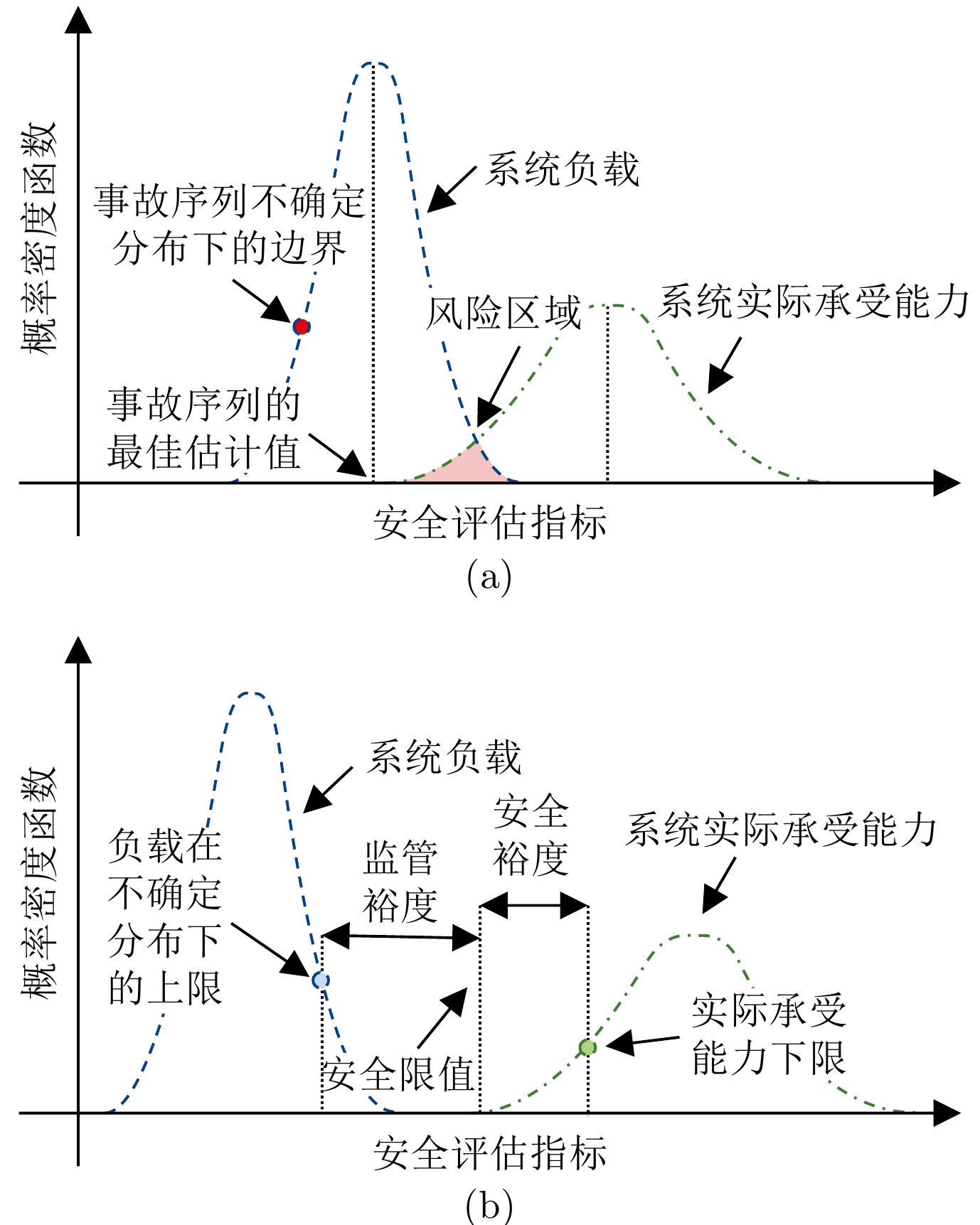
图 7 基于BEPU的风险与安全裕度示意图((a)由实际负载与承受能力决定的风险; (b)安全裕度)
Fig. 7 Schematic diagrams of risk and safety margin based on BEPU ((a) Risk determined by actual load and capacity; (b) Safety margin)
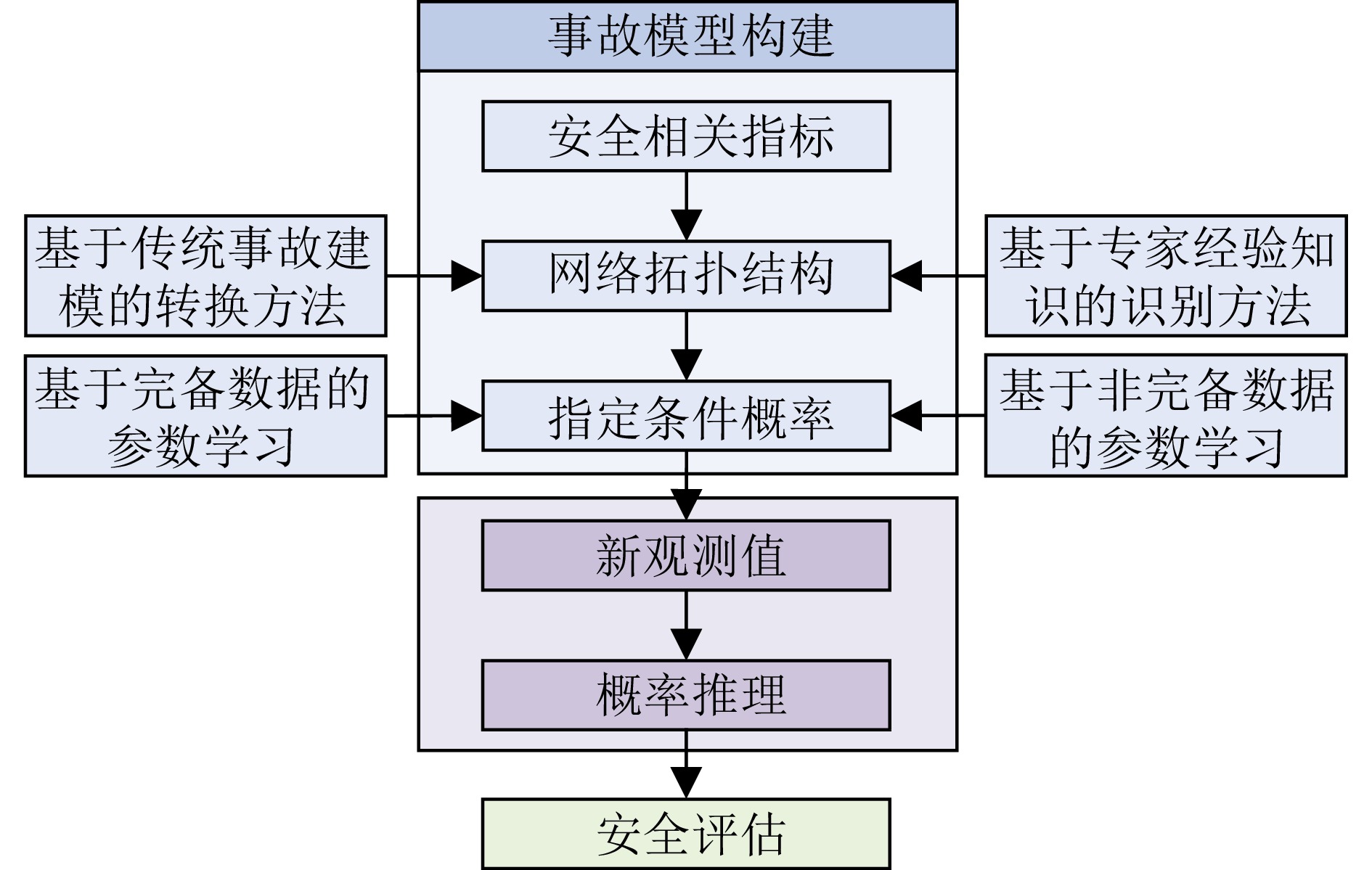
图 11 构建和使用贝叶斯网络进行安全量化评估的必要步骤
Fig. 11 Steps necessary to build and use the Bayesian network for safety quantification and assessment
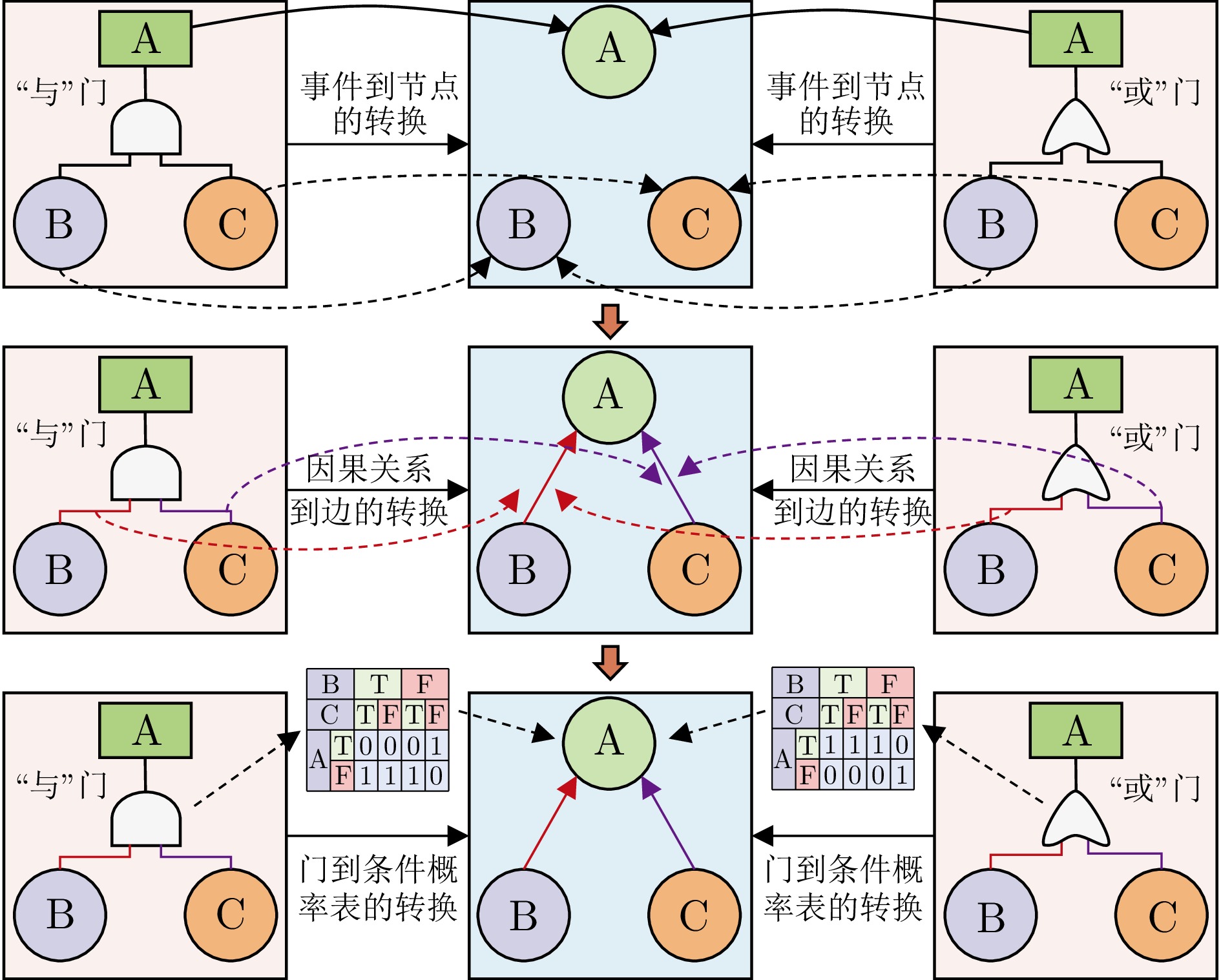
图 12 故障树到贝叶斯网络的转换过程
Fig. 12 Transformation process from fault tree to Bayesian network
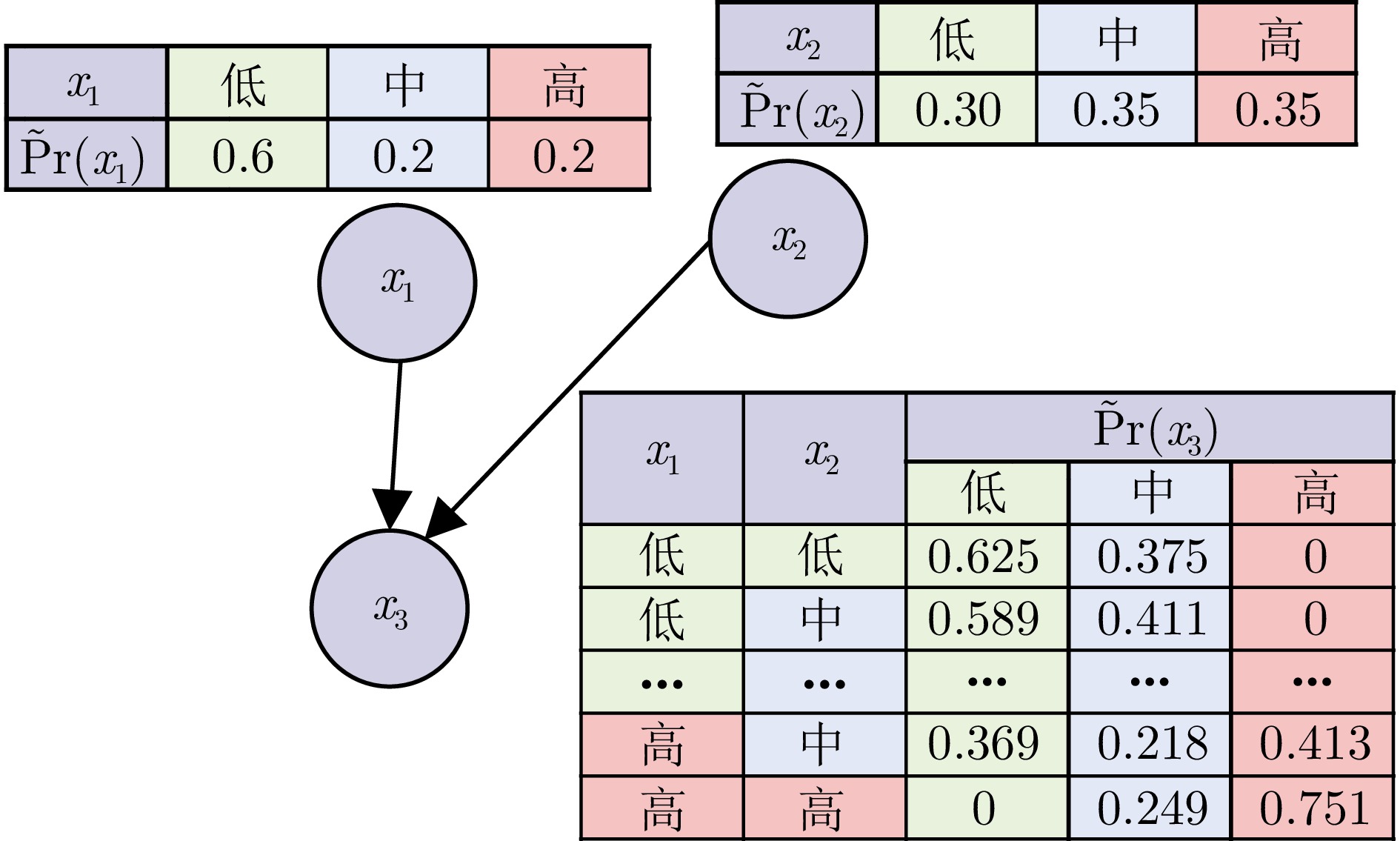
图 13 基于模糊贝叶斯网络的系统风险水平描述
Fig. 13 Description of system risk levels based on fuzzy Bayesian network
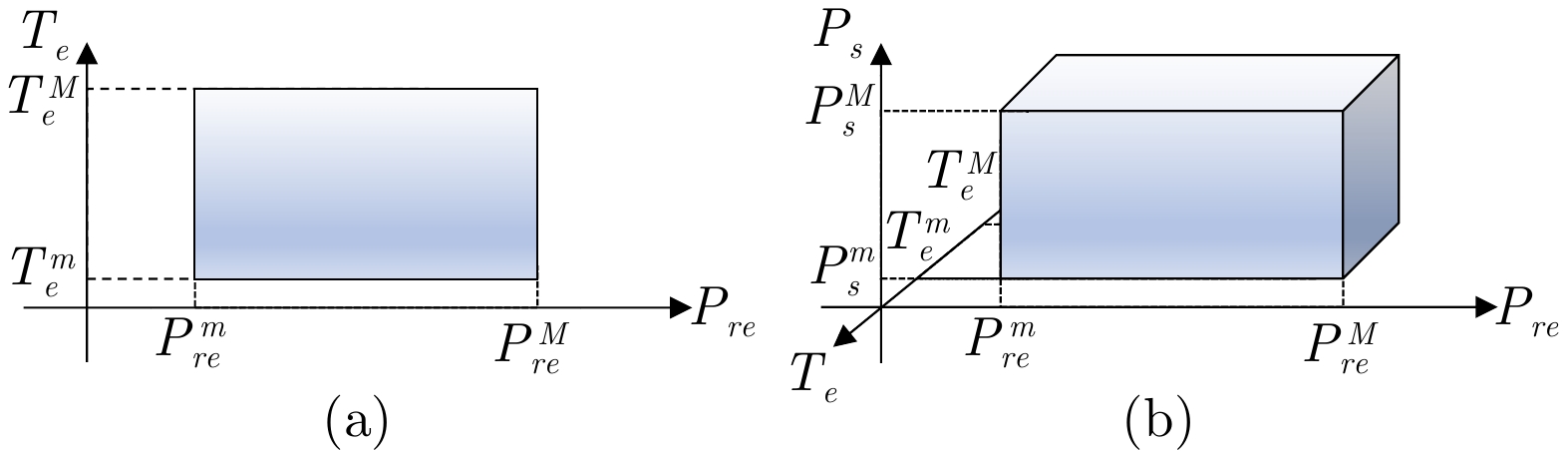
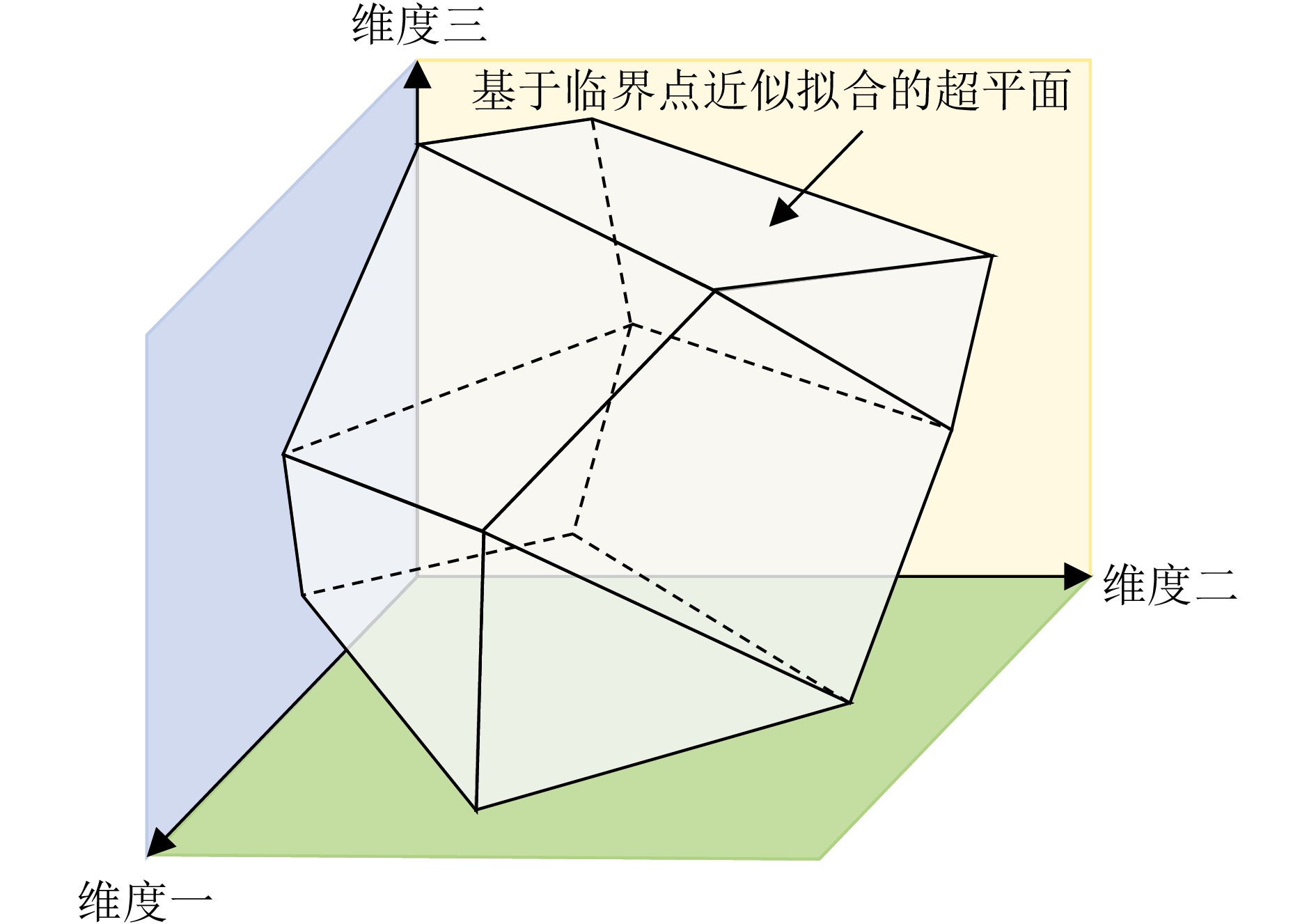
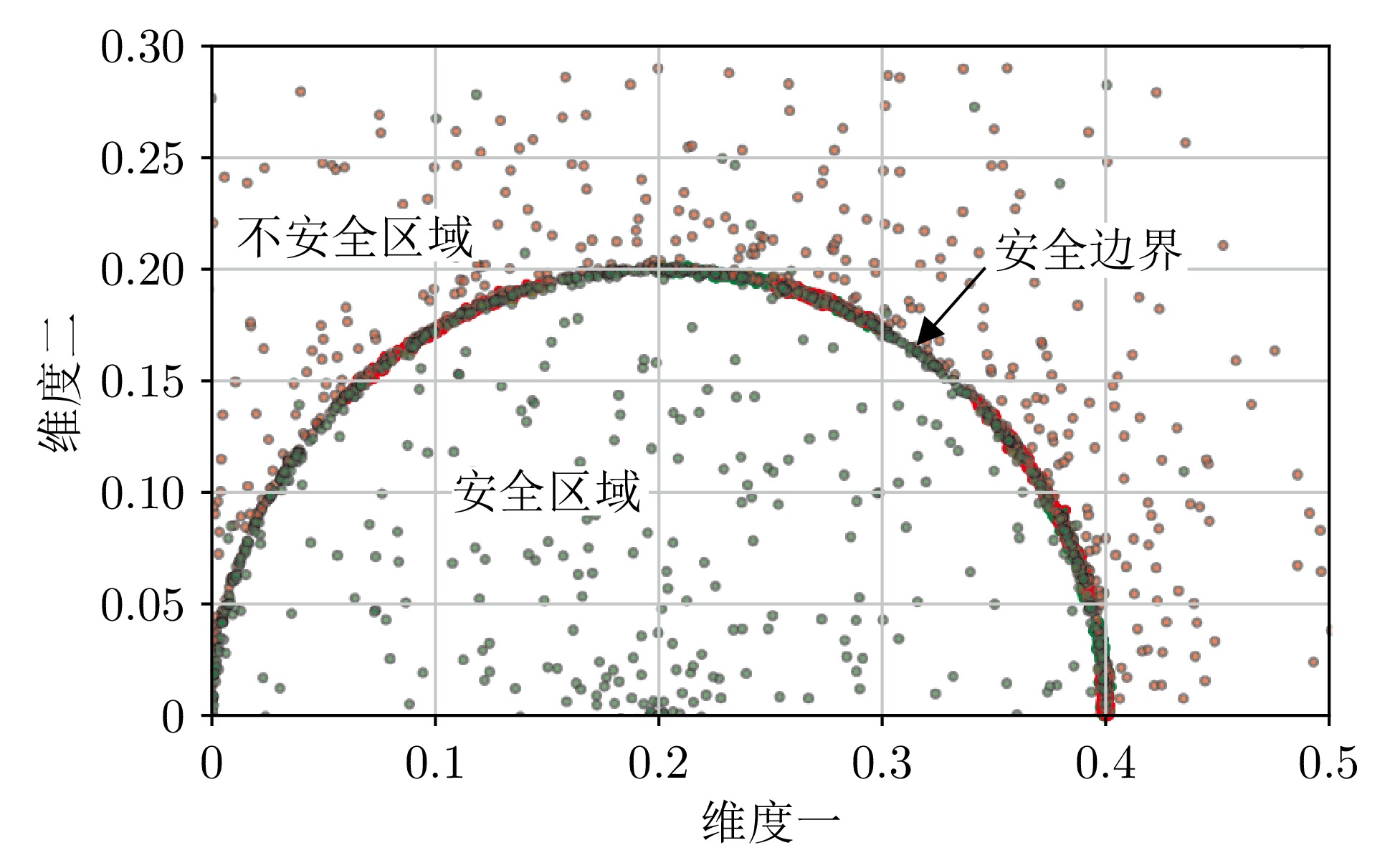
图 14 不同维度下的静态安全域示意图((a)二维空间中的静态安全域; (b)三维空间中的静态安全域)
Fig. 14 Schematic diagrams of SSR in different dimensions ((a) SSR in 2-dimensional space; (b) SSR in 3-dimensional space)
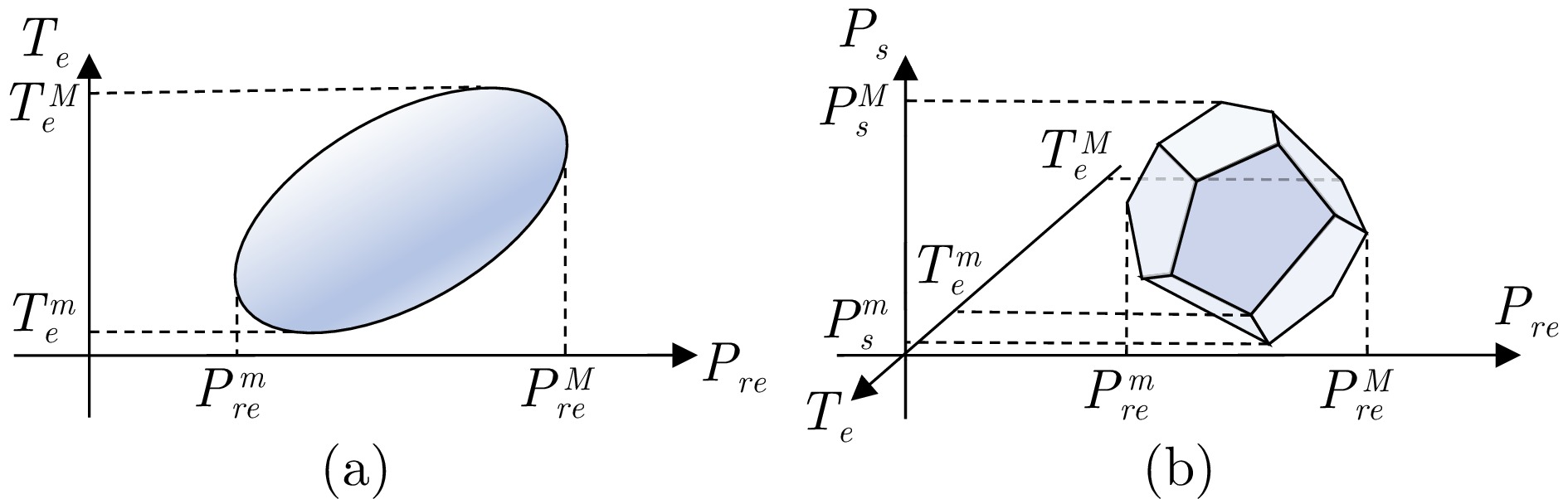
图 15 考虑变量耦合的静态安全域示意图((a)二维空间中耦合的静态安全域; (b)三维空间中耦合的静态安全域)
Fig. 15 Schematic diagrams of SSR considering variable coupling ((a) Coupled SSR in 2-dimensional space; (b) Coupled SSR in 3-dimensional space)
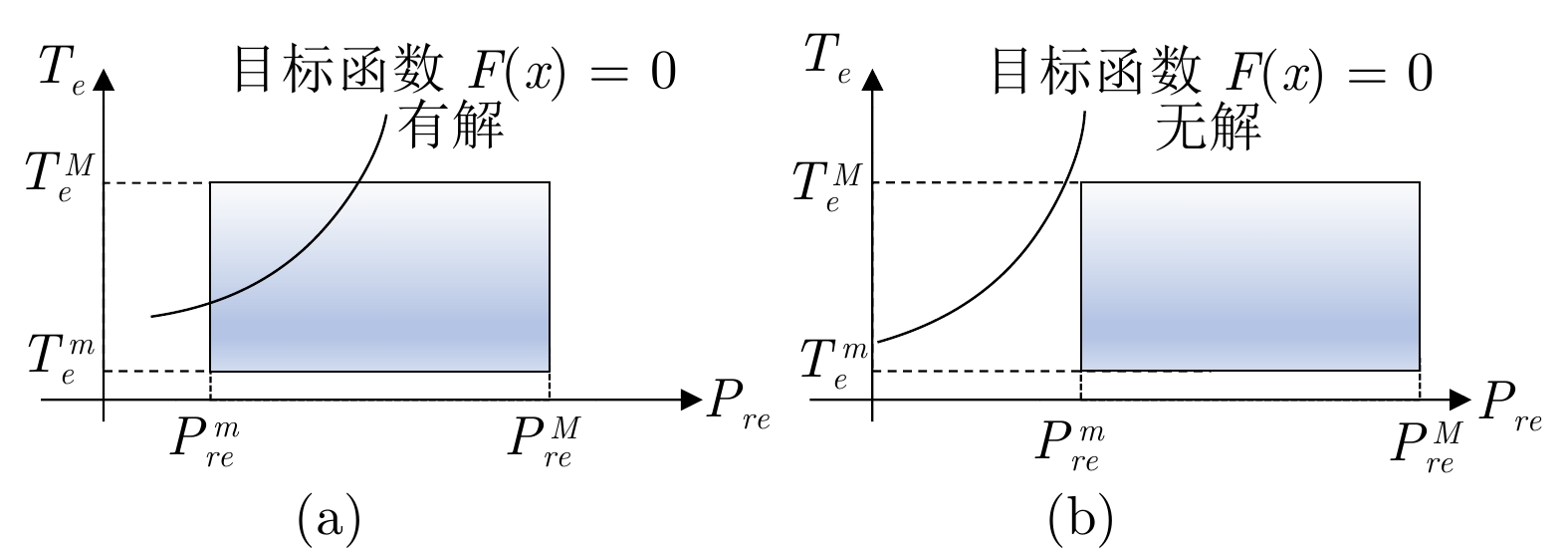
图 16 运行约束下的可行解((a)有解; (b)无解)
Fig. 16 Feasible solutions under operational constraints ((a) Have solutions; (b) No solution)
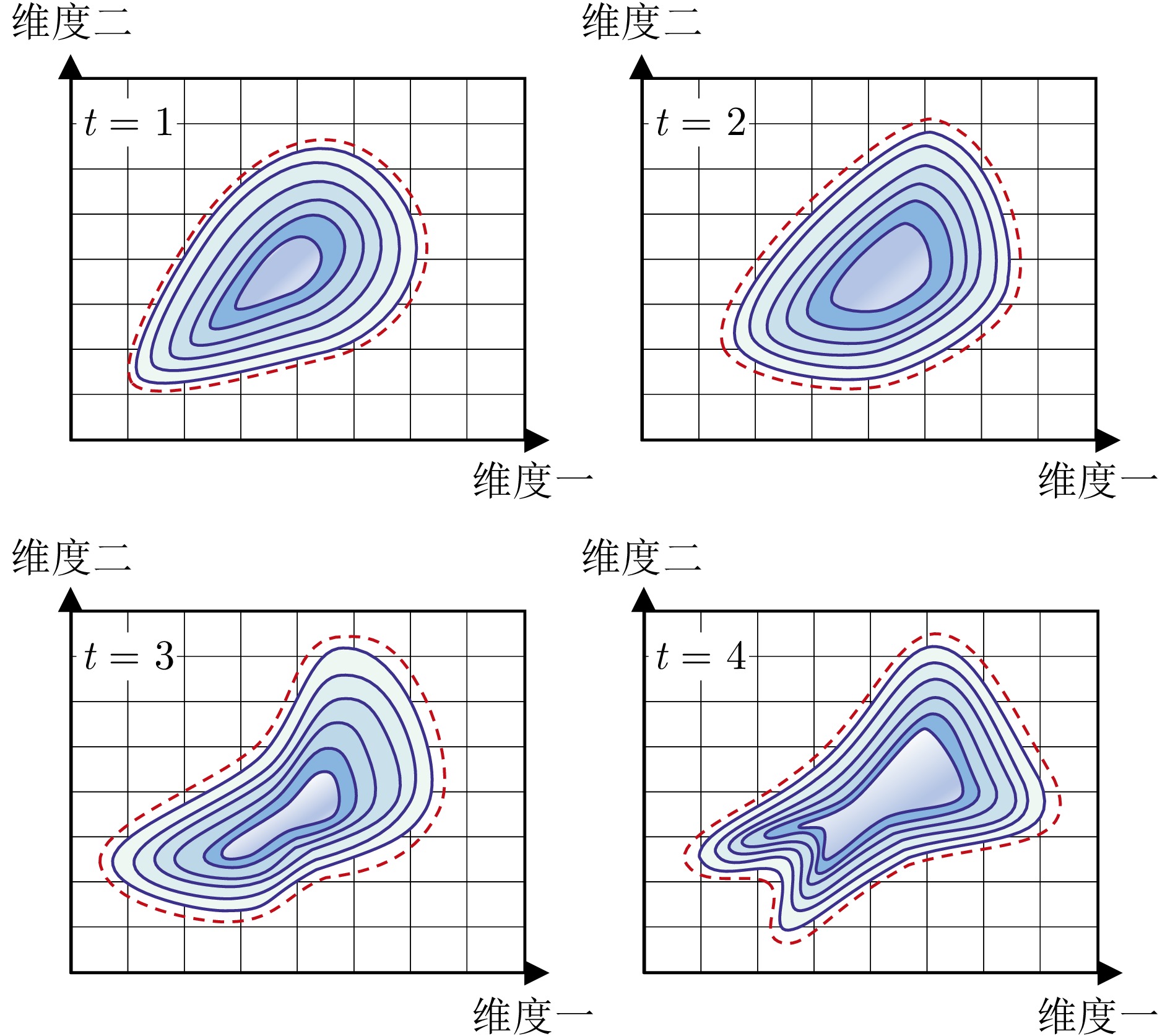
图 23 基于广义概率密度演化方程的概率密度演变过程
Fig. 23 Probability density evolution process based on GDEE
表 2 风险的7项要素
Table 2 Seven elements of risk
序号 要素 描述 要素在风险评估中的指导准则 1 多层级的主体构成 风险的产生受到社会治理体系中多层级主体的共同影响. 例如, 制定国家政策的政治家、主导企业制度构建的公司经理及一线操作人员等 应识别与风险相关的所有行为主体, 而不仅仅局限于直接参与执行的操作人员 2 跨层级决策的
协调失衡不同层级主体在职责定位或利益诉求上的错位性差异, 极易引发决策过程中的协调失衡 应重视并促进各层级主体之间的信息共享与认知协同, 从而就潜在风险达成共识性理解 3 外部环境压力对运营决策的偏向性影响 激烈的市场竞争迫使公司决策者倾向于关注公司的短期运营表现, 而对系统安全等长期保障因素关注不足 应针对性地考虑可能干扰决策者判断的外部环境压力 4 风险的持续累积 在复杂工程系统长期运行过程中, 微小的风险因未能被及时排除而持续累积, 并最终在无显著外部扰动的情况下逼近或突破安全阈值 应准确鉴别系统内部的安全薄弱环节及其演化累积路径, 构建基于系统安全临界状态的早期预警机制与主动干预措施 5 多源风险因素的
耦合效应复杂工程系统中的风险通常源于系统内部多层级风险之间的非线性交互与动态耦合, 难以通过风险因素的线性叠加予以刻画 应全面考虑系统内部同一层级及跨层级组件之间潜在的风险因素及其耦合关系, 而非聚焦于单一的突发性风险或孤立的异常行为 6 新型风险的持续涌现 复杂工程系统在长期运行过程中可能涌现出未曾预见的新型风险 应尽可能地考虑和包含所有的风险, 并具备对未知风险的自适应感知与动态更新能力 7 安全防护机制的
功能性退化受设备老化、部件磨损、性能漂移及环境干扰等影响, 而出现的冗余设计失效、报警阈值下降及安全裕度持续收窄等防护机制退化现象 应针对系统的安全裕度变化进行分析与感知, 以识别系统安全防护机制的退化程度  下载: 导出CSV
表 3 面向典型复杂工程系统的安全事件分析
Table 3 Safety events analysis for typical complex engineering systems
安全事件 外部风险因素 内部风险因素 评估指标 文献 冶金系统 尾矿库溃坝、高温熔融金属泄漏爆炸、瓦斯爆炸、粉尘爆炸火灾、煤气中毒、机械伤害、高空坠落、钢包掉落、其他 环境因素: 自然灾害(海啸、洪水、地震、泥石流、火山爆发等)、地下水位变化、雷暴与雷电等
人为因素: 第三方施工干扰、供应原料质量缺陷、维修保养不当、设备巡检不足、操作人员违规操作等高炉缸侵蚀、高炉悬料、热风炉烧损、转炉/电炉故障、连铸系统故障、钢包运输系统机械损坏、轧制设备故障、热处理故障、通风系统故障、除尘系统故障等 可燃气体浓度(煤气、硫化氢、甲烷等)、高炉炉壁厚度、高炉炉龄、炉温、炉压、铁水温度、煤气柜压力、粉尘浓度、烟气排放浓度、尾矿坝浸润线、操作人员日常行为记录、视频监控采集系统等 [27−29] 化工系统 火灾/爆炸、有毒气体泄漏、机械伤害、反应失控、其他 环境因素: 建筑环境恶劣、通风不良、自然灾害(海啸、洪水、地震、泥石流、火山爆发等)、外部公用设施中断等
人为因素: 人员缺乏安全意识、缺乏专职安全管理人员、人员未经培训或不符合标准等系统设计缺陷、未评估设备/工艺风险、化学品存储不当、反应釜过热或超压、阀门故障、离心机故障、管道腐蚀或泄漏、压力容器失效等 反应釜压力、反应釜温度、换热器压力、有毒气体浓度(一氧化碳、氨气、氯气等)、泵轴承振动信号、离心机转子振动信号、粉体输送管道静电聚集强度、换热器内部腐蚀速率、工作人员操作日志等 [30−32] 核电系统 反应堆停堆、核反应失控、不同回路的冷却失效、核辐射暴露、放射性气体意外排放、机械伤害、蒸汽爆炸、其他 环境因素: 极端天气(暴雪、干旱等)、自然灾害(海啸、洪水、地震、泥石流、火山爆发等)、海平面上升、外部公用设施中断等
人为因素: 维护或检查疏忽、应急响应不力、应急处置能力差、人员培训不足等系统设计缺陷、冷却系统故障、蒸汽发生系统故障、冷凝系统故障、汽轮机故障、稳压器故障、控制棒故障、辐射屏蔽失效等 冷却剂流量、冷却剂(进/出口)温度、蒸汽发生器水位、稳压器压力、控制棒插入深度、汽轮机转速、堆芯出口温度、燃料包壳温度、放射性气体浓度、堆芯损坏频率、运行日志等 [33−34] 运载火箭 高空解体、坠毁爆炸(并造成弹片和毒气散逸)、载荷掉落、失控、发动机关机、部件损毁、卫星未入轨、其他 环境因素: 高空风、雷暴与雷电、强风、大雾、地磁暴、地震、太阳耀斑、低轨空间碎片等
人为因素: 操作失误、维修保养不当、空域管制延误、外部供应链质量缺陷、发射流程执行偏差等地面发射设备故障、推进剂加注系统故障、测控与通信系统故障、内部结构材料疲劳老化、发动机设计缺陷、燃烧室压力波动、控制系统故障、传感器信号失真、热防护系统失效、焊接装配失误、软件系统故障等 冲击加速度、发动机推力、推进剂量、入轨精度(轨道高度、倾角、偏心率)、姿控精度(俯仰角、偏航角、滚转角等偏差)、地面安全半径影响范围、火箭结构系数、弹道偏差、工作人员操作日志等 [35−39] 船舶系统 船只碰撞、船只搁浅、船只触礁、船只沉没、火灾/爆炸、风灾、其他 环境因素: 航行海域、离港距离、极端天气(气旋、寒潮、海雾、冰雹等)、风向、风速、浪高等
人为因素: 船舶人员配置不齐、海员严重疲劳、海员缺乏航海理论知识、海员航海经验欠缺等船只类型、船只吨位、船体结构疲劳、推进系统故障、增压系统故障、起动系统故障、配气机构故障、汽轮机故障、光伏组件故障、活塞泵故障等 船体吃水深度、液压系统压力、燃油供给压力、螺旋桨轴系振动信号、螺旋桨推力、燃油温度、燃油喷射压力、液压油温度、航行效率、船体横倾度、船体纵倾度、船员生理监测数据等 [40−42] 高速列车 列车脱轨、列车碰撞、列车车体断裂、列车爆炸、其他 环境因素: 极端天气(高温、暴雨、冻雨、沙尘暴、强横风、大雾等)、轨道结冰或积雪等
人为因素: 驾驶员疲劳或操作失误、维护检修不到位或失误、第三方施工干扰、信号调度错误、违规占用线路或道口等焊接或连接件缺陷、车体结构疲劳、牵引变流器故障、牵引电机故障、闭锁结构故障、制动系统故障、转向架故障、供电系统故障、列车管理系统缺陷或通信丢包等 轨道温度、轨道几何参数、制动缸压力、制动响应时延、平均制动距离、转向架振动信号、牵引电机电流/扭矩、接触网电压、变流器温度、驾驶员生理监测数据、操作行为记录等 [43−45]
下载: 导出CSV
表 4 基本度量指标
Table 4 Basic metrics
序号 指标 描述 计算公式 该指标在安全分析中的作用 符号说明 1 度 节点$i$的度由连接到该节点的相关边数所定义 $k_i = \displaystyle\sum\limits_{i,\;j \in \mathit{\boldsymbol{X}},\;i \neq j} \lambda_{ij}$ 度量节点在图中的连接能力, 用于识别风险传播过程中的关键节点 当$\lambda_{ij}$=$0$时, 表示节点$i$到节点$j$不相连; 当$\lambda_{ij}$=$1$时, 则表示节点$i$到节点$j$相连 2 平均度 所有节点度的平均值 $ \lt k >$ =$\dfrac{ \sum\limits_{i \in \mathit{\boldsymbol{X}}}^{} k_i}{N}$ 用于衡量风险传播的总体潜在密度 节点集$\mathit{\boldsymbol{X}}$中总共包含$N$个节点 3 最短路径 节点$i$到节点$j$所有路径集合中的最小值 $d_{ij}$ =$ {\mathrm{min} \{\mathcal{P}_{ij}\}} $ 用于识别风险在节点间传播的最短路径 $\{\mathcal{P}_{ij}\}$表示从节点$i$到节点$j$所有路径的集合 4 最短路径长度 任意两个节点之间最短连接路径所包含的边数 $l$ =$ | d_{ij} | $ 用于描述风险在节点间传播的最小距离 $\forall i,\;j \in \mathit{\boldsymbol{X}}$ 且$i \neq j$ 5 平均最短路径长度 所有最短路径长度的平均值 $ \lt l \gt $=$\dfrac{ \sum\limits_{i,\;j \in\mathit{\boldsymbol{X}},\;i\neq j} \vert d_{ij} \vert}{N(N-1)}$ 用于反映整体的风险传播速度 — 6 直径 所有最短路径长度中的最大值 $d$ =$\max \{\vert d_{ij}\vert\}$ 衡量节点间最远的风险传播距离, 用于评估风险传播的整体波及范围 $\forall i,\;j \in \mathit{\boldsymbol{X}}$ 且$i \neq j$ 7 聚集系数 节点邻居间实际存在边数与最多可能边数的比例 $C = \dfrac{ \sum\limits_{i \in \mathit{\boldsymbol{X}}}^{}\dfrac{2\xi_i}{k_i(k_i-1)}}{N}$ 用于反映节点周边的风险聚集效应 $\xi_i$表示节点$i$与邻居节点之间实际存在的边数 8 介数中心性 节点在最短路径中出现的频率 $\tilde{b}_i = \dfrac{ \sum\limits_{i,\;j,\;k \in \mathit{\boldsymbol{X}},\;i\neq j \neq k}^{} \dfrac{\zeta_{jk}(i)}{\zeta_{jk}}}{(N-1)(N-2)}$ 反映节点在风险传播过程中的中介特性, 用于识别风险传播过程中的关键节点 $\zeta_{jk}$ 是节点$j$到节点$k$最短路径的条数; $\zeta_{jk}(i)$表示最短路径中通过节点$i$的条数 9 接近中心性 节点到图中其他所有节点平均最短路径长度的倒数 $cl_{i} = \dfrac{N-1}{ \sum\limits_{i,\;j \in \mathit{\boldsymbol{X}},\;i\neq j}^{} \vert d_{ij} \vert}$ 用于衡量风险传播过程中节点快速到达其他节点的能力 0$ \leq {cl_i} \leq$1 10 网络中心势 图中介数中心性的最高节点与其他节点之间中心性差异的平均程度 $Z_{B} = \dfrac{ \sum\limits_{i\in\mathit{\boldsymbol{X}}}^{}(\tilde{B}_{max}-\tilde{B}_i)}{N-1}$ 用于评估图结构是否过度依赖少数关键节点 $\tilde{B}_{max}$ 为图中介数中心性的最大值; $\tilde{B}_i$区别于$\tilde{b}_i$, 为节点$i$在全图中统一量化后的介数中心性数值
下载: 导出CSV
-
[1] Lu C, Li S, Xu K, Zhang Y. Research on data-driven coal mine environmental safety risk assessment system. Safety Science, 2025, 183: Article No. 106727 doi: 10.1016/j.ssci.2024.106727 [2] 阳春华, 孙备, 李勇刚, 黄科科, 桂卫华. 复杂生产流程协同优化与智能控制. 自动化学报, 2023, 49(3): 528−539 doi: 10.16383/j.aas.c220737Yang Chun-Hua, Sun Bei, Li Yong-Gang, Huang Ke-Ke, Gui Wei-Hua. Cooperative optimization and intelligent control of complex production processes. Acta Automatica Sinica, 2023, 49(3): 528−539 doi: 10.16383/j.aas.c220737 [3] 褚菲, 郝莉莉, 王福利. 复杂工业过程运行状态评价方法回顾与展望. 控制与决策, 2024, 39(3): 705−718 doi: 10.13195/j.kzyjc.2023.0359Chu Fei, Hao Li-Li, Wang Fu-Li. Review and prospect of operation performance assessment methods for complex industrial processes. Control and Decision, 2024, 39(3): 705−718 doi: 10.13195/j.kzyjc.2023.0359 [4] 柴毅, 张可, 毛永芳, 魏善碧. 动态系统运行安全性分析与技术. 北京: 化学工业出版社, 2019.Chai Yi, Zhang Ke, Mao Yong-Fang, Wei Shan-Bi. Operational Safety Analysis Technology for Dynamic Systems. Beijing: Chemical Industry Press, 2019. [5] 何潇, 刘泽夷, 胡嵩乔, 刘畅, 周东华. 动态系统的实时安全性评估技术. 自动化学报, 2025, 51(2): 249−270 doi: 10.16383/j.aas.c240096He Xiao, Liu Ze-Yi, Hu Song-Qiao, Liu Chang, Zhou Dong-Hua. Real-time safety assessment techniques of dynamic systems. Acta Automatica Sinica, 2025, 51(2): 249−270 doi: 10.16383/j.aas.c240096 [6] System Safety, MIL-STD-882E, 2012. [7] Functional Safety of Electrical/Electronic/Programmable Electronic Safety-related Systems, IEC 61508-1, 2010. [8] Safety Aspects——Guidelines for Their Inclusion in Standards, ISO/IEC Guide 51:2019, 2019. [9] Leveson N G. Engineering a Safer World: Systems Thinking Applied to Safety. Cambridge: MIT Press, 2012. [10] Hollnagel E. Barriers and Accident Prevention. London: Routledge, 2004. [11] Khan F I, Amyotte P R, Amin M T. Advanced methods of risk assessment and management: An overview. Methods in Chemical Process Safety, 2020, 4: 1−34 doi: 10.1016/bs.mcps.2020.03.002 [12] Rasmussen J. Risk management in a dynamic society: A modelling problem. Safety Science, 1997, 27(2−3): 183−213 doi: 10.1016/S0925-7535(97)00052-0 [13] Dallat C, Salmon P M, Goode N. Risky systems versus risky people: To what extent do risk assessment methods consider the systems approach to accident causation? A review of the literature. Safety Science, 2019, 119: 266−279 doi: 10.1016/j.ssci.2017.03.012 [14] Rad M A, Lefsrud L M, Hendry M T. Application of systems thinking accident analysis methods: A review for railways. Safety Science, 2023, 160: Article No. 106066 doi: 10.1016/j.ssci.2023.106066 [15] Yousefi A, Hernandez M R, Peña V L. Systemic accident analysis models: A comparison study between AcciMap, FRAM, and STAMP. Process Safety Progress, 2019, 38(2): Article No. e12002 doi: 10.1002/prs.12002 [16] Yuan C H, Fu G, Wu Z R, Zhao J K, Han M, Ye S P. Theory and practice of solution strategies for unsafe acts based on accident causation models: A systematic review. Journal of Loss Prevention in the Process Industries, 2025, 95: Article No. 105605 doi: 10.1016/j.jlp.2025.105605 [17] Wu Y L, Fu G, Han M, Jia Q S, Lv Q, Wang Y X, et al. Comparison of the theoretical elements and application characteristics of STAMP, FRAM, and 24Model: A major hazardous chemical explosion accident. Journal of Loss Prevention in the Process Industries, 2022, 80: Article No. 104880 doi: 10.1016/j.jlp.2022.104880 [18] Amin M T, Khan F. Dynamic process safety assessment using adaptive Bayesian network with loss function. Industrial & Engineering Chemistry Research, 2022, 61(45): 16799−16814 doi: 10.1021/acs.iecr.2c03080 [19] Hu Y W, Parhizkar T, Mosleh A. Guided simulation for dynamic probabilistic risk assessment of complex systems: Concept, method, and application. Reliability Engineering & System Safety, 2022, 217: Article No. 108047 doi: 10.1016/j.ress.2021.108047 [20] Aven T. The risk concept-historical and recent development trends. Reliability Engineering & System Safety, 2012, 99: 33−44 [21] Willis H H. Guiding resource allocations based on terrorism risk. Risk Analysis, 2007, 27(3): 597−606 doi: 10.1111/j.1539-6924.2007.00909.x [22] Leimeister M, Kolios A. A review of reliability-based methods for risk analysis and their application in the offshore wind industry. Renewable and Sustainable Energy Reviews, 2018, 91: 1065−1076 doi: 10.1016/j.rser.2018.04.004 [23] Khan F, Rathnayaka S, Ahmed S. Methods and models in process safety and risk management: Past, present and future. Process Safety and Environmental Protection, 2015, 98: 116−147 doi: 10.1016/j.psep.2015.07.005 [24] Bharatbhai M G. Failure mode and effect analysis of repower 5M wind turbine. International Journal of Advance Research in Engineering, Science & Technology, 2015, 2(5): 7−14 [25] Rausand M, Hoyland A. System Reliability Theory: Models, Statistical Methods, and Applications (Second edition). Hoboken: John Wiley & Sons, 2003. [26] Han Y H, Li Q, Wang C, Zhao Q. A novel knowledge enhanced graph neural networks for fault diagnosis with application to blast furnace process safety. Process Safety and Environmental Protection, 2022, 166: 143−157 doi: 10.1016/j.psep.2022.08.014 [27] Song T F, Zhang J L, Wang G W, Wang H Y, Xu R S. Influencing factors of the explosion characteristics of modified coal used for blast furnace injection. Powder Technology, 2019, 353: 171−177 doi: 10.1016/j.powtec.2019.05.022 [28] Jiang K, Jiang Z H, Jiang X D, Xie Y F, Gui W H. Reinforcement learning for blast furnace ironmaking operation with safety and partial observation considerations. IEEE Transactions on Neural Networks and Learning Systems, 2024, 35(3): 3077−3090 doi: 10.1109/TNNLS.2023.3340741 [29] Vuorio A, Stoop J, Johnson C. The need to establish consistent international safety investigation guidelines for the chemical industries. Safety Science, 2017, 95: 62−74 doi: 10.1016/j.ssci.2017.02.003 [30] Yang J F, Wang P C, Liu X Y, Bian M C, Chen L C, Lv S Y, et al. Analysis on causes of chemical industry accident from 2015 to 2020 in Chinese mainland: A complex network theory approach. Journal of Loss Prevention in the Process Industries, 2023, 83: Article No. 105061 doi: 10.1016/j.jlp.2023.105061 [31] Soltanzadeh A, Yarandi M S, Jazari M D, Mahdinia M. Incidence investigation of accidents in chemical industries: A comprehensive study based on factor analysis. Process Safety Progress, 2022, 41(3): 531−537 doi: 10.1002/prs.12335 [32] Zhou T T, Zhang L B, Hu J Q, Modarres M, Droguett E L. A critical review and benchmark study of dependency modeling for seismic probabilistic risk assessment in the nuclear power industry. Reliability Engineering & System Safety, 2024, 245: Article No. 110009 doi: 10.1016/j.ress.2024.110009 [33] Yao Y T, Han T, Yu J, Xie M. Uncertainty-aware deep learning for reliable health monitoring in safety-critical energy systems. Energy, 2024, 291: Article No. 130419 doi: 10.1016/j.energy.2024.130419 [34] Kuhn K D. Using structural topic modeling to identify latent topics and trends in aviation incident reports. Transportation Research Part C: Emerging Technologies, 2018, 87: 105−122 doi: 10.1016/j.trc.2017.12.018 [35] 柴毅, 毛万标, 任浩, 屈剑锋, 尹宏鹏, 杨志敏, 等. 航天发射系统运行安全性评估研究进展与挑战. 自动化学报, 2019, 45(10): 1829−1845 doi: 10.16383/j.aas.c180135Chai Yi, Mao Wan-Biao, Ren Hao, Qu Jian-Feng, Yin Hong-Peng, Yang Zhi-Min, et al. Research on operational safety assessment for spacecraft launch system: Progress and challenges. Acta Automatica Sinica, 2019, 45(10): 1829−1845 doi: 10.16383/j.aas.c180135 [36] Oster C V, Strong J S, Zorn C K. Analyzing aviation safety: Problems, challenges, opportunities. Research in Transportation Economics, 2013, 43(1): 148−164 doi: 10.1016/j.retrec.2012.12.001 [37] Rey M, Aloise D, Soumis F, Pieugueu R. A data-driven model for safety risk identification from flight data analysis. Transportation Engineering, 2021, 5: Article No. 100087 doi: 10.1016/j.treng.2021.100087 [38] 柴毅. 智能化航天发射系统及其关键技术研究. 国防科技, 2016, 37(1): 7−9 doi: 10.13943/j.issn1617-4547.2016.01.03Chai Yi. Intelligent space launch system and its key technology. National Defense Science & Technology, 2016, 37(1): 7−9 doi: 10.13943/j.issn1617-4547.2016.01.03 [39] Rawson A, Brito M. A survey of the opportunities and challenges of supervised machine learning in maritime risk analysis. Transport Reviews, 2023, 43(1): 108−130 doi: 10.1080/01441647.2022.2036864 [40] Chen P F, Huang Y M, Mou J M, van Gelder P H A J M. Probabilistic risk analysis for ship-ship collision: State-of-the-art. Safety Science, 2019, 117: 108−122 doi: 10.1016/j.ssci.2019.04.014 [41] 蒋少奇, 陈伟炯, 谢启苗, 汪金辉, 张盼飞. 基于关联分析的船舶事故关键致因识别. 中国航海, 2020, 43(4): 33−38 doi: 10.3969/j.issn.1000-4653.2020.04.006Jiang Shao-Qi, Chen Wei-Jiong, Xie Qi-Miao, Wang Jin-Hui, Zhang Pan-Fei. Identification of critical causes of marine accidents based on correlation analysis. Navigation of China, 2020, 43(4): 33−38 doi: 10.3969/j.issn.1000-4653.2020.04.006 [42] Tan Z, Gou H Y, Li W H, Bao Y. Effect of frost heave deformation of bridge foundation on operation safety of high-speed railway. Structures, 2023, 47: 2099−2112 doi: 10.1016/j.istruc.2022.12.011 [43] Wu X T, Lian W B, Zhou M, Bai W Q, Yang M K, Dong H R. Critical spatial-temporal node identification for a high-speed railway network: A cascading delay perspective. IEEE Transactions on Network Science and Engineering, 2024, 11(1): 823−833 doi: 10.1109/TNSE.2023.3308618 [44] Zhang D N, Chen F, Zhu J Y, Wang C Z, Cheng J C, Zhang Y L, et al. Research on drivers' hazard perception in plateau environment based on visual characteristics. Accident Analysis & Prevention, 2022, 166: Article No. 106540 doi: 10.1016/j.aap.2021.106540 [45] Bai X Y, Fan Y F, Hou J J. Reliability assessment method of wind power DC transmission system based on level fault tree analysis. Energy, 2025, 327: Article No. 136426 doi: 10.1016/j.energy.2025.136426 [46] Zhu C Y, Jiang Y J, Liu G Y, Zhang T Y. Integration frameworks and intelligent research in dynamic fault tree: A comprehensive review and future perspectives. Quality and Reliability Engineering International, 2023, 39(7): 3157−3178 doi: 10.1002/qre.3391 [47] 崔铁军, 李莎莎. 空间故障树与空间故障网络理论综述. 安全与环境学报, 2019, 19(2): 399−405 doi: 10.13637/j.issn.1009-6094.2019.02.006Cui Tie-Jun, Li Sha-Sha. Revision of the space fault tree and the space fault network system. Journal of Safety and Environment, 2019, 19(2): 399−405 doi: 10.13637/j.issn.1009-6094.2019.02.006 [48] Kaiser B, Gramlich C. State-event-fault-trees——A safety analysis model for software controlled systems. In: Proceedings of the 23rd International Conference on Computer Safety, Reliability and Security. Potsdam, Germany: Springer, 2004. 195−209 [49] 黄坤, 汪海涛, 安隆坤. 基于最小割集故障树分析的安全风险发生概率评估. 舰船电子对抗, 2024, 47(3): 45−50 doi: 10.16426/j.cnki.jcdzdk.2024.03.009Huang Kun, Wang Hai-Tao, An Long-Kun. Probability assessment of safety risk occurrence based on minimum cut set fault tree analysis method. Shipboard Electronic Countermeasure, 2024, 47(3): 45−50 doi: 10.16426/j.cnki.jcdzdk.2024.03.009 [50] Reay K A, Andrews J D. A fault tree analysis strategy using binary decision diagrams. Reliability Engineering & System Safety, 2002, 78(1): 45−56 doi: 10.1016/S0951-8320(02)00107-2 [51] Remenyte-Prescott R, Andrews J. Analysis of non-coherent fault trees using ternary decision diagrams. Proceedings of the Institution of Mechanical Engineers, Part O: Journal of Risk and Reliability, 2008, 222(2): 127−138 doi: 10.1243/1748006XJRR154 [52] Boudali H, Crouzen P, Stoelinga M. A compositional semantics for dynamic fault trees in terms of interactive Markov chains. In: Proceedings of the 5th International Symposium on Automated Technology for Verification and Analysis. Tokyo, Japan: Springer, 2007. 441−456 [53] Yevkin O. An efficient approximate Markov chain method in dynamic fault tree analysis. Quality and Reliability Engineering International, 2016, 32(4): 1509−1520 doi: 10.1002/qre.1861 [54] Kabir S, Walker M, Papadopoulos Y. Dynamic system safety analysis in HiP-HOPS with Petri nets and Bayesian networks. Safety Science, 2018, 105: 55−70 doi: 10.1016/j.ssci.2018.02.001 [55] Kabir S, Walker M, Papadopoulos Y. Quantitative evaluation of Pandora temporal fault trees via Petri nets. IFAC-PapersOnLine, 2015, 48(21): 458−463 doi: 10.1016/j.ifacol.2015.09.569 [56] Codetta-Raiteri D, Portinale L. Approaching dynamic reliability with predictive and diagnostic purposes by exploiting dynamic Bayesian networks. Proceedings of the Institution of Mechanical Engineers, Part O: Journal of Risk and Reliability, 2014, 228(5): 488−503 doi: 10.1177/1748006X14533958 [57] Barua S, Gao X D, Pasman H, Mannan M S. Bayesian network based dynamic operational risk assessment. Journal of Loss Prevention in the Process Industries, 2016, 41: 399−410 doi: 10.1016/j.jlp.2015.11.024 [58] Sun D B, Li L, Tian Z F, Chen S J, Wang H, Chen G L, et al. An advanced probability safety margin analysis approach combined deterministic and probabilistic safety assessment. Nuclear Engineering and Design, 2021, 385: Article No. 111514 doi: 10.1016/j.nucengdes.2021.111514 [59] Rahman S, Karanki D R, Epiney A, Wicaksono D, Zerkak O, Dang V N. Deterministic sampling for propagating epistemic and aleatory uncertainty in dynamic event tree analysis. Reliability Engineering & System Safety, 2018, 175: 62−78 doi: 10.1016/j.ress.2018.03.009 [60] Maidana R G, Parhizkar T, san Martin G, Utne I B. Dynamic probabilistic risk assessment with K-shortest-paths planning for generating discrete dynamic event trees. Reliability Engineering & System Safety, 2024, 242: Article No. 109725 doi: 10.1016/j.ress.2023.109725 [61] Baek S, Heo G. Development of dynamic integrated consequence evaluation (DICE) for dynamic event tree approaches: Numerical validation for a loss of coolant accident. Reliability Engineering & System Safety, 2023, 238: Article No. 109425 doi: 10.1016/j.ress.2023.109425 [62] Chi L X, Su H, Zio E, Zhang J J, Li X Y, Zhang L, et al. Integrated deterministic and probabilistic safety analysis of integrated energy systems with bi-directional conversion. Energy, 2020, 212: Article No. 118685 doi: 10.1016/j.energy.2020.118685 [63] Sun D B, Li L, Tian Z F, Wang H, Chen G L. Research on simplification of branches method of accident sequences based on expert knowledge and heuristic optimization algorithm. Nuclear Engineering and Design, 2023, 404: Article No. 112198 doi: 10.1016/j.nucengdes.2023.112198 [64] Liang T H, Liang K S, Cheng C K, Pei B S, Patelli E. Risk-informed analysis of the large break loss of coolant accident and PCT margin evaluation with the RISMC methodology. Nuclear Engineering and Design, 2016, 308: 214−221 doi: 10.1016/j.nucengdes.2016.08.035 [65] Kaneko F, Yuzui T. Novel method of dynamic event tree keeping the number of simulations in risk analysis small. Reliability Engineering & System Safety, 2023, 231: Article No. 109009 doi: 10.1016/j.ress.2022.109009 [66] Martin N S, Denman M R, Wheeler T A. Pruning of Discrete Dynamic Event Trees Using Density Peaks and Dynamic Time Warping, Technical Report SAND2016-5632C, Sandia National Laboratory, USA, 2016. [67] Queral C, Fernández-Cosials K, Zugazagoitia E, Paris C, Magan J, Mendizabal R, et al. Application of expanded event trees combined with uncertainty analysis methodologies. Reliability Engineering & System Safety, 2021, 205: Article No. 107246 doi: 10.1016/j.ress.2020.107246 [68] Yu S Z, Zhang J Z, Labeau P E. Safety margin quantification by integrating probabilistic and deterministic safety assessments: Application to design extension conditions. Nuclear Engineering and Design, 2024, 421: Article No. 113121 doi: 10.1016/j.nucengdes.2024.113121 [69] Mazgaj P, Darnowski P, Kaszko A, Hortal J, Dusic M, Mendizábal R, et al. Demonstration of the E-BEPU methodology for SL-LOCA in a Gen-Ⅲ PWR reactor. Reliability Engineering & System Safety, 2022, 226: Article No. 108707 doi: 10.1016/j.ress.2022.108707 [70] Martorell S, Sánchez-Sáez F, Villanueva J F, Carlos S. An extended BEPU approach integrating probabilistic assumptions on the availability of safety systems in deterministic safety analyses. Reliability Engineering & System Safety, 2017, 167: 474−483 doi: 10.1016/j.ress.2017.06.020 [71] Pirbalouti R G, Behnam B, Dehkordi M K. A risk-based approach to identify safety-critical equipment in process industries. Results in Engineering, 2023, 20: Article No. 101448 doi: 10.1016/j.rineng.2023.101448 [72] Khakzad N, Khan F, Amyotte P. Dynamic risk analysis using bow-tie approach. Reliability Engineering & System Safety, 2012, 104: 36−44 doi: 10.1016/j.ress.2012.04.003 [73] Yuan S Q, Reniers G, Yang M, Bai Y P. Cost-effective maintenance of safety and security barriers in the chemical process industries via genetic algorithm. Process Safety and Environmental Protection, 2023, 170: 356−371 doi: 10.1016/j.psep.2022.12.008 [74] Huang Y J, Zhang Z P, Tao Y, Hu H. Quantitative risk assessment of railway intrusions with text mining and fuzzy rule-based bow-tie model. Advanced Engineering Informatics, 2022, 54: Article No. 101726 doi: 10.1016/j.aei.2022.101726 [75] Yang L, Li K P. Safety risk analysis of railway accident with text-based bow-tie model. In: Proceedings of the 3rd International Conference of Safe Production and Informatization (ⅡCSPI). Chongqing, China: IEEE, 2020. 200−204 [76] Kuzucuoğlu D, Koc K, Kazar G, Tokdemir O B. Prioritization of risk mitigation strategies for contact with sharp object accidents using hybrid bow-tie approach. Safety Science, 2023, 166: Article No. 106248 doi: 10.1016/j.ssci.2023.106248 [77] Slatnick S, Angevine D, Cranefield J, Maddox C, Overstake M, Palmer L, et al. Bow-ties use for high-consequence marine risks of offshore structures. Process Safety and Environmental Protection, 2022, 165: 396−407 doi: 10.1016/j.psep.2022.07.026 [78] Abimbola M, Khan F, Khakzad N. Dynamic safety risk analysis of offshore drilling. Journal of Loss Prevention in the Process Industries, 2014, 30: 74−85 doi: 10.1016/j.jlp.2014.05.002 [79] Olamigoke O, Odumade A A, Abhulimen K E, Ehinmowo A B, Orodu O D. Risk assessment of floating, production, storage and offloading (FPSO) risers using bow-tie methodology. In: Proceedings of the 18th International Health, Safety and Environment Biennial Conference on the Oil and Gas Industry (IHSEB). Lagos, Nigeria: Society of Petroleum Engineers, 2018. 1−13 [80] Deacon T, Amyotte P R, Khan F I, MacKinnon S. A framework for human error analysis of offshore evacuations. Safety Science, 2013, 51(1): 319−327 doi: 10.1016/j.ssci.2012.07.005 [81] Li K P, Wang S S. A network accident causation model for monitoring railway safety. Safety Science, 2018, 109: 398−402 doi: 10.1016/j.ssci.2018.06.008 [82] Huang Y J, Zhang Z P, Hu H. Risk propagation mechanisms in railway systems under extreme weather: A knowledge graph-based unsupervised causation chain approach. Reliability Engineering & System Safety, 2025, 260: Article No. 110976 doi: 10.1016/j.ress.2025.110976 [83] Zhang L, Du Y, Li A. Rapid cascading risk assessment and vulnerable satellite identification schemes for LEO satellite networks. Reliability Engineering & System Safety, 2025, 256: Article No. 110699 doi: 10.1016/j.ress.2024.110699 [84] Zhang L, Du Y. Cascading failure model and resilience enhancement scheme of space information networks. Reliability Engineering & System Safety, 2023, 237: Article No. 109379 doi: 10.1016/j.ress.2023.109379 [85] Hu Y, Meng Z, Hu Y Z, Tian W J, Yang Y Y, Gao S L. Modelling of accident dynamic spreading based on spike timing dependent plasticity. Process Safety and Environmental Protection, 2022, 159: 727−739 doi: 10.1016/j.psep.2022.01.023 [86] Han Y W, Shen J, Zhu X W, Bao X Y. Two-stage propagation analysis of safety risks in complex underground engineering: An integrated modeling framework. Reliability Engineering & System Safety, 2025, 261: Article No. 111081 doi: 10.1016/j.ress.2025.111081 [87] Amin M T, Scarponi G E, Cozzani V, Khan F. Dynamic domino effect assessment (D2EA) in tank farms using a machine learning-based approach. Computers & Chemical Engineering, 2024, 181: Article No. 108556 doi: 10.1016/j.compchemeng.2023.108556 [88] Amin M T, Scarponi G E, Cozzani V, Khan F. Improved pool fire-initiated domino effect assessment in atmospheric tank farms using structural response. Reliability Engineering & System Safety, 2024, 242: Article No. 109751 doi: 10.1016/j.ress.2023.109751 [89] Zeng T, Chen G H, Yang Y F, Chen P Z, Reniers G. Developing an advanced dynamic risk analysis method for fire-related domino effects. Process Safety and Environmental Protection, 2020, 134: 149−160 doi: 10.1016/j.psep.2019.11.029 [90] Li X F, Chen G H, Amyotte P, Khan F, Alauddin M. Vulnerability assessment of storage tanks exposed to simultaneous fire and explosion hazards. Reliability Engineering & System Safety, 2023, 230: Article No. 108960 doi: 10.1016/j.ress.2022.108960 [91] Huang K X, Chen G H, Khan F, Yang Y F. Dynamic analysis for fire-induced domino effects in chemical process industries. Process Safety and Environmental Protection, 2021, 148: 686−697 doi: 10.1016/j.psep.2021.01.042 [92] Ding L, Khan F, Abbassi R, Ji J. FSEM: An approach to model contribution of synergistic effect of fires for domino effects. Reliability Engineering & System Safety, 2019, 189: 271−278 doi: 10.1016/j.ress.2019.04.041 [93] Zeng T, Wei L J, Reniers G, Chen G H. A comprehensive study for probability prediction of domino effects considering synergistic effects. Reliability Engineering & System Safety, 2024, 251: Article No. 110318 doi: 10.1016/j.ress.2024.110318 [94] Li X F, Chen G H, Amyotte P, Alauddin M, Khan F. Modeling and analysis of domino effect in petrochemical storage tank farms under the synergistic effect of explosion and fire. Process Safety and Environmental Protection, 2023, 176: 706−715 doi: 10.1016/j.psep.2023.06.054 [95] Luo Z Y, Li K P, Ma X, Zhou J. A new accident analysis method based on complex network and cascading failure. Discrete Dynamics in Nature and Society, 2013: Article No. 437428 [96] Xu Y F, Wang Z, Jiang Y, Yang Y X, Wang F. Small-world network analysis on fault propagation characteristics of water networks in eco-industrial parks. Resources, Conservation and Recycling, 2019, 149: 343−351 doi: 10.1016/j.resconrec.2019.05.040 [97] Zhang Y L, Yang N D, Lall U. Modeling and simulation of the vulnerability of interdependent power-water infrastructure networks to cascading failures. Journal of Systems Science and Systems Engineering, 2016, 25(1): 102−118 doi: 10.1007/s11518-016-5295-3 [98] Lu Z H, Wang X W, Liu L, Zhang X Y, Li C Q. An efficient method for network connectivity reliability computation considering correlation of components. Reliability Engineering & System Safety, 2025, 257: Article No. 110805 doi: 10.1016/j.ress.2025.110805 [99] Liu M, Chong H Y, Liao P C, Xu L Y. Probabilistic-based cascading failure approach to assessing workplace hazards affecting human error. Journal of Management in Engineering, 2019, 35(3): Article No. 04019006 doi: 10.1061/(asce)me.1943-5479.0000690 [100] Xing J D, Yang W, Yin X L, Zio E. An integrated method of resilience and risk assessment for maintenance strategy optimization of a train braking system. Reliability Engineering & System Safety, 2025, 260: Article No. 110929 doi: 10.1016/j.ress.2025.110929 [101] Zhou J, Xu W X, Guo X, Ma X. Railway faults spreading model based on dynamics of complex network. International Journal of Modern Physics B, 2015, 29(6): Article No. 1550038 doi: 10.1142/S0217979215500381 [102] Kang J, Meng X X, Su T, Chang W C, Wang Z X, Wang H, et al. Research on leakage control of river oil and gas pipelines based on accident situation evolution model. Journal of Loss Prevention in the Process Industries, 2025, 96: Article No. 105615 doi: 10.1016/j.jlp.2025.105615 [103] Meng X K, Li X H, Wang W G, Song G Z, Chen G M, Zhu J Y. A novel methodology to analyze accident path in deepwater drilling operation considering uncertain information. Reliability Engineering & System Safety, 2021, 205: Article No. 107255 doi: 10.1016/j.ress.2020.107255 [104] Wang W C, Zhang Y, Li Y X, Hu Q H, Liu C S, Liu C W. Vulnerability analysis method based on risk assessment for gas transmission capabilities of natural gas pipeline networks. Reliability Engineering & System Safety, 2022, 218: Article No. 108150 doi: 10.1016/j.ress.2021.108150 [105] Wang W C, Zhang Y, Li Y X, Liu C S, Han S Y. Vulnerability analysis of a natural gas pipeline network based on network flow. International Journal of Pressure Vessels and Piping, 2020, 188: Article No. 104236 doi: 10.1016/j.ijpvp.2020.104236 [106] Ren T, Xu Y J, Wang P Y. Identifying influential spreaders in complex network based on the node's weight and spreading probability. International Journal of Modern Physics C, 2024, 35(11): Article No. 2450142 doi: 10.1142/S0129183124501420 [107] Nazempour R, Monfared M A S, Zio E. A complex network theory approach for optimizing contamination warning sensor location in water distribution networks. International Journal of Disaster Risk Reduction, 2018, 30: 225−234 doi: 10.1016/j.ijdrr.2018.04.029 [108] 张晗, 王强. 基于有向网络的航空安全事故风险识别与评估. 系统工程与电子技术, 2024, 46(6): 1995−2001 doi: 10.12305/j.issn.1001-506X.2024.06.17Zhang Han, Wang Qiang. Aviation safety accident risk identification and evaluation based on directed networks. Systems Engineering and Electronics, 2024, 46(6): 1995−2001 doi: 10.12305/j.issn.1001-506X.2024.06.17 [109] 张晗, 王强, 闵桂龙. 基于平均场理论的航空安全风险预警模型. 系统工程与电子技术, 2025, 47(1): 210−216 doi: 10.12305/j.issn.1001-506X.2025.01.22Zhang Han, Wang Qiang, Min Gui-Long. Aviation safety risk early warning model based on mean field theory. Systems Engineering and Electronics, 2025, 47(1): 210−216 doi: 10.12305/j.issn.1001-506X.2025.01.22 [110] Zhou J, Xu W X, Guo X, Ding J. A method for modeling and analysis of directed weighted accident causation network (DWACN). Physica A: Statistical Mechanics and Its Applications, 2015, 437: 263−277 doi: 10.1016/j.physa.2015.05.112 [111] Wang Z Y, Hill D J, Chen G, Dong Z Y. Power system cascading risk assessment based on complex network theory. Physica A: Statistical Mechanics and Its Applications, 2017, 482: 532−543 doi: 10.1016/j.physa.2017.04.031 [112] Ma X G, Tsai Y T, Shu C M, Yang Y. Risk evolution analysis of gas leakage accidents based on complex network. Safety Science, 2025, 182: Article No. 106692 doi: 10.1016/j.ssci.2024.106692 [113] Feng J R, Zhao M K, Lu S X. Accident spread and risk propagation mechanism in complex industrial system network. Reliability Engineering & System Safety, 2024, 244: Article No. 109940 doi: 10.1016/j.ress.2024.109940 [114] Jia M W, Jiang L W, Guo B, Liu Y, Chen T. Physical-anchored graph learning for process key indicator prediction. Control Engineering Practice, 2025, 154: Article No. 106167 doi: 10.1016/j.conengprac.2024.106167 [115] Jia M W, Yao Y, Liu Y. Review on graph neural networks for process soft sensor development, fault diagnosis, and process monitoring. Industrial & Engineering Chemistry Research, 2025, 64(17): 8543−8564 doi: 10.1021/acs.iecr.5c00283 [116] Jia M W, Yang C, Pan Z X, Liu Q, Liu Y. Adversarial relationship graph learning soft sensor via negative information exclusion. Journal of Process Control, 2025, 145: Article No. 103354 doi: 10.1016/j.jprocont.2024.103354 [117] Ma L, Zhao R H. AcciMap causal analysis of Chinese chemical industry accidents unraveled by graph neural networks. Reliability Engineering & System Safety, 2025, 264: Article No. 111425 doi: 10.1016/j.ress.2025.111425 [118] Zheng J H, Zhuo Y, Jiang X Y, Zeng L Q, Ge Z Q. Advances in Bayesian networks for industrial process analytics: Bridging data and mechanisms. Expert System With Applications, 2025, 271: Article No. 126670 doi: 10.1016/j.eswa.2025.126670 [119] Torres-Toledano J G, Sucar L F. Bayesian networks for reliability analysis of complex systems. In: Proceedings of the 6th Ibero-American Congress on Artificial Intelligence (IBERAMIA). Lisbon, Portugal: Springer, 1998. 195−206 [120] Zhou Z B, Jin G, Dong D D, Zhou J L. Reliability analysis of multistate systems based on Bayesian networks. In: Proceedings of the 13th Annual IEEE International Symposium and Workshop on Engineering of Computer-based Systems (ECBS). Potsdam, Germany: IEEE, 2006. 347−352 [121] Li K J, Yi R, Ma Z. Reliability analysis of dynamic reliability blocks through conversion into dynamic Bayesian networks. In: Proceedings of the IEEE International Conference on Industrial Engineering and Engineering Management (IEEM). Bali, Indonesia: IEEE, 2016. 1330−1334 [122] Portinale L, Bobbio A. Bayesian networks for dependability analysis: An application to digital control reliability. In: Proceedings of the 15th Conference on Uncertainty in Artificial Intelligence. Stockholm, Sweden: ACM, 2013. 551−558 [123] Bobbio A, Portinale L, Minichino M, Ciancamerla E. Improving the analysis of dependable systems by mapping fault trees into Bayesian networks. Reliability Engineering & System Safety, 2001, 71(3): 249−260 doi: 10.1016/S0951-8320(00)00077-6 [124] Khakzad N, Khan F, Amyotte P. Risk-based design of process systems using discrete-time Bayesian networks. Reliability Engineering & System Safety, 2013, 109: 5−17 doi: 10.1016/j.ress.2012.07.009 [125] Boudali H, Dugan J B. A continuous-time Bayesian network reliability modeling, and analysis framework. IEEE Transactions on Reliability, 2006, 55(1): 86−97 doi: 10.1109/TR.2005.859228 [126] Codetta-Raiteri D, Portinale L. Generalized continuous time Bayesian networks as a modelling and analysis formalism for dependable systems. Reliability Engineering & System Safety, 2017, 167: 639−651 doi: 10.1016/j.ress.2017.04.014 [127] Kim M C. Reliability block diagram with general gates and its application to system reliability analysis. Annals of Nuclear Energy, 2011, 38(11): 2456−2461 doi: 10.1016/j.anucene.2011.07.013 [128] Bobbio A, Ciancamerla E, Franceschinis G, Gaeta R, Minichino M, Portinale L. Sequential application of heterogeneous models for the safety analysis of a control system: A case study. Reliability Engineering & System Safety, 2003, 81(3): 269−280 doi: 10.1016/S0951-8320(03)00091-7 [129] Martins M R, Maturana M C. Application of Bayesian belief networks to the human reliability analysis of an oil tanker operation focusing on collision accidents. Reliability Engineering & System Safety, 2013, 110: 89−109 doi: 10.1016/j.ress.2012.09.008 [130] Simon C, Weber P, Levrat E. Bayesian networks and evidence theory to model complex systems reliability. Journal of Computers, 2007, 2(1): 33−43 doi: 10.4304/jcp.2.1.33-43 [131] Simon C, Weber P, Evsukoff A. Bayesian networks inference algorithm to implement Dempster Shafer theory in reliability analysis. Reliability Engineering & System Safety, 2008, 93(7): 950−963 doi: 10.1016/j.ress.2007.03.012 [132] Yin X W. Common cause failure model of system reliability based on Bayesian networks. International Journal of Performability Engineering, 2010, 6(3): 255−268 [133] 尹晓伟, 钱文学, 谢里阳. 系统可靠性的贝叶斯网络评估方法. 航空学报, 2008, 306: 1482−1489Yin Xiao-Wei, Qian Wen-Xue, Xie Li-Yang. A method for system reliabiltiy assessment based on Bayesian networks. Acta Aeronautica et Astronautica Sinica, 2008, 306: 1482−1489 [134] Yazdi M, Kabir S. A fuzzy Bayesian network approach for risk analysis in process industries. Process Safety and Environmental Protection, 2017, 111: 507−519 doi: 10.1016/j.psep.2017.08.015 [135] Leu S S, Chang C M. Bayesian-network-based safety risk assessment for steel construction projects. Accident Analysis & Prevention, 2013, 54: 122−133 doi: 10.1016/j.aap.2013.02.019 [136] Li H, Soares C G, Huang H Z. Reliability analysis of a floating offshore wind turbine using Bayesian networks. Ocean Engineering, 2020, 217: Article No. 107827 doi: 10.1016/j.oceaneng.2020.107827 [137] Zheng Y, Zhao F, Wang Z. Fault diagnosis system of bridge crane equipment based on fault tree and Bayesian network. The International Journal of Advanced Manufacturing Technology, 2019, 105(9): 3605−3618 doi: 10.1007/s00170-019-03793-0 [138] Codetta-Raiteri D. Applying generalized continuous time Bayesian networks to a reliability case study. IFAC-PapersOnLine, 2015, 48(21): 676−681 doi: 10.1016/j.ifacol.2015.09.605 [139] Codetta-Raiteri D, Portinale L. Dynamic Bayesian networks for fault detection, identification, and recovery in autonomous spacecraft. IEEE Transactions on Systems, Man, and Cybernetics: Systems, 2015, 45(1): 13−24 doi: 10.1109/TSMC.2014.2323212 [140] Boudali H, Dugan J B. A discrete-time Bayesian network reliability modeling and analysis framework. Reliability Engineering & System Safety, 2005, 87(3): 337−349 doi: 10.1016/j.ress.2004.06.004 [141] Marquez D, Neil M, Fenton N. Improved reliability modeling using Bayesian networks and dynamic discretization. Reliability Engineering & System Safety, 2010, 95(4): 412−425 doi: 10.1016/j.ress.2009.11.012 [142] Mi J H, Li Y P, Yang Y J, Peng W W, Huang H Z. Reliability assessment of complex electromechanical systems under epistemic uncertainty. Reliability Engineering & System Safety, 2016, 152: 1−15 doi: 10.1016/j.ress.2016.02.003 [143] Khakzad N, Khan F, Amyotte P. Dynamic safety analysis of process systems by mapping bow-tie into Bayesian network. Process Safety and Environmental Protection, 2013, 91(1−2): 46−53 doi: 10.1016/j.psep.2012.01.005 [144] Abimbola M, Khan F, Khakzad N, Butt S. Safety and risk analysis of managed pressure drilling operation using Bayesian network. Safety Science, 2015, 76: 133−144 doi: 10.1016/j.ssci.2015.01.010 [145] Zarei E, Azadeh A, Khakzad N, Aliabadi M M, Mohammadfam I. Dynamic safety assessment of natural gas stations using Bayesian network. Journal of Hazardous Materials, 2017, 321: 830−840 doi: 10.1016/j.jhazmat.2016.09.074 [146] Zhou Q Y, Li B, Lu Y, Chen J, Shu C M, Bi M S. Dynamic risk analysis of oil depot storage tank failure using a fuzzy Bayesian network model. Process Safety and Environmental Protection, 2023, 173: 800−811 doi: 10.1016/j.psep.2023.03.072 [147] Wang C S, Xie Y H. Applying Bayesian network to distribution system reliability analysis. In: Proceedings of the IEEE Region 10 Conference TENCON 2004. Chiang Mai, Thailand: IEEE, 2004. 562−565 [148] 王成山, 谢莹华. 基于双层同构贝叶斯网络模型的配电网可靠性评估. 电网技术, 2005, 29(7): 41−46 doi: 10.3321/j.issn:1000-3673.2005.07.009Wang Cheng-Shan, Xie Ying-Hua. A new Bayesian network model for distribution system reliability evaluation based on dual isomorphic Bayesian network model. Power System Technology, 2005, 29(7): 41−46 doi: 10.3321/j.issn:1000-3673.2005.07.009 [149] Fu S S, Yu Y R, Chen J H, Xi Y T, Zhang M Y. A framework for quantitative analysis of the causation of grounding accidents in arctic shipping. Reliability Engineering & System Safety, 2022, 226: Article No. 108706 doi: 10.1016/j.ress.2022.108706 [150] Zhang L M, Wu X G, Skibniewski M J, Zhong J B, Lu Y J. Bayesian-network-based safety risk analysis in construction projects. Reliability Engineering & System Safety, 2014, 131: 29−39 doi: 10.1016/j.ress.2014.06.006 [151] Zhang X G, Mahadevan S. Bayesian network modeling of accident investigation reports for aviation safety assessment. Reliability Engineering & System Safety, 2021, 209: Article No. 107371 doi: 10.1016/j.ress.2020.107371 [152] Hünninen M, Kujala P. Bayesian network modeling of port state control inspection findings and ship accident involvement. Expert Systems With Applications, 2014, 41(4): 1632−1646 doi: 10.1016/j.eswa.2013.08.060 [153] Hossain N U I, el Amrani S, Jaradat R, Marufuzzaman M, Buchanan R, Rinaudo C, et al. Modeling and assessing interdependencies between critical infrastructures using Bayesian network: A case study of inland waterway port and surrounding supply chain network. Reliability Engineering & System Safety, 2020, 198: Article No. 106898 doi: 10.1016/j.ress.2020.106898 [154] Xu S, Kim E, Haugen S, Zhang M Y. A Bayesian network risk model for predicting ship besetting in ice during convoy operations along the northern sea route. Reliability Engineering & System Safety, 2022, 223: Article No. 108475 doi: 10.1016/j.ress.2022.108475 [155] Moradi R, Cofre-Martel S, Droguett E L, Modarres M, Groth K M. Integration of deep learning and Bayesian networks for condition and operation risk monitoring of complex engineering systems. Reliability Engineering & System Safety, 2022, 222: Article No. 108433 doi: 10.1016/j.ress.2022.108433 [156] Leoni L, BahooToroody A, de Carlo F, Paltrinieri N. Developing a risk-based maintenance model for a natural gas regulating and metering station using Bayesian network. Journal of Loss Prevention in the Process Industries, 2019, 57: 17−24 doi: 10.1016/j.jlp.2018.11.003 [157] Wu J S, Zhou R, Xu S D, Wu Z W. Probabilistic analysis of natural gas pipeline network accident based on Bayesian network. Journal of Loss Prevention in the Process Industries, 2017, 46: 126−136 doi: 10.1016/j.jlp.2017.01.025 [158] Wang Q A, Chen J, Ni Y Q, Xiao Y F, Liu N B, Liu S K, et al. Application of Bayesian networks in reliability assessment: A systematic literature review. Structures, 2025, 71: Article No. 108098 doi: 10.1016/j.istruc.2024.108098 [159] Soomro A A, Mokhtar A A, Kurnia J C, Lashari N, Sarwar U, Jameel S M, et al. A review on Bayesian modeling approach to quantify failure risk assessment of oil and gas pipelines due to corrosion. International Journal of Pressure Vessels and Piping, 2022, 200: Article No. 104841 doi: 10.1016/j.ijpvp.2022.104841 [160] Kammouh O, Gardoni P, Cimellaro G P. Probabilistic framework to evaluate the resilience of engineering systems using Bayesian and dynamic Bayesian networks. Reliability Engineering & System Safety, 2020, 198: Article No. 106813 doi: 10.1016/j.ress.2020.106813 [161] Luque J, Straub D. Reliability analysis and updating of deteriorating systems with dynamic Bayesian networks. Structural Safety, 2016, 62: 34−46 doi: 10.1016/j.strusafe.2016.03.004 [162] Villa V, Paltrinieri N, Khan F, Cozzani V. Towards dynamic risk analysis: A review of the risk assessment approach and its limitations in the chemical process industry. Safety Science, 2016, 89: 77−93 doi: 10.1016/j.ssci.2016.06.002 [163] Animah I. Application of Bayesian network in the maritime industry: Comprehensive literature review. Ocean Engineering, 2024, 302: Article No. 117610 doi: 10.1016/j.oceaneng.2024.117610 [164] Figueroa-García J C, Neruda R, Hernandez-Perez G J. On cosine fuzzy sets and uncertainty quantification. Engineering Applications of Artificial Intelligence, 2024, 138: Article No. 109241 doi: 10.1016/j.engappai.2024.109241 [165] Wang Y F, Xie M. Approach to integrate fuzzy fault tree with Bayesian network. Procedia Engineering, 2012, 45: 131−138 doi: 10.1016/j.proeng.2012.08.133 [166] Ben-Haim Y. Evidence and uncertainty: An info-gap analysis of uncertainty-augmenting evidence. Risk Analysis, 2024, 44(11): 2649−2659 [167] Deng J X, Deng Y, Yang J B. Random permutation set reasoning. IEEE Transactions on Pattern Analysis and Machine Intelligence, 2024, 46(12): 10246−10258 doi: 10.1109/TPAMI.2024.3438349 [168] Zhang H. Interval importance sampling method for finite element-based structural reliability assessment under parameter uncertainties. Structural Safety, 2012, 38: 1−10 doi: 10.1016/j.strusafe.2012.01.003 [169] Jiang C, Bi R G, Lu G Y, Han X. Structural reliability analysis using non-probabilistic convex model. Computer Methods in Applied Mechanics and Engineering, 2013, 254: 83−98 doi: 10.1016/j.cma.2012.10.020 [170] Tonon F. Using random set theory to propagate epistemic uncertainty through a mechanical system. Reliability Engineering & System Safety, 2004, 85(1−3): 169−181 doi: 10.1016/j.ress.2004.03.010 [171] Yang X F, Liu Y S, Zhang Y S, Yue Z F. Hybrid reliability analysis with both random and probability-box variables. Acta Mechanica, 2015, 226(5): 1341−1357 doi: 10.1007/s00707-014-1252-8 [172] Zu G Q, Xiao J, Sun K. Mathematical base and deduction of security region for distribution systems with DER. IEEE Transactions on Smart Grid, 2019, 10(3): 2892−2903 doi: 10.1109/TSG.2018.2814584 [173] Wu F, Kumagai S. Steady-state security regions of power-systems. IEEE Transactions on Circuits and Systems, 1982, 29(11): 703−711 doi: 10.1109/TCS.1982.1085091 [174] di Maio F, Picoco C, Zio E, Rychkov V. Safety margin sensitivity analysis for model selection in nuclear power plant probabilistic safety assessment. Reliability Engineering & System Safety, 2017, 162: 122−138 doi: 10.1016/j.ress.2017.01.020 [175] Alobaid F, Mertens N, Starkloff R, Lanz T, Heinze C, Epple B. Progress in dynamic simulation of thermal power plants. Progress in Energy and Combustion Science, 2017, 59: 79−162 doi: 10.1016/j.pecs.2016.11.001 [176] Lin W, Yang Z F, Yu J, Xie K G, Wang X B, Li W Y. Tie-line security region considering time coupling. IEEE Transactions on Power Systems, 2021, 36(2): 1274−1284 doi: 10.1109/TPWRS.2020.3015483 [177] Wang Y C, Ji Z Z, Cao Y, Yang S H. Safety critical variable analysis for process systems. Industrial & Engineering Chemistry Research, 2023, 62(50): 21704−21720 doi: 10.1021/acs.iecr.3c02715 [178] Qin C, Yu Y X. Small signal stability region of power systems with DFIG in injection space. Journal of Modern Power Systems and Clean Energy, 2013, 1(2): 127−133 doi: 10.1007/s40565-013-0023-1 [179] Yang T K, Yu Y X. Steady-state security region-based voltage/var optimization considering power injection uncertainties in distribution grids. IEEE Transactions on Smart Grid, 2019, 10(3): 2904−2911 doi: 10.1109/TSG.2018.2814585 [180] Yu Y X, Qin C. Security region based security-constrained unit commitment. Science China Technological Sciences, 2013, 56(11): 2732−2744 doi: 10.1007/s11431-013-5355-6 [181] 余贻鑫. 电力系统安全域方法研究述评. 天津大学学报, 2008, 41(6): 635−646 doi: 10.3969/j.issn.0493-2137.2008.06.001Yu Yi-Xin. Review of study on methodology of security regions of power system. Journal of Tianjin University, 2008, 41(6): 635−646 doi: 10.3969/j.issn.0493-2137.2008.06.001 [182] Ma X Y, Liang J W, Wan Y H, Gui Z S, Yuan Z H, Wang Y, et al. Small-signal stability region analysis of multi-time delay wind power system considering degenerate Hopf bifurcation. IEEE Transactions on Circuits and Systems I: Regular Papers, 2025, 72(11): 7146−7159 doi: 10.1109/TCSI.2025.3566244 [183] 王成山, 许晓菲, 余贻鑫, 魏炜, Stephen T L, Zhang Pei. 基于割集功率空间上的静态电压稳定域局部可视化方法. 中国电机工程学报, 2004, 24(9): 13−18Wang Cheng-Shan, Xu Xiao-Fei, Yu Yi-Xin, Wei Wei, Stephen T L, Zhang Pei. Visualization of power system static voltage stability region in cut-set space. Proceedings of the CSEE, 2004, 24(9): 13−18 [184] 李慧玲, 余贻鑫, 韩琪, 宿吉锋, 赵金利, Lee S T, et al. 割集功率空间上静态电压稳定域的实用边界. 电力系统自动化, 2005, 29(4): 18−23 doi: 10.3321/j.issn:1000-1026.2005.04.004Li Hui-Ling, Yu Yi-Xin, Han Qi, Su Ji-Feng, Zhao Jin-Li, Lee S T, et al. Practical boundary of static voltage stability region in cut-set power space of power systems. Automation of Electric Power Systems, 2005, 29(4): 18−23 doi: 10.3321/j.issn:1000-1026.2005.04.004 [185] 姜涛, 贾宏杰, 姜懿郎, 孔祥玉, 陆宁. 跨区互联电网热稳定安全域边界近似方法. 电工技术学报, 2016, 31(8): 134−146 doi: 10.3969/j.issn.1000-6753.2016.08.017Jiang Tao, Jia Hong-Jie, Jiang Yi-Lang, Kong Xiang-Yu, Lu Ning. Approximating method of wide area thermal security region boundary in bulk power system. Transactions of China Electrotechnical Society, 2016, 31(8): 134−146 doi: 10.3969/j.issn.1000-6753.2016.08.017 [186] Maihemuti S, Wang W Q, Wang H Y, Wu J H, Zhang X. Dynamic security and stability region under different renewable energy permeability in IENGS system. IEEE Access, 2021, 9: 19800−19817 doi: 10.1109/ACCESS.2021.3049236 [187] Wu D, Nie T T, Turitsyn K, Blumsack S. Estimating loadability region of natural gas system via monotone inner polytope sequence. IEEE Transactions on Control of Network Systems, 2020, 7(2): 660−672 doi: 10.1109/TCNS.2019.2937212 [188] Perninge M, Söder L. Risk estimation of the distance to voltage instability using a second order approximation of the saddle-node bifurcation surface. Electric Power Systems Research, 2011, 81(2): 625−635 doi: 10.1016/j.jpgr.2010.10.021 [189] Perninge M, Soder L. On the validity of local approximations of the power system loadability surface. IEEE Transactions on Power Systems, 2011, 26(4): 2143−2153 doi: 10.1109/TPWRS.2011.2115259 [190] Sun D W, Yu Y X. Accurate identification of critical boundary hyperplanes of practical steady-state security region in distribution grids. IEEE Transactions on Smart Grid, 2023, 14(6): 4312−4321 doi: 10.1109/TSG.2023.3262693 [191] Gutierrez-Martinez V J, Canizares C A, Fuerte-Esquivel C R, Pizano-Martinez A, Gu X P. Neural-network security-boundary constrained optimal power flow. IEEE Transactions on Power Systems, 2011, 26(1): 63−72 doi: 10.1109/TPWRS.2010.2050344 [192] Qiu Y W, Wu H, Song Y H, Wang J H. Global approximation of static voltage stability region boundaries considering generator reactive power limits. IEEE Transactions on Power Systems, 2018, 33(5): 5682−5691 doi: 10.1109/TPWRS.2018.2800722 [193] Qiu Y W, Wu H, Zhou Y Z, Song Y H. Global parametric polynomial approximation of static voltage stability region boundaries. IEEE Transactions on Power Systems, 2017, 32(3): 2362−2371 doi: 10.1109/TPWRS.2016.2597364 [194] Qin Y, Yu S, Zhang Y, Jia L M, Cheng X Q. An online quantified safety assessment method for train service state based on safety region estimation and hybrid intelligence technologies. International Journal of Software Engineering and Knowledge Engineering, 2015, 25(3): 493−511 doi: 10.1142/S0218194015400185 [195] He Y N, Yu H F, Brat G, Davies M. Statistical learning framework for safety and failure analysis of a DNN-based autonomous aircraft system. In: Proceedings of the 20th International Conference on Machine Learning and Applications (ICMLA). Pasadena, USA: IEEE, 2021. 1−6 [196] He Y N, Schumann J. A framework for the analysis of deep neural networks in aerospace applications using Bayesian statistics. In: Proceedings of the 14th International Joint Conference on Neural Networks (IJCNN). Glasgow, UK: IEEE, 2020. 1−9 [197] Yu Y X, Huang C H, Feng F. A study on reactive power steady-state security regions. Electric Machines & Power Systems, 1989, 17(3): 155−166 doi: 10.1080/07313568908909422 [198] Yu Y X, Liu Y L, Qin C, Yang T K. Theory and method of power system integrated security region irrelevant to operation states: An introduction. Engineering, 2020, 6(7): 754−777 doi: 10.1016/j.eng.2019.11.016 [199] Yu Y X, Liu Y L, Yu D D. Smart grid innovations: Increasing resilience, security, and sustainability in the era of energy transition. Engineering, 2025, 51: 1−2 doi: 10.1016/j.eng.2025.07.014 [200] Liu Y L, Jia R P. Space division and WGAN-GP based fast generation method of practical dynamic security region boundary. Engineering, 2025, 51: 75−85 doi: 10.1016/j.eng.2024.05.017 [201] 曾沅, 樊纪超, 余贻鑫, 卢放, 黄耀贵. 电力大系统实用动态安全域. 电力系统自动化, 2001, 25(16): 6−10 doi: 10.3321/j.issn:1000-1026.2001.16.002Zeng Yuan, Fan Ji-Chao, Yu Yi-Xin, Lu Fang, Huang Yao-Gui. Practical dynamic security regions of bulk power systems. Automation of Electric Power Systems, 2001, 25(16): 6−10 doi: 10.3321/j.issn:1000-1026.2001.16.002 [202] 余贻鑫, 曾沅, 冯飞. 电力系统注入空间动态安全域的微分拓扑特性. 中国科学E辑: 技术科学, 2002, 32(4): 503−509 doi: 10.3969/j.issn.1674-7259.2002.04.012Yu Yi-Xin, Zeng Yuan, Feng Fei. Differential topological characteristics of the DSR on injection space of electrical power system. Science in China Series E: Technological Science, 2002, 32(4): 503−509 doi: 10.3969/j.issn.1674-7259.2002.04.012 [203] Wang Y C, Ji Z Z, Cao Y, Yang S H. Dynamic risk assessment for process operational safety based on reachability analysis. Reliability Engineering & System Safety, 2025, 253: Article No. 110564 doi: 10.1016/j.ress.2024.110564 [204] Li J, Chen J B. Probability density evolution method for dynamic response analysis of structures with uncertain parameters. Computational Mechanics, 2004, 34(5): 400−409 doi: 10.1007/s00466-004-0583-8 [205] Liu G, Gao K, Yang Q S, Tang W, Law S S. Improvement to the discretized initial condition of the generalized density evolution equation. Reliability Engineering & System Safety, 2021, 216: Article No. 107999 doi: 10.1016/j.ress.2021.107999 [206] Das S, Tesfamariam S. Reliability assessment of stochastic dynamical systems using physics informed neural network based PDEM. Reliability Engineering & System Safety, 2024, 243: Article No. 109849 doi: 10.1016/j.ress.2023.109849 [207] Lv M Z, Feng D C, Chen J B, Li J. A decoupled approach for determination of the joint probability density function of a high-dimensional nonlinear stochastic dynamical system via the probability density evolution method. Computer Methods in Applied Mechanics and Engineering, 2024, 418: Article No. 116443 doi: 10.1016/j.cma.2023.116443 [208] Behrendt M, Lv M Z, Luo Y B, Chen J, Beer M. Failure probability estimation of dynamic systems employing relaxed power spectral density functions with dependent frequency modeling and sampling. Probabilistic Engineering Mechanics, 2024, 75: Article No. 103592 doi: 10.1016/j.probengmech.2024.103592 [209] Kumar P, Merzouki R, Bouamama B O. Multilevel modeling of system of systems. IEEE Transactions on Systems, Man, and Cybernetics: Systems, 2018, 48(8): 1309−1320 doi: 10.1109/TSMC.2017.2668065 [210] Li M Z, She Z K, Xu D, Song X Y, Jia W. Complex state networks based safety analysis of complex engineering systems considering closed-loop feedback. Reliability Engineering & System Safety, 2025, 259: Article No. 110931 doi: 10.1016/j.ress.2025.110931 [211] Yazdi M, Kabir S, Walker M. Uncertainty handling in fault tree based risk assessment: State of the art and future perspectives. Process Safety and Environmental Protection, 2019, 131: 89−104 doi: 10.1016/j.psep.2019.09.003 [212] Dai X H, Tu J H, Quan Q. Safety assessment approach to UAVs based on profust safety index and HIL simulation. IEEE/ASME Transactions on Mechatronics, 2024, 29(5): 3336−3347 doi: 10.1109/TMECH.2023.3341851 [213] Arunthavanathan R, Sajid Z, Amin M T, Tian Y H, Khan F, Pistikopoulos E. Process safety 4.0: Artificial intelligence or intelligence augmentation for safer process operation? AIChE Journal, 2024, 70(7): Article No. e18475 doi: 10.1002/aic.18475 [214] Li X X, Huang W C. Resilience quantification method of high-speed railway train diagram under operation section interference: Strategies and practices. Reliability Engineering & System Safety, 2025, 260: Article No. 111020 doi: 10.1016/j.ress.2025.111020 [215] Zhang L, Du Y. Resilience enhancement scheme for gateway placement in space information networks. Computer Networks, 2023, 222: Article No. 109555 doi: 10.1016/j.comnet.2022.109555 [216] Zhu Z R, Huang P F, Zhang X M, Chai Y, Song Z H. First attempt of barrier functions for Caputo's fractional-order nonlinear dynamical systems. Science China Information Sciences, 2023, 66(7): Article No. 179205 doi: 10.1007/s11432-021-3418-4 [217] 陈仲秋, 刘勇华, 苏春翌. 基于滤波控制障碍函数的严格反馈系统安全控制. 自动化学报, 2024, 50(12): 2474−2486 doi: 10.16383/j.aas.c240003Chen Zhong-Qiu, Liu Yong-Hua, Su Chun-Yi. Safe control of strict-feedback systems using filtered control barrier functions. Acta Automatica Sinica, 2024, 50(12): 2474−2486 doi: 10.16383/j.aas.c240003 [218] Zhang Z Y, Zhao Q C, Sun K L. A learning-based method for computing control barrier functions of nonlinear systems with control constraints. IEEE Robotics and Automation Letters, 2023, 8(7): 4259−4266 doi: 10.1109/LRA.2023.3281930 -

 下载:
下载:

计量
- 文章访问数: 1276
- HTML全文浏览量: 1362
- PDF下载量: 273
- 被引次数: 0
