


Research Status and Technical Challenges of Embodied Intelligent Non-destructive Defect Testing
-
摘要: 随着航空航天、能源动力与智能制造等领域对结构安全与运行可靠性要求的不断提升, 缺陷无损检测的重要性日益凸显. 然而传统方法受限于固定采集、人工依赖及泛化能力不足等因素制约, 难以满足复杂场景下高精度效率与智能化的需求. 具身智能在智能体自主移动、多模态感知与闭环决策控制方面, 提供了新路径. 通过将环境感知与缺陷检测模块集成于智能体平台, 并结合物理建模及主动规划等算法, 可实现由被动采集向主动信息获取的转变, 显著提升检测的可达性、自主性与数据质量. 围绕这一范式, 系统梳理具身智能缺陷无损检测的概念内涵与整体组成框架, 从传感器体系、无人系统平台及核心算法三个层面构建统一技术体系, 并结合典型工作对不同具身载体下的实现路径进行综合分析. 在此基础上, 归纳当前该领域在复杂环境适应、多模态协同与自主决策等方面面临的关键挑战, 并对未来发展趋势进行展望, 为具身智能缺陷无损检测技术的进一步研究与工程应用提供系统性参考.Abstract: With the continuous advancement of aerospace, energy and power, and intelligent manufacturing, the requirements for structural safety and operational reliability have become increasingly stringent, thereby highlighting the critical importance of non-destructive defect testing. However, traditional approaches are constrained by limitations such as fixed data acquisition setups, heavy reliance on manual operation, and insufficient generalization capability, making them inadequate for meeting the demands of high-precision, high-efficiency, and intelligence in complex scenarios. Embodied intelligence offers a new paradigm for addressing this challenge through the autonomous mobility of agents, multimodal perception, and closed-loop decision-making and control. By integrating environmental perception and defect testing modules into agent platforms, and incorporating physical modeling alongside active planning algorithms, it facilitates a transformation from passive data acquisition to active information gathering, significantly enhancing accessibility, autonomy, and data quality in testing processes. Within this paradigm, this paper systematically reviews the conceptual foundations and overall architectural framework of embodied intelligence for non-destructive defect testing, and establishes a unified technical system from three key perspectives: sensor systems, unmanned system platforms, and core algorithms. Furthermore, representative studies are analyzed to provide a comprehensive understanding of implementation pathways across different embodied carriers. Building upon this analysis, the paper identifies critical challenges in areas such as adaptation to complex environments, multimodal collaboration, and autonomous decision-making, and outlines future research directions. This work aims to provide a systematic reference for the further development and engineering application of embodied intelligence in non-destructive defect testing.
-
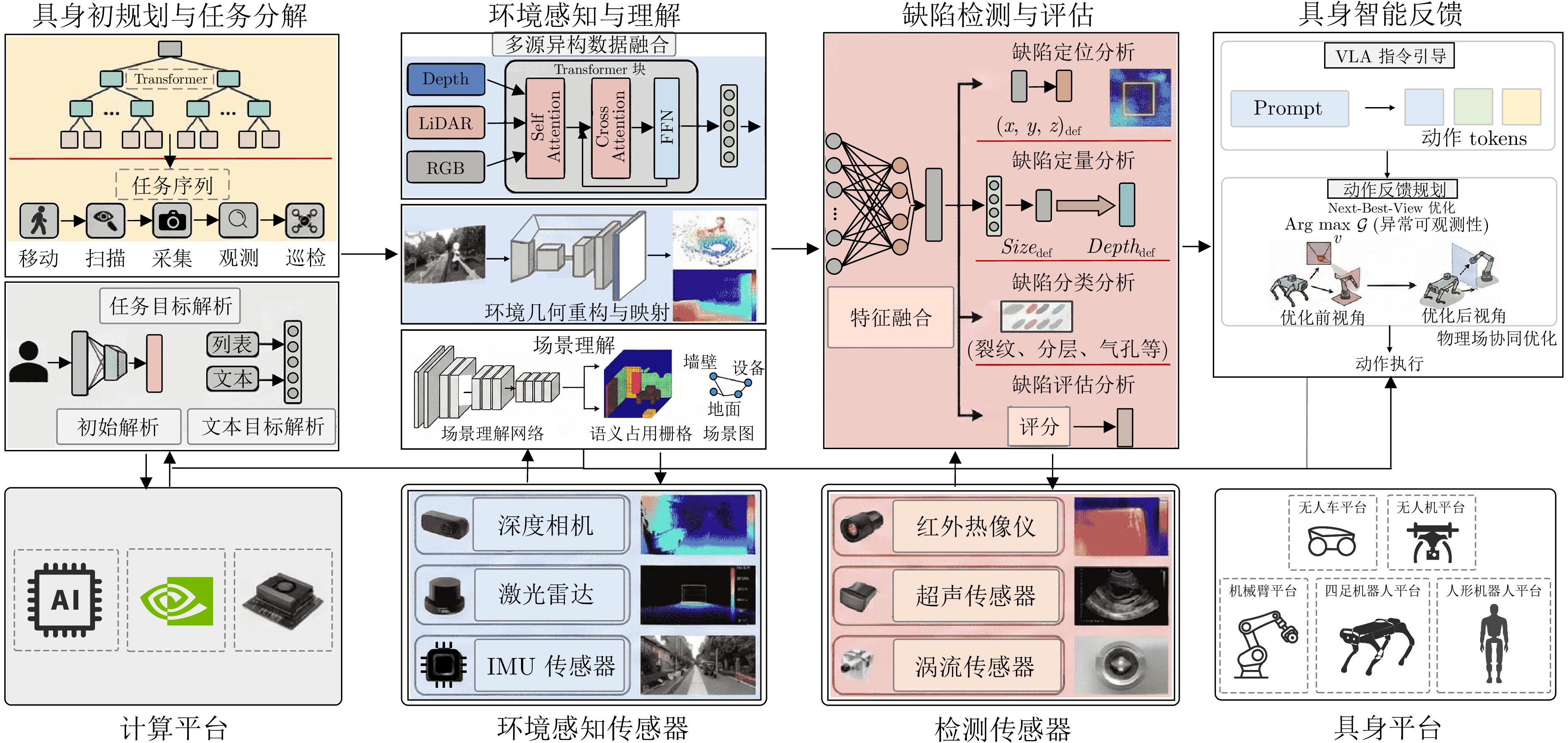
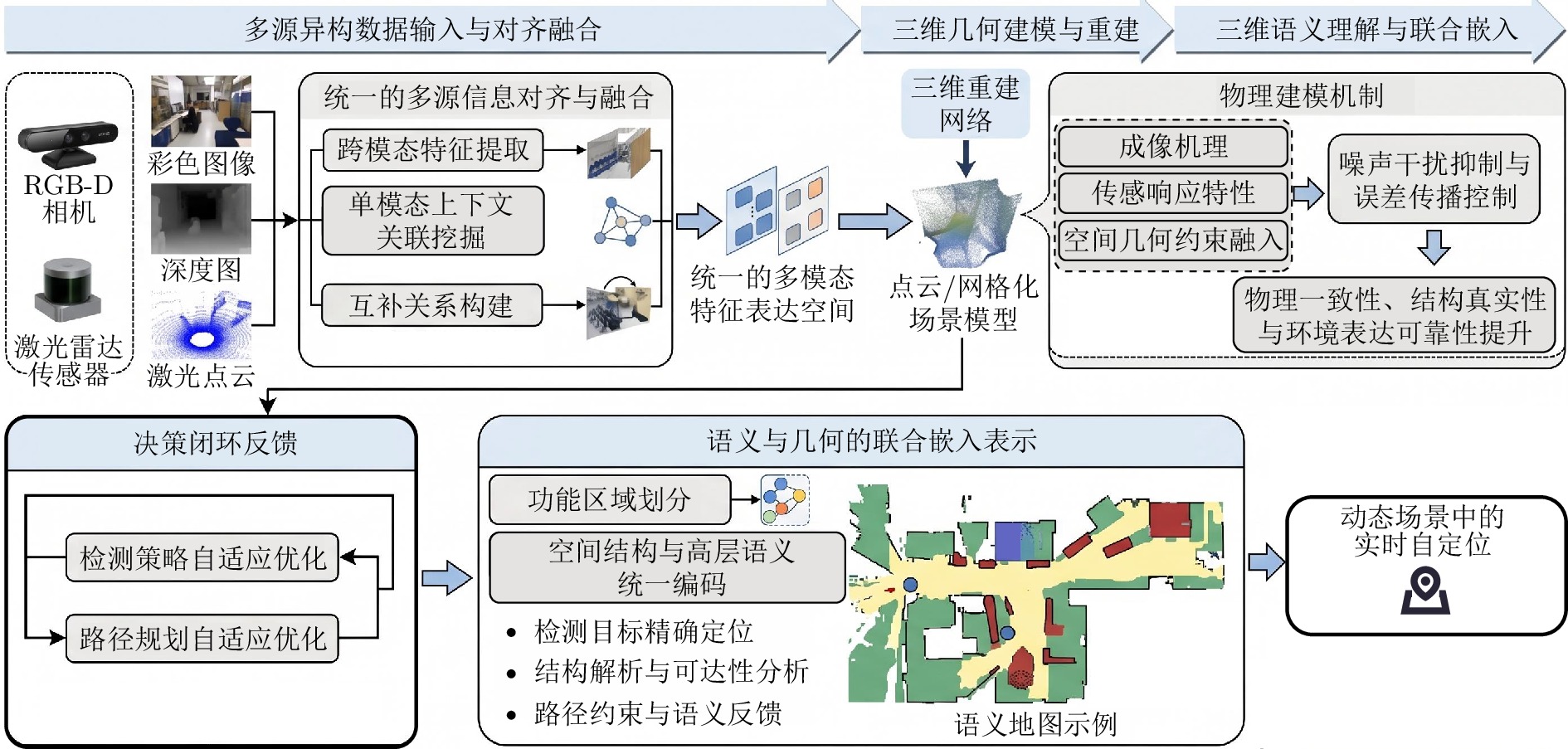
图 1 具身智能缺陷无损检测流程
Fig. 1 Non-destructive testing process for embodied intelligence defects
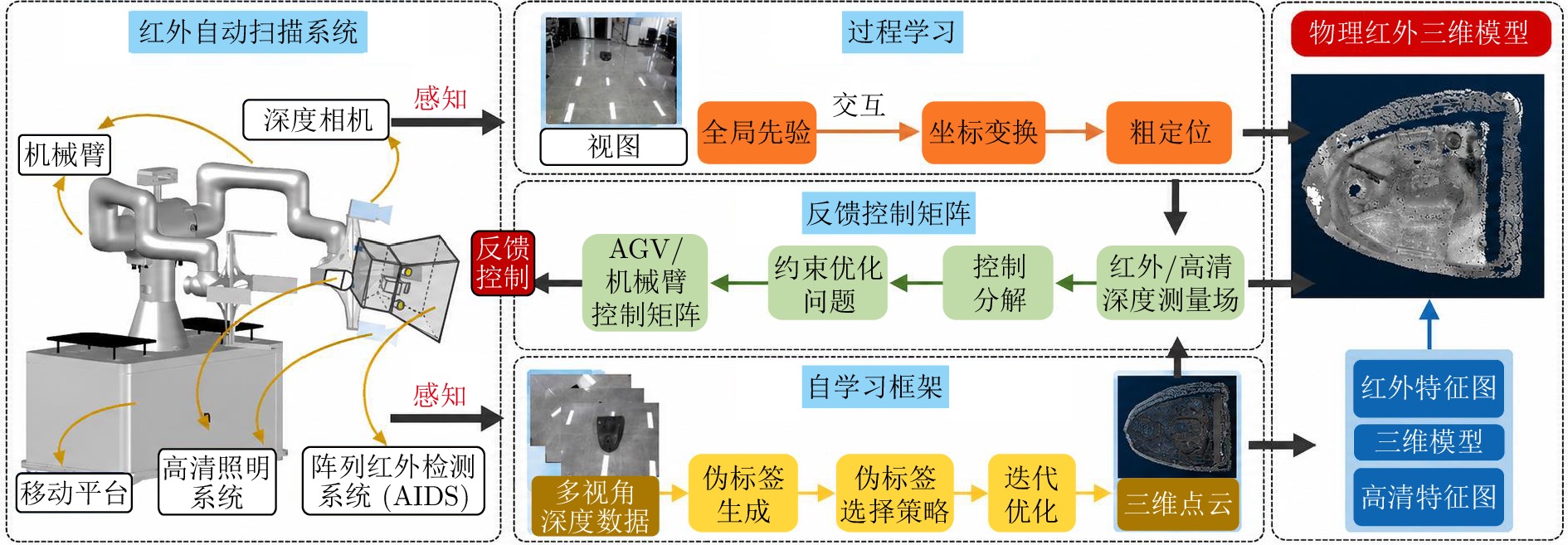
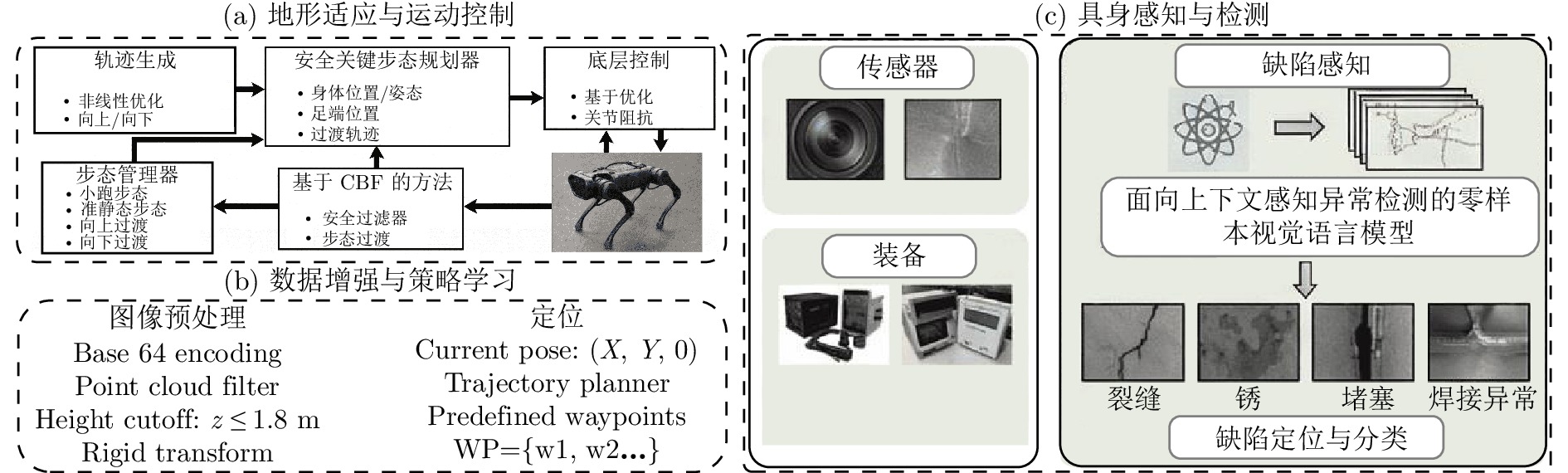
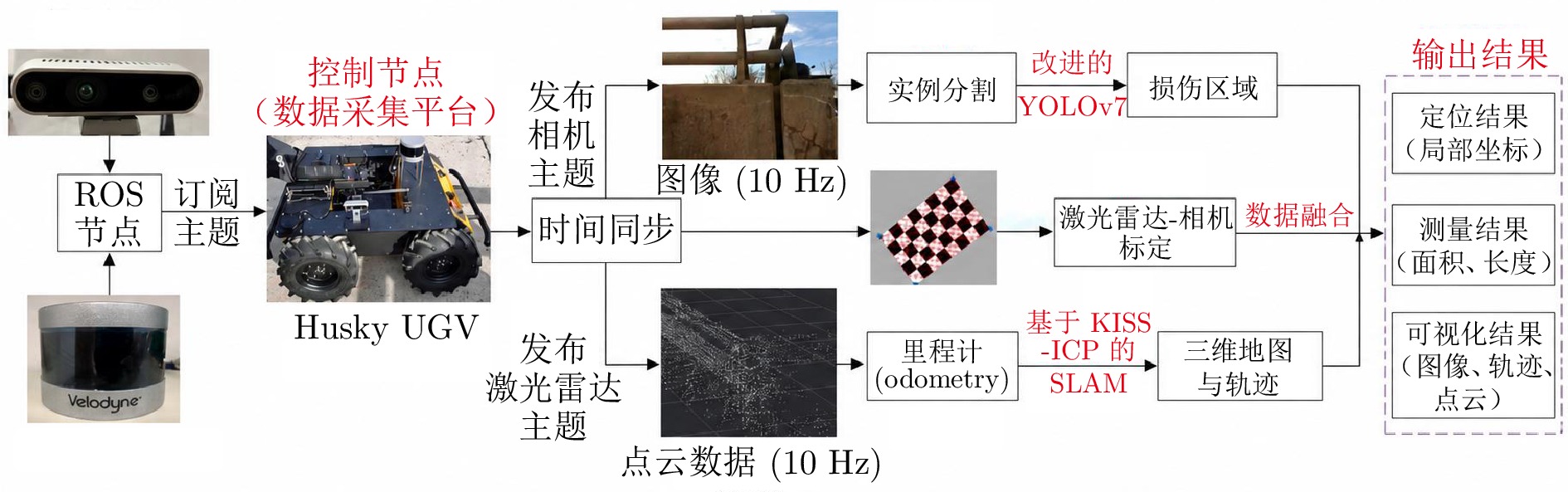
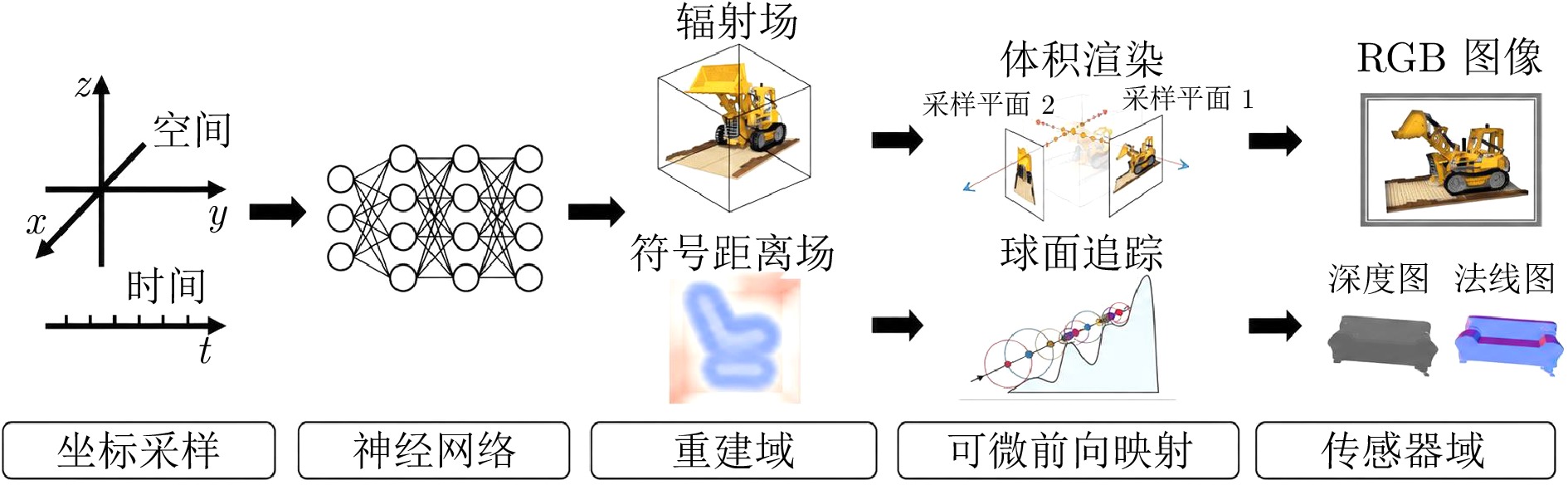
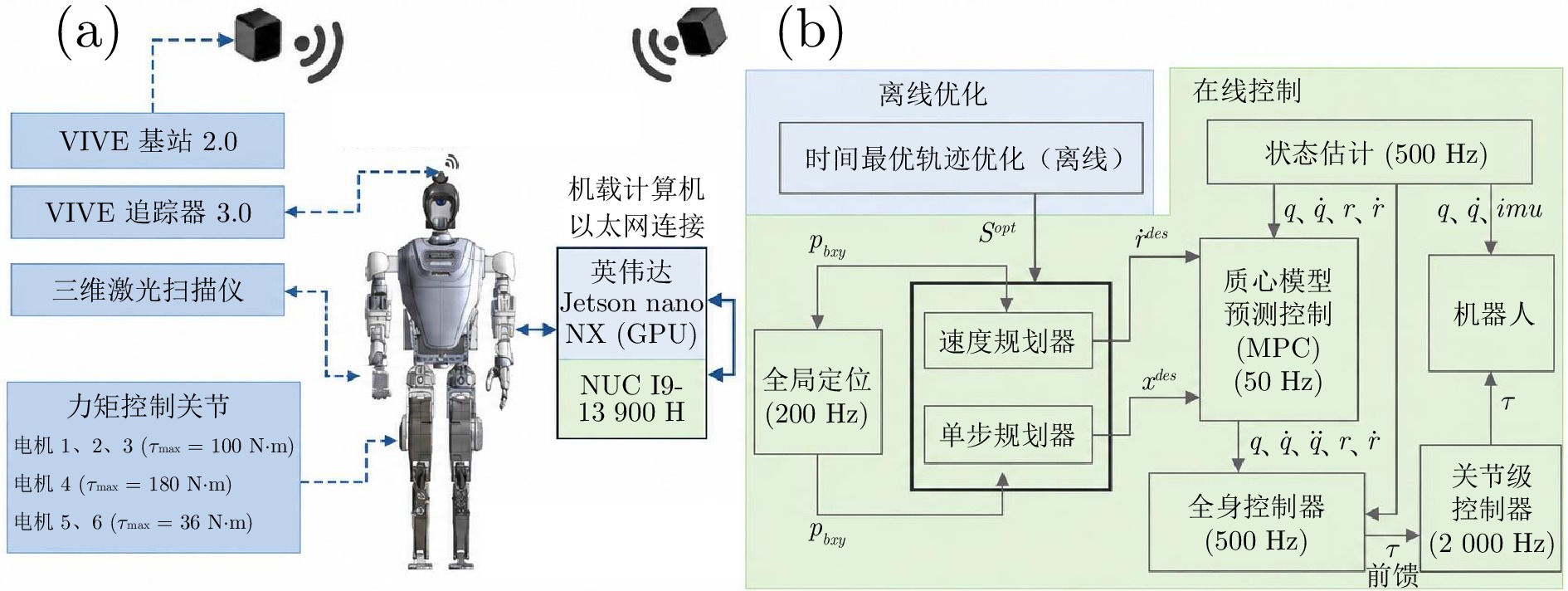
表 1 传感器介绍
Table 1 Introduction to sensors
传感器类型 物理感知维度 核心作用 局限性分析 部署难度 【环境感知传感器[57−58]】 RGB相机 二维颜色与高频纹理 场景语义理解与目标全局粗定位 缺乏深度空间信息, 易受复杂光照变化干扰 部署灵活, 需额外考虑防尘、防油污及光照稳定性问题 深度相机 三维局部几何与深度 形态建模与近距离运动避障约束 测量距离受限, 对强反光或透明材质敏感 需严格完成内外参标定, 对安装角度、遮挡关系及实时同步精度要求高 LiDAR 大范围全局三维点云 复杂大尺度环境的鲁棒建图与导航定位 点云相对稀疏, 缺乏目标表面的精细色彩与纹理 设备成本与算力需求高, 需解决点云配准与多传感器时空同步 IMU 连续加速度与角速度 高频运动状态估计与视觉感知误差补偿 存在累积漂移误差, 需与其他视觉传感器联合标定 部署体积小但高度依赖时间同步与融合算法, 对长期漂移补偿要求高 力觉/触觉 接触力、压力与形变 评估支撑稳定性与实现柔顺物理交互 空间分辨率低, 且依赖近距离直接物理接触 需与机械结构深度耦合, 安装位置、柔顺控制与接触安全性设计复杂 【检测传感器[59−60]】 红外热像仪 表面热场分布与演化 捕捉热扩散路径畸变与实现主动非接触探伤 边缘成像易模糊, 高度依赖平台提供的有效热激励 对环境温度及平台运动稳定性要求高, 同时需协调激励装置与热成像系统同步运行 超声换能器 声波内部传播与反射 提供高分辨率的内部深度与几何尺寸测量 需借助耦合剂或严格控制入射角, 非接触检测难 对轨迹精度、接触压力控制及探头姿态一致性要求高, 现场部署复杂 涡流/电磁 导电体电磁响应畸变 高灵敏度捕捉电磁特性变化与表面异常映射 仅适用于导电或铁磁性材料, 受探头提离效应影响显著 易受复杂电磁环境干扰, 需解决探头稳定安装与电磁屏蔽问题 X射线成像 射线穿透内部密度场 跨越复杂结构实现高保真内部透视与定量 辐射安全风险高, 体积与重量较大, 移动部署难 对辐射防护、平台负载能力及远程安全控制要求高, 移动集成难度大 激光/多光谱 多波段光热物理响应 精细刻画表面微观状态及增强特定材质对比度 多维数据处理算力消耗大, 对表面粗糙度及环境散射敏感 系统标定复杂, 对光路稳定性、环境光隔离及实时多模态数据融合要求高 【系统内部传感器[61, 62]】 温度传感器 内部热状态与器件温升 实时监测系统热稳定性与关键模块运行状态 对局部热点敏感, 复杂热耦合条件下易存在测量滞后 部署简单, 需合理布置采样位置以避免局部温差导致监测失真 振动传感器 平台振动频率与幅值 感知运动扰动并辅助稳定控制与异常诊断 易受复杂环境噪声干扰, 高频微振动分离难度较高 需与平台动力结构深度耦合, 并进行复杂振动源隔离与滤波设计 编码器 关节角度与位移变化 精确反馈执行机构运动状态与轨迹误差 易受机械磨损与间隙误差影响, 长期运行精度下降 需与驱动机构高度集成, 对机械加工精度与长期可靠性要求高 电流/电压传感器 能量消耗与驱动负载 实时监测系统功耗状态与执行器工作负载 难以直接反映复杂机械故障原因, 对环境波动敏感 电气集成复杂, 需兼顾供电安全、电磁兼容与实时数据采样稳定 力矩传感器 关节输出力矩与负载变化 实现柔顺控制与动态接触状态感知 高精度力矩测量成本较高, 复杂工况下标定困难 需与机械关节及控制系统深度耦合, 对结构空间与标定精度要求高 状态监测传感器 系统运行健康状态参数 故障诊断与平台健康管理 多源状态信息耦合复杂, 异常原因难以精准分离 需构建统一状态监测与数据融合框架, 对系统级协同设计要求高  下载: 导出CSV
表 2 具身智能检测与其他缺陷检测方法的对比
Table 2 Comparison of embodied intelligence detection with other defect testing methods
方法 传统机器视觉 深度学习 多模态大模型 具身智能 核心范式 规则驱动, 依赖人工设计的特征算子 数据驱动, 依赖大规模标注数据训练 知识语义驱动, 利用预训练大模型的通用知识和零样本推理能力 行为驱动, 感知与行动闭环, 通过物理交互获取信息 感知模式 被动/静态固定机位, 单帧图像分析, 无法改变观测条件 被动/静态或离线数据, 依赖图像质量, 无法主动优化视角 被动或基于Prompt交互, 物理上仍无法自主移动 主动/动态规划观测路径, 通过移动平台改变视角, 实现主动探索 检测能力 仅限规则明显的简单缺陷 高精度识别复杂纹理缺陷, 但对未知缺陷泛化能力有限 具备强泛化能力, 可识别开放集缺陷, 并理解复杂语义 支持全空间检测, 解决遮挡与盲区问题, 并可评估缺陷三维物理属性 优点 1)运行速度快;
2)算力需求低;
3)可解释性强1)特征提取自动化;
2)识别精度高;
3)对噪声具鲁棒性1)少样本/零样本能力强;
2)支持自然语言交互;
3)通用性强1)消除视觉盲区;
2)具备物理操作能力;
3)适应非结构化环境局限性 1)对光照与角度敏感;
2)难处理复杂背景;
3)依赖人工调参1)依赖高质量标注数据;
2)存在黑盒问题;
3)跨域迁移困难1)推理延迟高;
2)存在幻觉风险;
3)缺乏物理空间感1)系统复杂度高;
2)存在安全风险;
3)有Sim-to-Real差距典型应用场景 电子元器件尺寸测量、印刷品色差检测 汽车零部件、PCB板、织物缺陷检测 复杂场景异常描述、柔性检测、人机协作质检 大型装备巡检、管廊检测、接触式精密装配检测
下载: 导出CSV
表 3 具身闭环程度分类表
Table 3 Embodied closed-loop level classification table
具身闭环程度 机制特征 代表工作 被动采集型 具备移动能力, 但按预设或外部生成的固定路径执行开环数据采集; 无法根据实时感知状态动态调整采集策略, 检测通常在线下或后端完成 Ma等[72, 73](基于前置静态3D扫描生成固定路径); Liao等[101](无人机采集回传地面站离线分析) 主动观测型 具备基本的"感知-行动"单向反馈; 系统利用视觉或其他感知信息定位目标, 并主动调整自身位姿或传感器角度, 以获取更高质量的观测数据 Zeng等[69](多尺度视觉伺服调整检测场); Wu等[78](视觉定位与超声反馈联合控制); Zhu等[89](云台与底盘协同运动寻优); Wu等[104](时间最优站位生成与末端跟踪) 检测反馈重规划型 形成初步闭环; 系统在感知到疑似缺陷后, 能够触发局部重规划机制, 或基于多模态反馈重构物理空间关系 Chen等[70](物理-数字双驱动的电磁感知增强与位姿协同); Agarwal等[79](视觉全局定位后触发精细扫描复测); Liu等[100](外部约束定位与表面缺陷三维映射闭环) 任务级自主决策型 系统能够理解抽象的高层语义指令, 在非结构化环境中进行零样本/少样本任务拆解、推理决策, 并执行复杂的物理交互动作 Forni等[76](缺陷检测结果映射为喷涂修复路径规划与动作控制); Aydogmus等[83](VLM零样本提示词驱动异常检测); Lan等[106](自然语言复杂指令解析与动作生成)
下载: 导出CSV
表 4 自主能力分类表
Table 4 Autonomy capability classification table
自主能力分级 系统行为特征 代表工作 遥操作 依赖人类专家的实时介入与底层动作控制; 智能体仅作为感知与执行的物理延伸 Wonsick等[103](人形机器人远程运维); S. Choi等[107](基于混合现实与专家视线追踪的指令下达); Nor等[82](人工控制四足机器人实地操作测试); Ji等[84](依赖人工控制采集数据) 半自主 具备一定的导航及常规感知能力; 但在遭遇异常、执行关键决策或理解复杂意图时, 仍需依赖人类的监督与引导 Futterlieb等[86](与人工协同工作, 依赖人工监督评估); Lan等[106](通过VLM接收自然语言指令进行交互) 自主导航 解决如何安全到达的问题; 具备复杂的建图、地形适应、动态避障与轨迹规划能力, 但在高精度缺陷检测层面的自主逻辑相对有限 Lee等[80](四足机器人狭窄空间安全控制与重规划); Ge等[90](无人车点云里程计与结构映射); Phillips等[91](无人车SLAM检测平台) 自主检测 在导航的基础上, 能够自主锁定目标并完成高精度的缺陷特征提取、定位、定量与分类评估; 无需人工干预即可输出检测结果 Tseng等[81](磁吸附AI识别); Ding等[94](无人机NeRF三维重建与缺陷定位); Lin等[74](流水线动态多目标识别); Wang等[105](人形机器人多模态缺陷自动识别) 自主复检与修复 较高的自主层级, 能够自主发现缺陷, 能根据缺陷状态自主切换探测模态进行多维复核, 生成控制指令执行原位修复任务 Forni等[76](高精度缺陷定位与自适应喷涂修正框架); Agarwal等[79](视觉初检与触觉精细复核两阶段框架)
下载: 导出CSV
表 5 机械臂检测相关工作总结
Table 5 Summary of work related to robotic arm detection
应用场景方向 代表工作 核心方法 具身智能优势体现 复杂曲面与复合材料缺陷检测 Zeng、Chen等[69−70]
Zhang等[71]
Ma等[72−73]
Wu等[78]
Agarwal等[79]融合视觉伺服驱动的多场激励、可拉伸超声阵列及视觉-触觉双模态感知技术 基于多模态反馈的自主规划, 通过位姿自适应贴合复杂几何表面, 弥补传感盲区, 实现一致性的三维交互与深度感知 动态场景的自主巡检 Lin等[74]
Bosco等[75]
Cao等[77]融合YOLO动态检测、卷积模糊网络与EfficientNet, 并结合RRT*路径规划框架 融合深度视觉与机械臂实时控制, 消除静态观测盲区, 提升流水线检测覆盖率与效率 工艺缺陷实时闭环修正 Forni等[76] 基于YOLOv10实现高精度实时缺陷定位, 并映射为喷涂修正路径与控制指令 突破被动检测范式, 构建感知定位到自适应修复执行的具身决策闭环
下载: 导出CSV
表 6 四足机器人与无人车平台检测相关工作
Table 6 Work related to the testing of quadruped robots and autonomous vehicle platforms
应用场景方向 代表工作 核心方法 具身智能优势体现 复杂地形适应与
开放环境认知感知Lee等[80]
Tseng等[81]
Nor等[82]
Aydogmus等[83]
Ji等[84]
Sanchez-Cubillo等[85]融合控制障碍函数重规划、磁吸附控制、VLM零样本推理与生成式半监督学习框架 突破空间与重力约束, 在开放无标注环境中依托语义推理实现上下文感知与形态自适应 高危特种设施与
密闭空间多模态巡检Futterlieb等[86]
Montes等[87]
Zholtayev等[88]
Zhu等[89]融合人机协同、磁记忆监测、底盘视觉与多源视觉-云台协同控制 在受限管网与安全约束下突破纯视觉表检局限, 实现隐蔽损伤深度感知, 并以视动耦合提升多模态采集效率 大尺度工业基础设施
三维建图与量化表征Ge等[90]
Phillips等[91]融合简化LiDAR-单目里程计、改进YOLOv7与SLAM的自主空间计算架构 融合无人车广域移动与空间建图, 以低成本实现结构缺陷的三维高精度定位与定量分析
下载: 导出CSV
表 7 无人机检测相关工作
Table 7 Summary of drone detection-related work
应用场景方向 代表工作 核心方法 具身智能优势体现 三维空间计算与抗噪表征 Ali等[92]
Avdelidis等[93]
Ding等[94]融合抗噪深度学习、迁移学习及NeRF与数字孪生点云对齐技术 依托无人机多视角采集构建三维映射, 突破二维局限, 大幅提升自动化缺陷定位的精度与安全性 广域能源网络自主巡航与边缘高精感知 Addabbo等[95]
Li等[96]
Ma等[97]
Zhang等[98]
Zhang等[99]融合高精度定位、轻量特征金字塔、注意力网络与自监督视觉Transformer 在光伏与输电巡航中实现边缘轻量推理并缓解长尾分布, 体现大尺度环境下的自主决策与精细感知能力 弱信号空间定位约束与多模态探测 Liu等[100]
Liao[101]融合视觉惯性里程计与人工标记优化, 并集成红外热像无损评估 实现从空间定位到缺陷三维映射的闭环, 消除高空盲区并提升环境自适应定位能力
下载: 导出CSV
表 8 具身智能检测的应用领域
Table 8 Application areas of embodied intelligence detection
应用领域 工作来源 方法 应用场景 优越性 主动感知与自主智能体巡检 Liu等[108] 视觉三维模型导引控制 复杂曲面与复合材料的自适应检测 有效解决异形复合材料热传导不均导致的漏检问题, 检出率显著优于传统自动检测方法 Altinay等[109] 自适应姿态调整策略 基础设施与非结构化环境的自主巡检 实现从移动导航到缺陷标记的全自主流程, 机器人可根据检测置信度主动调整观测位置, 平均置信度提升18%, 显著降低漏检率 Xing等[110] 多波段照明图像融合 工业产品的多维视觉增强检测 结合3D视觉引导与图像增强技术, 解决景深不足与变焦困难问题, 显著提升图像信息量与识别性能 NABHAN等[111] RoboDef-Net框架 复杂制造品表面的主动探索与
异常发现提出无需预定义路径与大量标注数据的无标签检测范式, 通过强化学习实现自主检测, 显著提升召回率并减少运动周期 大模型与认知智能的具身规划与交互 Wanna等[112] 具身AI智能体 人机协作与自然语言驱动任务规划 利用AR实现多模态对齐, 验证自然语言驱动的人机协同检测可行性 Wang等[113] 工业机器人代码自动生成库 缺陷修复与工艺决策自动化 基于LLM生成修复策略并转化为执行, 实现感知-决策-执行闭环 Sun等[114] 具身物理交互机制 多源环境安全评估与推理 实现潜在安全风险的动态预测与评估能力 虚实融合的具身环境构建 He等[115] 物联网传感器AI分析 实时监控与预测性维护 构建系统级监控与预测机制, 为具身智能提供数字化环境支撑 Wang等[116] 域泛化方法 虚实数据融合检测 有效缓解域漂移问题, 降低对真实数据的依赖 工业级具身通用架构与范式 Zhang等[117]
Gupta等[118]知识驱动EIIR框架 高混合度制造 构建工业具身智能理论框架, 提升复杂制造场景下的通用理解与决策能力
下载: 导出CSV
-
[1] Bardiani J, Ragani R F, Pinello L, et al. Shape sensing and damage detection of composite pressure vessels using inverse finite element method coupled with physics-based strain pre-extrapolation. Thin-Walled Structures, 2026, 218: 113935 doi: 10.1016/j.tws.2025.113935 [2] Bai J, Wu D, Shelley T, et al. A Comprehensive Survey on Machine Learning Driven Material Defect Detection. ACM Computing Surveys, 2025, 57(11): 1−36 [3] 苏虎, 张家斌, 张博豪, 等. 基于视觉感知的表面缺陷检测综述. 计算机集成制造系统, 2023, 29(1): 169−191 doi: 10.13196/j.cims.2023.01.015Su Hu, Zhang Jia-Bin, Zhang Bo-Hao, et al. Survey on surface defect detection based on visual perception. Computer Integrated Manufacturing Systems, 2023, 29(1): 169−191 doi: 10.13196/j.cims.2023.01.015 [4] Yu K, Yao Y, Zhang W, et al. Defects, monitoring, and AI-enabled control in soft material additive manufacturing: a review. Virtual and Physical Prototyping, 2025, 20(1): e2588456 doi: 10.1080/17452759.2025.2588456 [5] Liu Y, Xu J, Wu Y. A CISG method for internal defect detection of solar cells in different production processes. IEEE Transactions on Industrial Electronics, 2021, 69(8): 8452−8462 doi: 10.1109/tie.2021.3104584 [6] Xia J, Ji B, Yuanzhou Z, et al. A crack ultrasonic detection method considering the beam deflection at the crack tips. Nondestructive Testing and Evaluation, 20261−18 [7] Wen X, Chen S, Song K, et al. X-Ray Techniques for Defect Detection in Industrial Components and Materials: A Review. Computers, Materials and Continua, 2025, 85(3): 4173−4201 doi: 10.32604/cmc.2025.070906 [8] AbouelNour Y, Gupta N. Assisted defect detection by in-process monitoring of additive manufacturing using optical imaging and infrared thermography. Additive Manufacturing, 2023, 67: 103483 doi: 10.1016/j.addma.2023.103483 [9] Jimenez K, Cano J B, Velilla E. A lightweight deep learning model for fault detection of PV modules using thermal images. Solar Energy, 2026, 303: 114120 doi: 10.1016/j.solener.2025.114120 [10] Li R, Wang F, Yang F, et al. Adaptive Tomographic Radar Thermography: A Novel Approach for Multi-origin Defects Imaging in Hybrid Fiber-Metal and Carbon-Fiber Laminates. Composites Part B: Engineering, 2026113392 [11] Alvarado J W V, Caballero García L F, Taboada Neira M, et al. Probability of defects detection in welded joints using the magnetic particle method. Archives of Metallurgy and Materials, 2024607−612 [12] Huang P, Pu H, Li J, et al. A novel eddy current method for defect detection immune to lift-off. IEEE Transactions on Instrumentation and Measurement, 2022, 71: 1−13 doi: 10.1109/tim.2022.3199272 [13] Wang S, Chen S, Wang H, et al. Internal defect detection model based on laser ultrasonic signal decomposition and deep learning. Measurement, 2025, 242: 116194 doi: 10.1016/j.measurement.2024.116194 [14] Xu X, Ran B, Jiang N, et al. A systematic review of ultrasonic techniques for defects detection in construction and building materials. Measurement, 2024, 226: 114181 doi: 10.1016/j.measurement.2024.114181 [15] Ye Q, Dong Y, Zhang X, et al. Robustness defect detection: improving the performance of surface defect detection in interference environment. Optics and Lasers in Engineering, 2024, 175: 108035 doi: 10.1016/j.optlaseng.2024.108035 [16] Li X, He Y, Wang H, et al. Thermal inspection of subsurface defects in wind turbine blade segments under the natural solar condition. IEEE Transactions on Industrial Electronics, 2023, 71(9): 11488−11497 [17] Li D, Li Y, Xie Q, et al. Tiny defect detection in high-resolution aero-engine blade images via a coarse-to-fine framework. IEEE Transactions on Instrumentation and Measurement, 2021, 70: 1−12 doi: 10.1109/tim.2021.3062175 [18] 可帅, 张小花, 杨跃, 等. 工业缺陷检测中卷积神经网络的发展与应用. 机械研究与应用, 20261−4 doi: 10.16576/j.ISSN.1007-4414.2026.02.053Ke Shuai, Zhang Xiao-Hua, Yang Yue, et al. Development and application of convolutional neural networks in industrial defect detection. Mechanical Research and Application, 20261−4 doi: 10.16576/j.ISSN.1007-4414.2026.02.053 [19] Ren Z, Fang F, Yan N, et al. State of the art in defect detection based on machine vision. International Journal of Precision Engineering and Manufacturing-Green Technology, 2022, 9(2): 661−691 doi: 10.1007/s40684-021-00343-6 [20] Tulbure A A, Tulbure A A, Dulf E H. A review on modern defect detection models using DCNNs-Deep convolutional neural networks. Journal of Advanced Research, 2022, 35: 33−48 doi: 10.1016/j.jare.2021.03.015 [21] Zhang Z, Zhou M, Wan H, et al. IDD-Net: Industrial defect detection method based on Deep-Learning. Engineering Applications of Artificial Intelligence, 2023, 123: 106390 doi: 10.1016/j.engappai.2023.106390 [22] Usamentiaga R, Lema D G, Pedrayes O D, et al. Automated surface defect detection in metals: a comparative review of object detection and semantic segmentation using deep learning. IEEE Transactions on Industry Applications, 2022, 58(3): 4203−4213 doi: 10.1109/TIA.2022.3151560 [23] Zhou H, Yang R, Hu R, et al. ETDNet: Efficient transformer-based detection network for surface defect detection. IEEE Transactions on Instrumentation and Measurement, 2023, 72: 1−14 [24] 罗东亮, 蔡雨萱, 杨子豪, 等. 工业缺陷检测深度学习方法综述. 中国科学: 信息科学, 2022, 52(6): 1002−1039Luo Dong-Liang, Cai Yu-Xuan, Yang Zi-Hao, et al. Survey of deep learning methods for industrial defect detection. Science China: Information Sciences, 2022, 52(6): 1002−1039 [25] 杨传礼, 张修庆. 基于机器视觉和深度学习的材料缺陷检测应用综述. 材料导报, 2022, 36(16): 226−234 doi: 10.11896/cldb.20070136Yang Chuan-Li, Zhang Xiu-Qing. Survey of material defect detection applications based on machine vision and deep learning. Materials Review, 2022, 36(16): 226−234 doi: 10.11896/cldb.20070136 [26] Xu C, Li W, Cui X, et al. Scarcity-GAN: Scarce data augmentation for defect detection via generative adversarial nets. Neurocomputing, 2024, 566: 127061 doi: 10.1016/j.neucom.2023.127061 [27] Lu F, Yao X, Fu C W, et al. Removing anomalies as noises for industrial defect localization. Proceedings of the IEEE/CVF International Conference on Computer Vision, 202316166−16175 [28] Goknil A, Nguyen P, Sen S, et al. A systematic review of data quality in CPS and IoT for industry 4.0. ACM Computing Surveys, 2023, 55(14s): 1−38 doi: 10.1145/3593043 [29] Qiao Q, Ahmad A, Hu H, et al. Advancements in Industrial Product Surface Defect Detection: From Traditional Methods to Modern Advanced Techniques. Machine Learning and Intelligent Systems, 202482−89 [30] Apostolopoulos I D, Tzani M A. Industrial object and defect recognition utilizing multilevel feature extraction from industrial scenes with Deep Learning approach. Journal of Ambient Intelligence and Humanized Computing, 2023, 14(8): 10263−10276 doi: 10.1007/s12652-021-03688-7 [31] Jin D, Zhang L. Embodied intelligence weaves a better future. Nature Machine Intelligence, 2020, 2(11): 663−664 doi: 10.1038/s42256-020-00250-6 [32] Gupta A, Savarese S, Ganguli S, et al. Embodied intelligence via learning and evolution. Nature Communications, 2021, 12(1): 5721 doi: 10.1038/s41467-021-25874-z [33] Brooks R A. Intelligence without representation. Artificial Intelligence, 1991, 47(1-3): 139−159 doi: 10.1016/0004-3702(91)90053-M [34] Anderson M L. Embodied cognition: A field guide. Artificial Intelligence, 2003, 149(1): 91−130 doi: 10.1016/S0004-3702(03)00054-7 [35] Liu H, Guo D, Cangelosi A. Embodied intelligence: A synergy of morphology, action, perception and learning. ACM Computing Surveys, 2025, 57(7): 1−36 [36] Majumdar A, Yadav K, Arnaud S, et al. Where are we in the search for an artificial visual cortex for embodied intelligence?. Advances in Neural Information Processing Systems, 2023, 36: 655−677 doi: 10.52202/075280-0031 [37] Roumeliotis K I, Tselikas N D. ChatGPT and OpenAI models: A preliminary review. Future Internet, 2023, 15(6): 192 [38] 刘建伟, 丁熙浩, 罗雄麟. 多模态深度学习综述. 计算机应用研究, 2020, 37(6): 1601−1614 doi: 10.3969/j.issn.1001-4632.2025.01.07Liu Jian-Wei, Ding Xi-Hao, Luo Xiong-Lin. Survey of multimodal deep learning. Computer Applications and Research, 2020, 37(6): 1601−1614 doi: 10.3969/j.issn.1001-4632.2025.01.07 [39] Lansford J L, Vlachos D G. Infrared spectroscopy data-and physics-driven machine learning for characterizing surface microstructure of complex materials. Nature Communications, 2020, 11(1): 1513 doi: 10.1038/s41467-020-15340-7 [40] Wu G, Zhang Y, Deng L, et al. Cross-modal learning for anomaly detection in complex industrial process: Methodology and benchmark. IEEE Transactions on Circuits and Systems for Video Technology, 2024 [41] Ma T, Yang Z, Ren X, et al. Infrared small target detection based on smoothness measure and thermal diffusion flowmetry. IEEE Geoscience and Remote Sensing Letters, 2021, 19: 1−5 doi: 10.1109/lgrs.2021.3096520 [42] Gautam A, Whiting T, Cao X, et al. A method for designing autonomous robots that know their limits. Proceedings of the 2022 International Conference on Robotics and Automation (ICRA), 2022121−127 [43] Algburi R N A, Gao H, Al-Huda Z. Improvement of an industrial robotic flaw detection system. IEEE Transactions on Automation Science and Engineering, 2022, 19(4): 3953−3967 doi: 10.1109/TASE.2022.3141248 [44] Li W, Gu Y, Chen X, et al. Towards visual discrimination and reasoning of real-world physical dynamics: Physics-grounded anomaly detection. Proceedings of the Computer Vision and Pattern Recognition Conference, 202530409−30419 [45] Wang P, Wu Z, Ten J J S, et al. Towards intelligent defect detection in metal powder bed fusion: A review of in situ monitoring, data pre-processing, and machine learning. Materials Science and Engineering: R: Reports, 2026, 167: 101112 doi: 10.1016/j.mser.2025.101112 [46] Zhou Q, Feng B, Li B, et al. Enhancing Human-Robot Collaborative Transportation of Deformable Objects using Multi-modal Reinforcement Learning and Adaptive Admittance Control. Advanced Engineering Informatics, 2026, 69: 103905 doi: 10.1016/j.aei.2025.103905 [47] Chen Z, Xie Q, Zhang L, et al. Dynamic Visual Defect Detection System for Disc Castings Based on Multimodal Fusion Strategy. Knowledge-Based Systems, 2026115325 [48] Liu Q, Liu C, Wei X, et al. Laser-induced MXene/LIG ternary heterostructure: construction and health monitoring application of a high performance self-powered friction sensor. Journal of Materials Chemistry A, 2026 [49] Guo Y, Ai X, Guo M, et al. Automatic perception of potential safety hazards: A cross-modal multi-task framework for feature alignment, image classification and captioning. Advanced Engineering Informatics, 2026, 69: 103919 doi: 10.1016/j.aei.2025.103919 [50] Ma N, Pan J, Liu Y, et al. Embodied Interactive Intelligence Towards Autonomous Driving. Engineering, 2025 [51] Wang T, Jin T, Lin W, et al. Multimodal sensors enabled autonomous soft robotic system with self-adaptive manipulation. ACS Nano, 2024, 18(14): 9980−9996 doi: 10.1021/acsnano.3c11281 [52] Han X, Chen S, Fu Z, et al. Multimodal fusion and vision-language models: A survey for robot vision. Information Fusion, 2025103652 [53] Cheng Y, Liu H, Pan G, et al. Quadruped robot traversing 3D complex environments with limited perception. Proceedings of the 2024 IEEE/RSJ International Conference on Intelligent Robots and Systems (IROS), 20249074−9081 [54] Stoelen M F, de Azambuja R, López Rodríguez B, et al. The GummiArm project: a replicable and variable-stiffness robot arm for experiments on embodied AI. Frontiers in Neurorobotics, 2022, 16: 836772 doi: 10.3389/fnbot.2022.836772 [55] Umar S, Qureshi M S, Nawaz M U. Thermal imaging and AI in solar panel defect identification. International Journal of Advanced Engineering Technologies and Innovations, 2024, 1(3): 73−95 [56] 邵宏, 谢大雄. 具身智能机器人技术. 中兴通讯技术, 2024, 30(S1): 40−44Shao Hong, Xie Da-Xiong. Embodied intelligent robotics technology. ZTE Communications Technology, 2024, 30(S1): 40−44 [57] 李健翔, 翟弟华, 丁子恺, 等. RC-LIO: 退化环境中多传感器融合补偿的激光雷达惯性里程计. 自动化学报, 2026, 52(6): 1−19Li Jian-Xiang, Zhai Di-Hua, Ding Zi-Kai, et al. RC-LIO: lidar-inertial odometry enhanced by multi-sensor fusion compensation under degraded environments. Acta Automatica Sinica, 2026, 52(6): 1−19 [58] 粟傈, 杨帆, 王向禹, 等. 基于事件相机的机器人感知与控制综述. 自动化学报, 2022, 48(8): 1869−1889 doi: 10.16383/j.aas.c210263Su Li, Yang Fan, Wang Xiang-Yu, et al. A survey of robot perception and control based on event camera. Acta Automatica Sinica, 2022, 48(8): 1869−1889 doi: 10.16383/j.aas.c210263 [59] 王耀南, 江一鸣, 姜娇, 等. 机器人感知与控制关键技术及其智能制造应用. 自动化学报, 2023, 49(3): 494−513 doi: 10.16383/j.aas.c220995Wang Yao-Nan, Jiang Yi-Ming, Jiang Jiao, et al. Key technologies of robot perception and control and its intelligent manufacturing applications. Acta Automatica Sinica, 2023, 49(3): 494−513 doi: 10.16383/j.aas.c220995 [60] 胡云峰, 曲婷, 刘俊, 等. 智能汽车人机协同控制的研究现状与展望. 自动化学报, 2019, 45(7): 1261−1280 doi: 10.16383/j.aas.c180136Hu Yun-Feng, Qu Ting, Liu Jun, et al. Human-machine cooperative control of intelligent vehicle: Recent developments and future perspectives. Acta Automatica Sinica, 2019, 45(7): 1261−1280 doi: 10.16383/j.aas.c180136 [61] 谭帅, 王一帆, 姜庆超, 等. 基于不同故障传播路径差异化的故障诊断方法. 自动化学报, 2025, 51(1): 161−173 doi: 10.16383/j.aas.c240151Tan Shuai, Wang Yi-Fan, Jiang Qing-Chao, et al. Fault propagation path-aware network: A fault diagnosis method. Acta Automatica Sinica, 2025, 51(1): 161−173 doi: 10.16383/j.aas.c240151 [62] 王亚朝, 赵伟, 徐海洋, 等. 基于多阶段注意力机制的多种导航传感器故障识别研究. 自动化学报, 2021, 47(12): 2784−2790 doi: 10.16383/j.aas.c190435Wang Ya-Zhao, Zhao Wei, Xu Hai-Yang, et al. Multiple navigation sensor fault diagnose research based on multi-stage attention mechanism. Acta Automatica Sinica, 2021, 47(12): 2784−2790 doi: 10.16383/j.aas.c190435 [63] Li Shutao, Li Congyu, Kong Xudong. Development status and future prospects of multi-source remote sensing image fusion. National Remote Sensing Bulletin, 2021, 25(1): 148−166 doi: 10.11834/jrs.20210259 [64] Božič J, Tabernik D, Skočaj D. Mixed supervision for surface-defect detection: From weakly to fully supervised learning. Computers in Industry, 2021, 129: 103459 doi: 10.1016/j.compind.2021.103459 [65] Zhang J, Su H, Zou W, et al. CADN: A weakly supervised learning-based category-aware object detection network for surface defect detection. Pattern Recognition, 2021, 109: 107571 doi: 10.1016/j.patcog.2020.107571 [66] Caron M, Touvron H, Misra I, et al. Emerging properties in self-supervised vision transformers. Proceedings of the IEEE/CVF International Conference on Computer Vision, 20219650−9660 [67] Chen T, Kornblith S, Norouzi M, et al. A simple framework for contrastive learning of visual representations. Proceedings of the International Conference on Machine Learning, 20201597−1607 [68] He K, Chen X, Xie S, et al. Masked autoencoders are scalable vision learners. Proceedings of the IEEE/CVF Conference on Computer Vision and Pattern Recognition, 202216000−16009 [69] Zeng Y, Kang Y, Gao B, et al. Physically guided multi-scale visual servoing robot for automatic detection of large heterogeneous composite structure. IEEE Transactions on Instrumentation and Measurement, 2025 [70] Chen R, Gao B, Qin G, et al. Physical and digital dual-driven AI framework for enhanced electromagnetic perception of nondestructive testing tomography. IEEE Transactions on Industrial Informatics, 2025 [71] Zhang Z, Wang Y, Mei D, et al. Highly sensitive and stretchable ultrasonic transducer array for object internal characteristics detection in robotics. IEEE Transactions on Instrumentation and Measurement, 2023, 72: 1−9 doi: 10.1109/tim.2023.3277988 [72] Ma K S, Lee K J, Lee J R. A study on 3D scan-based robot arm control approach for pulse-echo laser ultrasonic testing of curved composite structures. Measurement Science and Technology, 2025, 36(4): 045903 doi: 10.1088/1361-6501/adbf37 [73] Ma K S, Lee K J, Lee J R. Development of 3D scan integrated robot arm control for pulse-echo laser ultrasonic testing. Proceedings of Active and Passive Smart Structures and Integrated Systems XVⅢ, 2024, 12946: 267−270 [74] Lin C J, Jhang J Y, Gao Y J, et al. Vision-based robotic arm in defect detection and object classification applications. Sensors & Materials, 2024, 36 [75] Bosco K J, Pavalam S M. Robotics-based automated quality inspection system using computer vision and machine learning. National Journal of Electrical Electronics and Automation Technologies, 2025, 1(2): 50−57 doi: 10.1117/12.3068802 [76] Forni T, Mattera G, Vozza M, et al. Vision-based defect localisation and automated planning for robotic spray coating systems. Journal of the Brazilian Society of Mechanical Sciences and Engineering, 2025, 47(9): 1−15 doi: 10.1007/s40430-025-05746-z [77] Ye Z, Zeng L, Wang Q, et al. An intelligent equipment inspection system based on robotic arm. Frontiers in Computing and Intelligent Systems, 2023, 6(1): 115−119 doi: 10.54097/fcis.v6i1.22 [78] Wu Y, Wilcox P D, Croxford A J. Robotic inspection of fastener holes with hybrid visual and ultrasonic motion control. Journal of Manufacturing Systems, 2025, 83: 770−783 doi: 10.1016/j.jmsy.2025.11.003 [79] Agarwal A, Ajith A, Wen C, et al. Robotic defect inspection with visual and tactile perception for large-scale components. Proceedings of the 2023 IEEE/RSJ International Conference on Intelligent Robots and Systems (IROS), 202310110−10116 [80] Lee J, Kim J, Ubellacker W, et al. Safety-critical control of quadrupedal robots with rolling arms for autonomous inspection of complex environments. Proceedings of the 2024 IEEE International Conference on Robotics and Automation (ICRA), 20243485−3491 [81] Tseng A, Kalaycioglu S. Intelligent magnetic inspection robot for enhanced structural health monitoring of ferromagnetic infrastructure. arXiv preprint, 2024: arXiv: 2411.02651 [82] Nor M H B M, Mahmood I A T, Junoh S, et al. Real environment testing of quadruped robot mobile manipulator in oil and gas facilities. Proceedings of the 2025 IEEE 6th International Conference in Robotics and Manufacturing Automation (ROMA), 2025182−187 [83] Aydogmus O, Boztas G. Zero-shot visual anomaly detection on a quadruped robot using state of the art visual language models. IEEE Access, 2026 [84] Ji X, Chen J, Fu Y, et al. Text-prompted generative data augmentation and semi-supervised learning for indoor defect detection using quadruped robots. Expert Systems with Applications, 2026131545 [85] Sanchez-Cubillo J, Del Ser J, Martin J L. Toward fully automated inspection of critical assets supported by autonomous mobile robots, vision sensors, and artificial intelligence. Sensors, 2024, 24(12): 3721 doi: 10.3390/s24123721 [86] Futterlieb M, Frejaville J, Donadio F, et al. Air-Cobot: aircraft enhanced inspection by smart and collaborative robot. Mater Sci, 2017 [87] Montes de Oca-Mora N J, Woo-Garcia R M, Juarez-Aguirre R, et al. Mobile robot with failure inspection system for ferromagnetic structures using magnetic memory method. SN Applied Sciences, 2021, 3(12): 853 doi: 10.1007/s42452-021-04833-9 [88] Zholtayev D, Dauletiya D, Tileukulova A, et al. Smart pipe inspection robot with in-chassis motor actuation design and integrated AI-powered defect detection system. IEEE Access, 2024, 12: 119520−119534 doi: 10.1109/ACCESS.2024.3450502 [89] Zhu M, Zhang B, Zhou C, et al. Target recognition of multi source machine vision pan tilt integrated inspection robot for power inspection. IEEE Access, 2024, 12: 45693−45708 doi: 10.1109/ACCESS.2024.3378580 [90] Ge L, Sadhu A. Deep learning-enhanced smart ground robotic system for automated structural damage inspection and mapping. Automation in Construction, 2025, 170: 105951 doi: 10.1016/j.autcon.2024.105951 [91] Phillips S, Charron N, McLaughlin E, et al. Infrastructure mapping and inspection using mobile ground robotics. Structural Health Monitoring 2019, 2019 [92] Ali M A H, Zulkifle M Z A, Nik Ghazali N N, et al. AI-driven UAV with image processing algorithm for automatic visual inspection of aircraft external surface. Scientific Reports, 2025, 15(1): 19581 doi: 10.1038/s41598-025-02902-2 [93] Avdelidis N P, Tsourdos A, Lafiosca P, et al. Defects recognition algorithm development from visual UAV inspections. Sensors, 2022, 22(13): 4682 doi: 10.3390/s22134682 [94] Ding T K, Xiang D, Qi Y, et al. NeRF-based defect detection. Proceedings of the International Conference on Remote Sensing, Mapping, and Image Processing (RSMIP 2025), 2025, 13650: 368−373 doi: 10.1117/12.3067707 [95] Addabbo P, Angrisano A, Bernardi M L, et al. A UAV infrared measurement approach for defect detection in photovoltaic plants. Proceedings of the 2017 IEEE International Workshop on Metrology for AeroSpace (MetroAeroSpace), 2017345−350 [96] Li X, Yang Q, Chen Z, et al. Visible defects detection based on UAV-based inspection in large-scale photovoltaic systems. IET Renewable Power Generation, 2017, 11(10): 1234−1244 doi: 10.1049/iet-rpg.2017.0001 [97] Ma Z Q, Guo H, Wen H, et al. Lfs-yolo: a PV panel defect detection algorithm for UAV infrared sensors. IEEE Sensors Journal, 2025 [98] Zhang Y, Li B, Shang J, et al. DSA-Net: An attention-guided network for real-time defect detection of transmission line dampers applied to UAV inspections. IEEE Transactions on Instrumentation and Measurement, 2023, 73: 1−22 doi: 10.1109/tim.2023.3331418 [99] Zhang K, Zhou R, Wang J, et al. Transmission line component defect detection based on UAV patrol images: A self-supervised HC-ViT method. IEEE Transactions on Systems, Man, and Cybernetics: Systems, 2024, 54(11): 6510−6521 doi: 10.1109/TSMC.2024.3386873 [100] Liu Y, Dong J, Li Y, et al. A UAV-based aircraft surface defect inspection system via external constraints and deep learning. IEEE Transactions on Instrumentation and Measurement, 2022, 71: 1−15 doi: 10.1109/tim.2022.3198713 [101] Liao K C, Liou J L, Hidayat M, et al. Detection and analysis of aircraft composite material structures using UAV. Inventions, 2024, 9(3): 47 doi: 10.3390/inventions9030047 [102] Yoshiike T, Kuroda M, Ujino R, et al. The experimental humanoid robot e2-dr: A design for inspection and disaster response in industrial environments. IEEE Robotics & Automation Magazine, 2019, 26(4): 46−58 doi: 10.1109/MRA.2019.2941241 [103] Wonsick M, Long P, Önol A Ö, et al. A holistic approach to human-supervised humanoid robot operations in extreme environments. Frontiers in Robotics and AI, 2021, 8: 550644 doi: 10.3389/frobt.2021.550644 [104] Wu J, Li J, Zhang S, et al. Path and motion optimization for efficient multi-location inspection with humanoid robots. arXiv preprint, 2025: arXiv: 2510.11401 [105] Wang T B, Wang H P, Qi H, et al. The humanoid substation inspection robot modelling design. Applied Mechanics and Materials, 2013, 365: 771−774 doi: 10.4028/www.scientific.net/amm.365-366.771 [106] Lan X, Zhang L, Huang P, et al. Remote human-robot interaction in industrial inspection system based on vision-language models. Proceedings of the 2025 40th Youth Academic Annual Conference of Chinese Association of Automation (YAC), 20252717−2722 [107] Choi S, Al-Sabbag Z A, Narasimhan S, et al. Gaze-based human-robot interaction system for infrastructure inspections. Proceedings of the 2024 IEEE International Conference on Robotics and Automation (ICRA), 20249571−9577 [108] 刘磊. 基于光热双谱的三维重构缺陷检测技术研究. 电子科技大学, 2023Liu Lei. Research on three-dimensional reconstruction defect detection technology based on photothermal dual-spectrum. University of Electronic Science and Technology of China, 2023 [109] Altinay K, Ye Z, Mitoulis S A, et al. Automated surface damage detection with an embodied intelligence robotic platform. Data-Centric Engineering, 2026, 7 [110] Xing B. Industrial robot product inspection system based on 3D vision guidance. International Journal of Intelligent Robotics and Applications, 20251−12 [111] Nabhan Y, Sata D A, Minal S, et al. RoboDef-Net: Autonomous robotic inspection with active vision for industrial defect detection. Available at SSRN: 5938793 [112] Wanna S, Parra F, Valner R, et al. Multimodal grounding for embodied AI via augmented reality headsets for natural language driven task planning. arXiv preprint, 2023: arXiv: 2304.13676 [113] Wang S, Tan Z, Wang Y, et al. A novel paradigm of robotic machining towards embodied intelligent manufacturing: Case study on paint defect repair. Robotics and Computer-Integrated Manufacturing, 2026, 98: 103184 doi: 10.1016/j.rcim.2025.103184 [114] Sun Y, Ji F. An embodied intelligence system for coal mine safety assessment based on multi-level large language models. Sensors, 2025, 25(2): 488 doi: 10.3390/s25020488 [115] He W, Hu J, Zhang X, et al. Research on smart inspection system based on digital twin: A revolutionary approach for modern industrial inspection. International Core Journal of Engineering, 2024, 10(12): 92−96 [116] Wang F, Wu J, Yang Z, et al. Industrial vision inspection using digital twins: bridging CAD models and realistic scenarios. Journal of Intelligent Manufacturing, 2025, 36(7): 4963−4975 doi: 10.1007/s10845-024-02485-1 [117] Zhang C, Zhang C, Xu Z, et al. Embodied intelligent industrial robotics: Concepts and techniques. arXiv preprint, 2025: arXiv: 2505.09305 [118] Gupta S K. Embodied AI for smart robotic cells in manufacturing applications. Proceedings of the AAAI Conference on Artificial Intelligence, 2025, 39(27): 28630−28636 -

 下载:
下载:

计量
- 文章访问数: 324
- HTML全文浏览量: 194
- 被引次数: 0
