


Winning Region Computation and Analysis for a UAV-vehicle Pursuit-evasion Game Based on Smooth Approximation
-
摘要: 针对无人机攻击地面车辆场景下具有非零攻击半径、任务时间受限以及目标受地面约束的追逃博弈问题, 建立空地异构参与者的相对运动学模型, 并将无人机在给定时间内进入攻击范围的问题表述为有限时域获胜区求解问题. 在此基础上, 构造相应的哈密顿–雅可比–伊萨克斯变分不等式模型, 给出原始博弈的最优控制与闭式哈密顿量表达, 并针对其中由控制切换与分段结构引起的非光滑性构造平滑近似哈密顿量. 结合水平集框架、局部Lax-Friedrichs耗散和Runge-Kutta时间推进, 对全四维状态空间中的值函数进行回溯求解, 并基于固定切片、参数–相对航向角热力图及边界轮廓对速度比、角速度比和攻击半径对获胜区的影响进行分析. 数值结果表明, 在平滑近似模型与参数扫描范围下, 三类参数的增大均有助于扩大无人机获胜区, 但作用方式存在明显差异: 速度比主要决定获胜区的整体扩张, 角速度比主要表现为对局部边界形状的修正, 攻击半径则主要体现为终端命中条件放宽所带来的几何外扩. 相关结果可为无人机攻击约束设计、机动能力配置及对抗效能评估提供参考.Abstract: This paper studies a pursuit-evasion game problem involving an attacking UAV and a ground vehicle, where the UAV has a nonzero attack radius and a limited mission time, while the target is constrained to move on the ground. A relative kinematic model for the heterogeneous aerial and ground players is established, and the problem of whether the UAV can enter the attack range within a prescribed time is recast as that of solving for the finite-horizon winning region. On this basis, the corresponding Hamilton-Jacobi-Isaacs variational inequality model is constructed, and the optimal controls of the original game and a closed-form expression for its Hamiltonian are derived. To address the nonsmoothness caused by control switching and piecewise structures, a smooth-approximation Hamiltonian is further constructed. The value function is solved backward in the full four-dimensional state space using a level-set framework, local Lax-Friedrichs dissipation, and Runge-Kutta time marching. Fixed slices, parameter-relative heading angle heatmaps, and boundary contours are then used to analyze the effects of the speed ratio, angular-speed ratio, and attack radius on the winning region. Numerical results show that, under the smooth-approximation model and within the parameter ranges scanned, an increase in each of the three parameters helps enlarge the UAV winning region, but they do so in significantly different ways: The speed ratio mainly determines the overall expansion of the winning region, the angular-speed ratio mainly modifies the local boundary shape, and the attack radius mainly causes geometric outward expansion by relaxing the terminal hit condition. Related results provide references for UAV attack-constraint design, maneuverability allocation, and evaluation of engagement effectiveness.
-
Key words:
- pursuit-evasion game /
- winning region /
- smooth approximation /
- parameter effect analysis
-
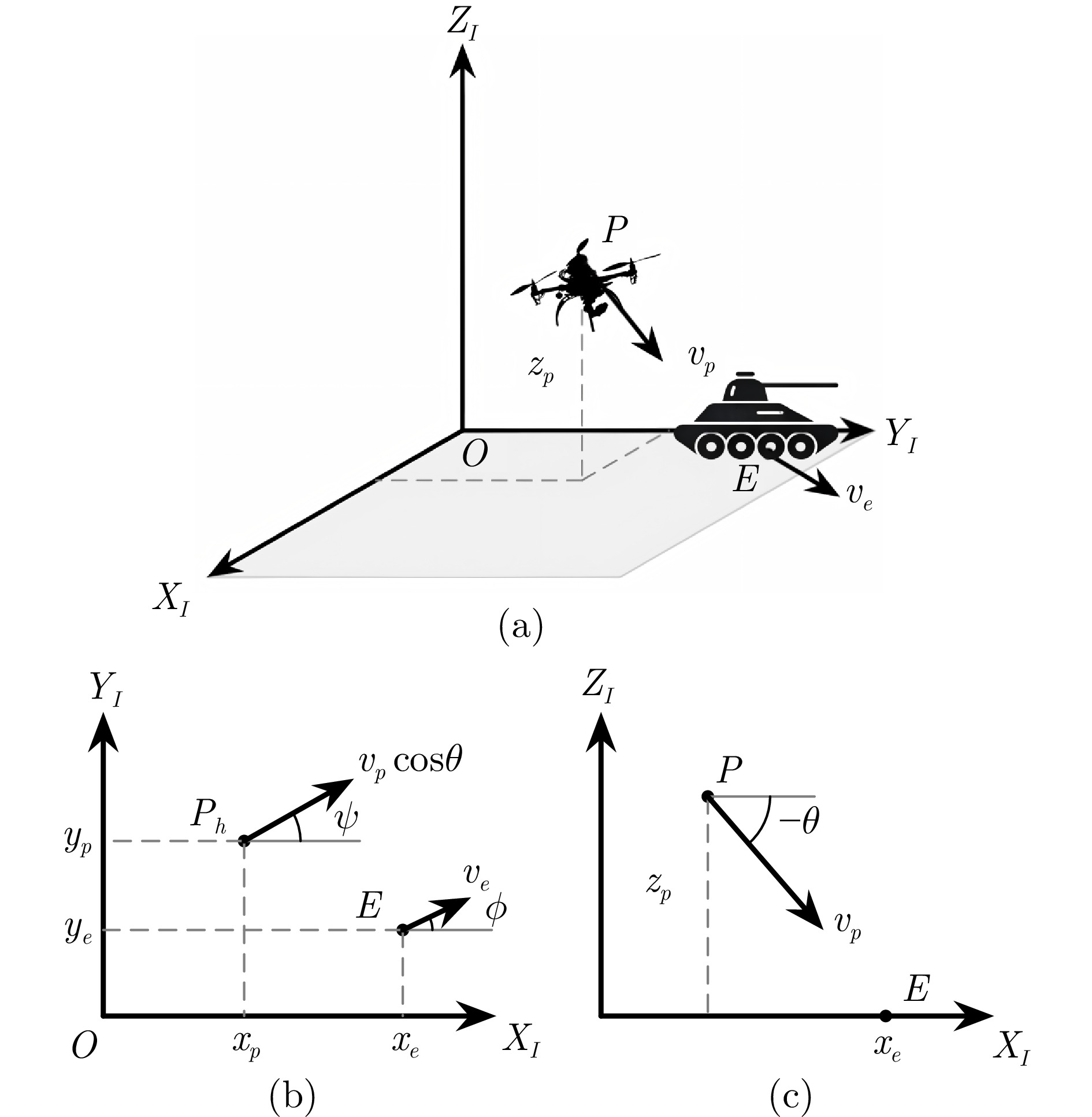
图 1 无人机攻击地面车辆追逃场景的惯性坐标系与运动变量示意图((a)空间态势示意图; (b)水平投影视图; (c)侧视图)
Fig. 1 Illustration of the inertial coordinate system and motion variables in the UAV-ground vehicle pursuit-evasion scenario ((a) Illustration of the spatial engagement configuration; (b) Horizontal projection view; (c) Side view)
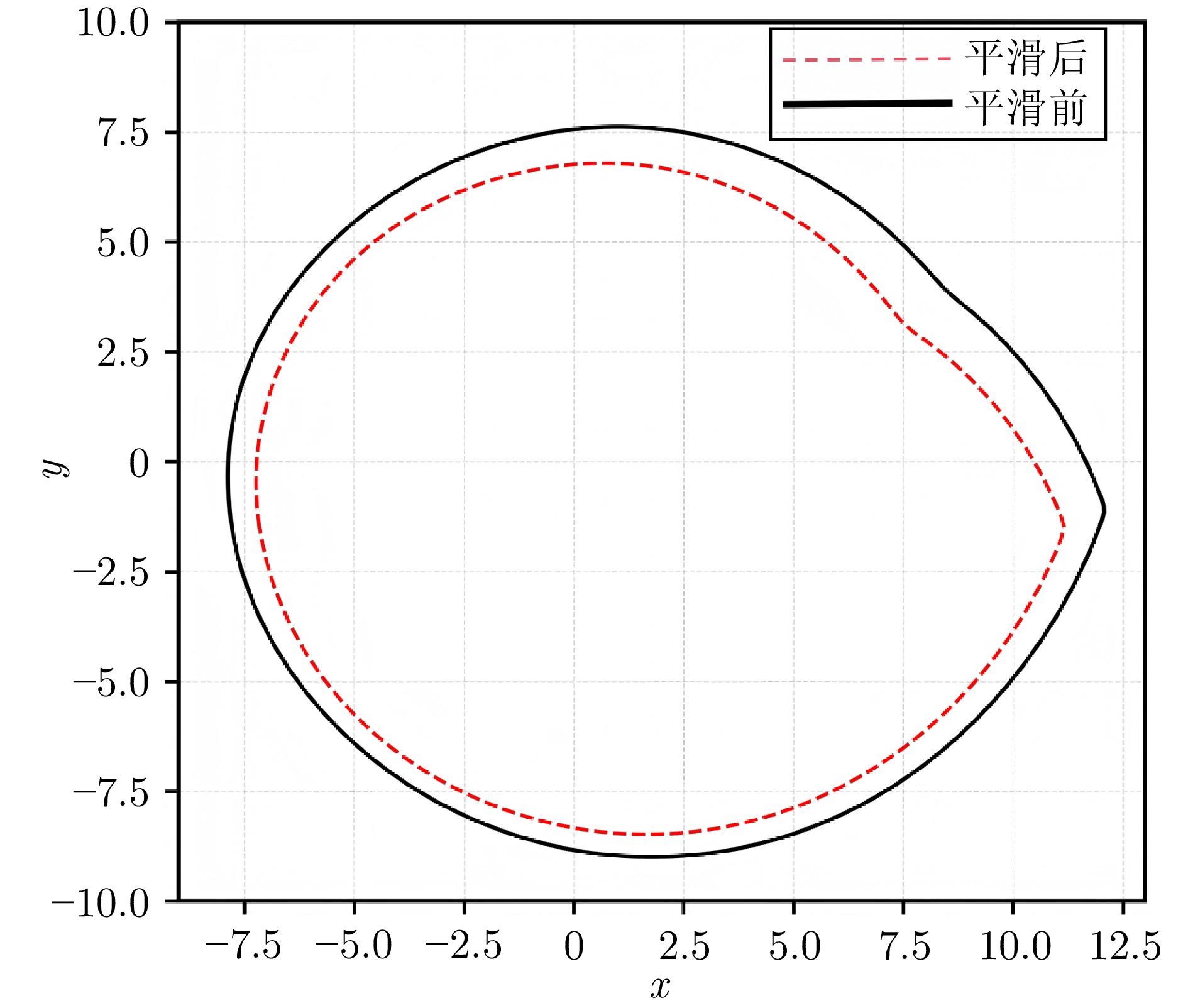
图 2 原始非光滑哈密顿量与平滑近似哈密顿量所得零水平集边界对比
Fig. 2 Comparison of zero level set boundaries obtained from the original nonsmooth Hamiltonian and the smooth-approximation Hamiltonian
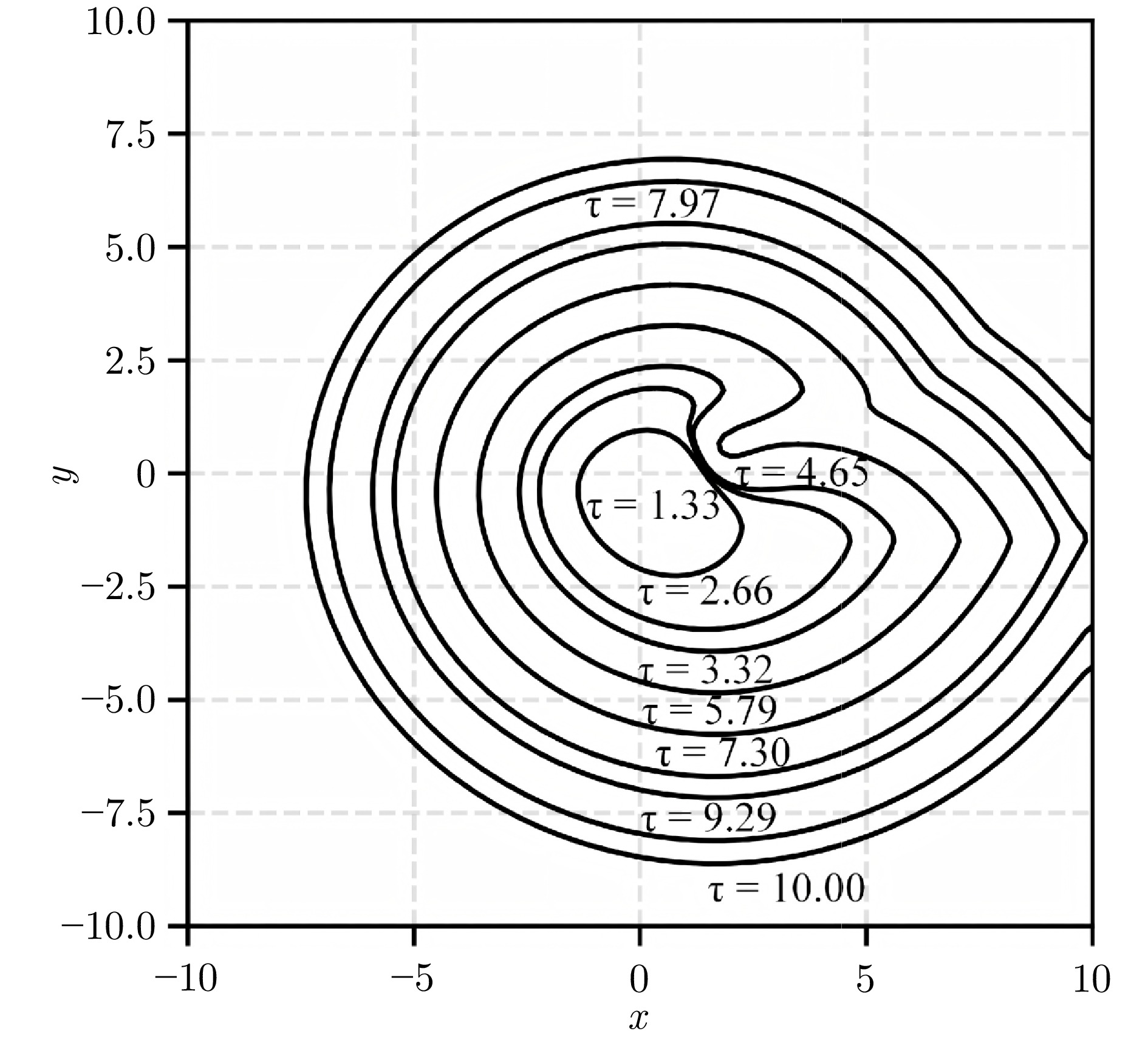
图 3 基准参数下固定$ z=1 $、$ \alpha=\pi/4 $时$ x $-$ y $平面获胜区零水平集随回溯时间$ \tau $的演化
Fig. 3 Evolution of the winning-region zero level set on the $ x $-$ y $ plane with respect to backward time $ \tau $ at fixed $ z=1 $ and $ \alpha=\pi/4 $ under the baseline parameters
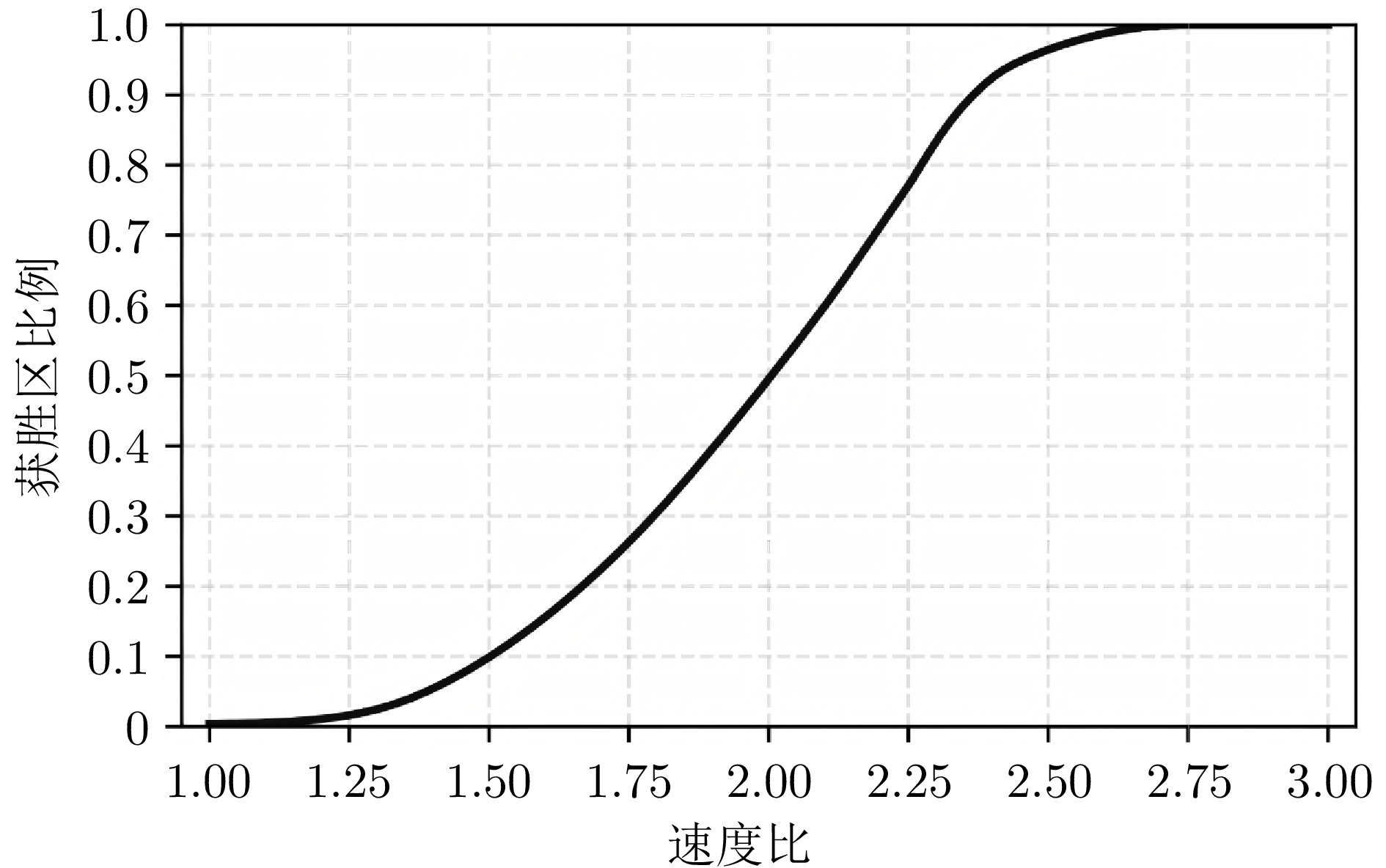
图 4 获胜区比例随速度比的变化
Fig. 4 Variation of the winning region proportion with the speed ratio
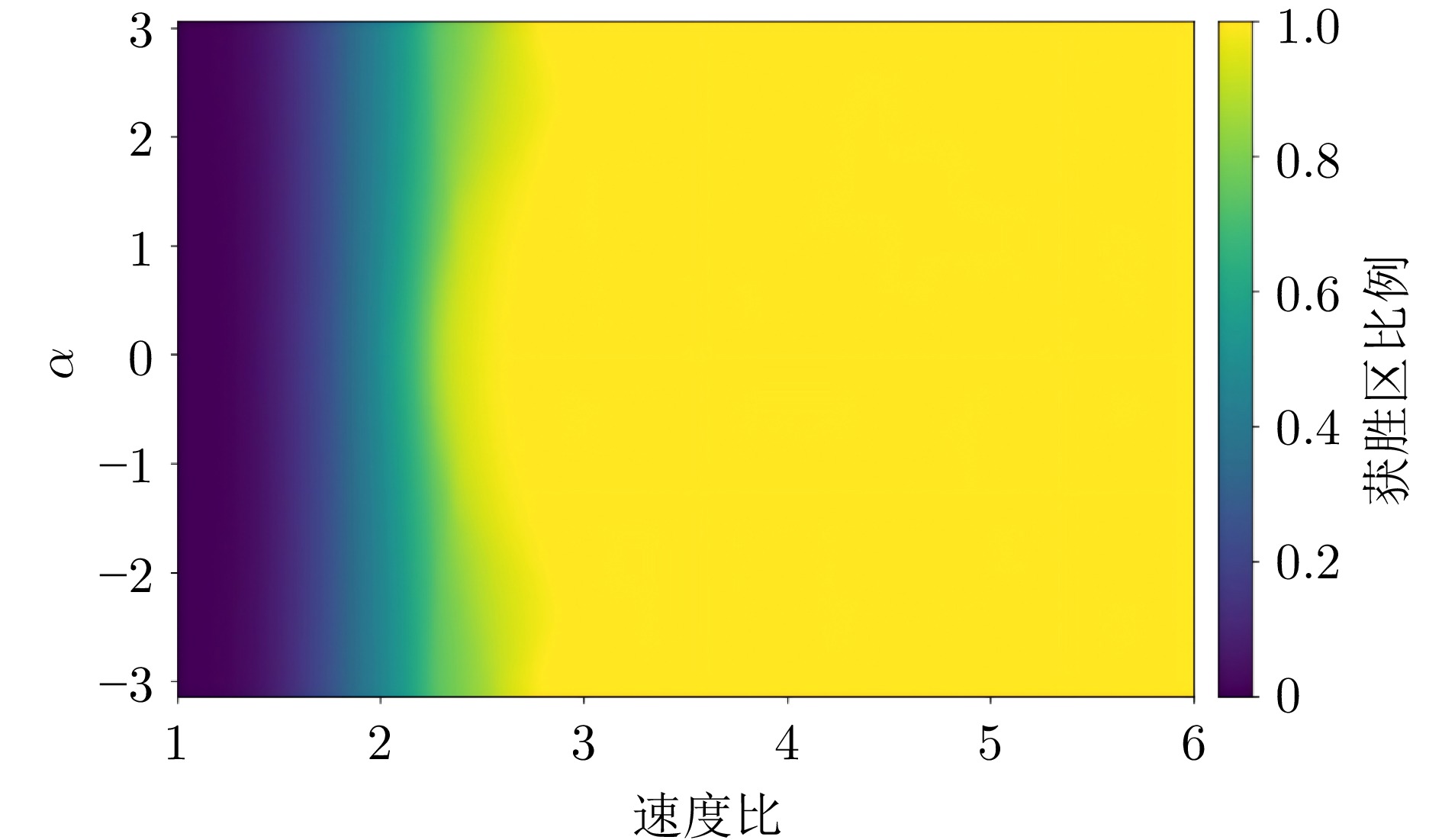
图 5 终端获胜区比例随速度比与相对航向角$ \alpha $的联合变化热力图
Fig. 5 Heatmap of the joint variation of the terminal winning region proportion with the speed ratio and the relative heading angle $ \alpha $
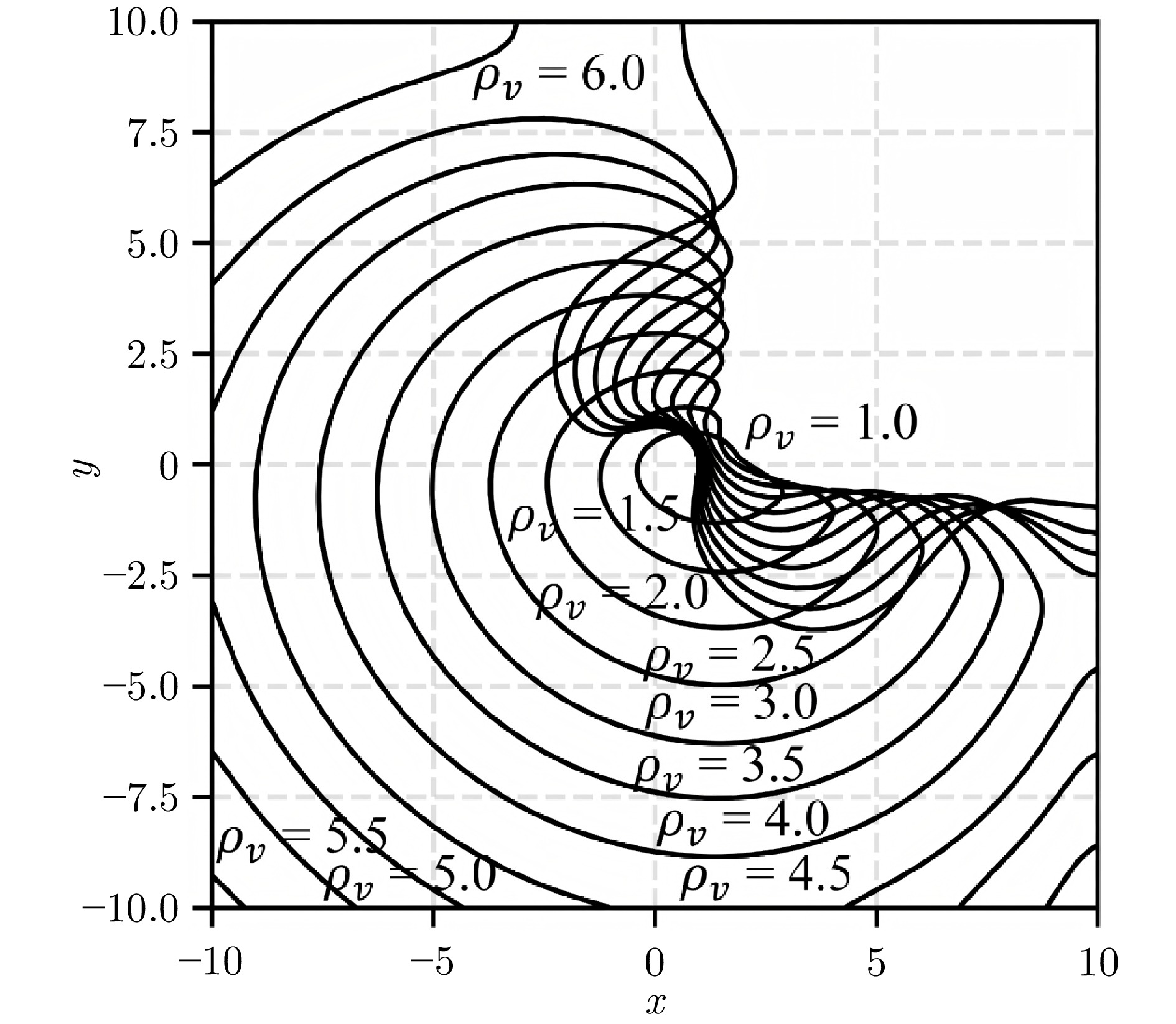
图 6 固定$ \tau=3 $、$ z=1 $、$ \alpha=\pi/4 $时, 不同速度比对应的$ x $-$ y $平面零水平集轮廓
Fig. 6 Zero level set contours on the $ x $-$ y $ plane for different speed ratios with fixed $ \tau=3 $, $ z=1 $, and $ \alpha=\pi/4 $
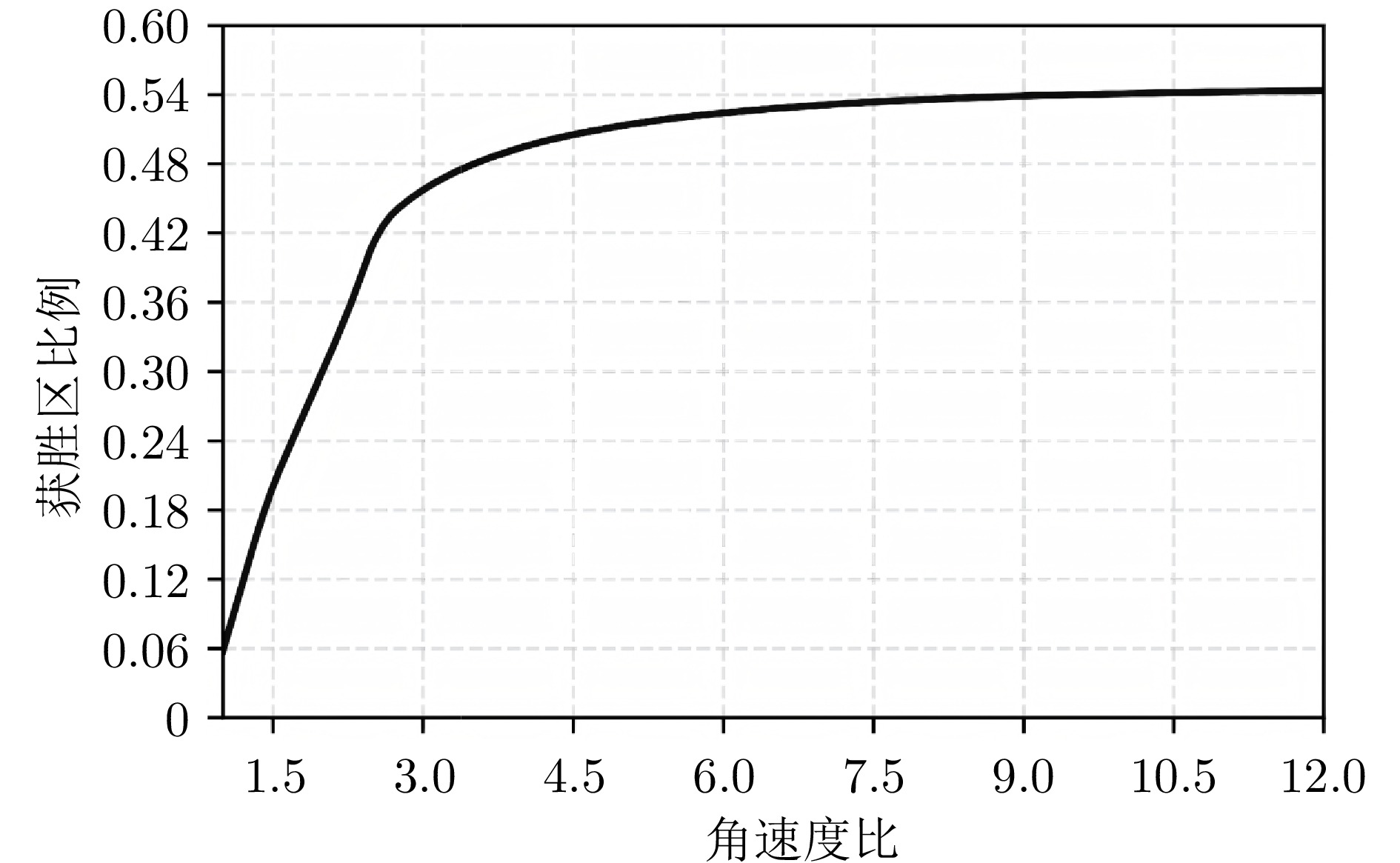
图 7 终端总体获胜区比例随角速度比的变化
Fig. 7 Variation of the overall terminal winning region proportion with the angular speed ratio
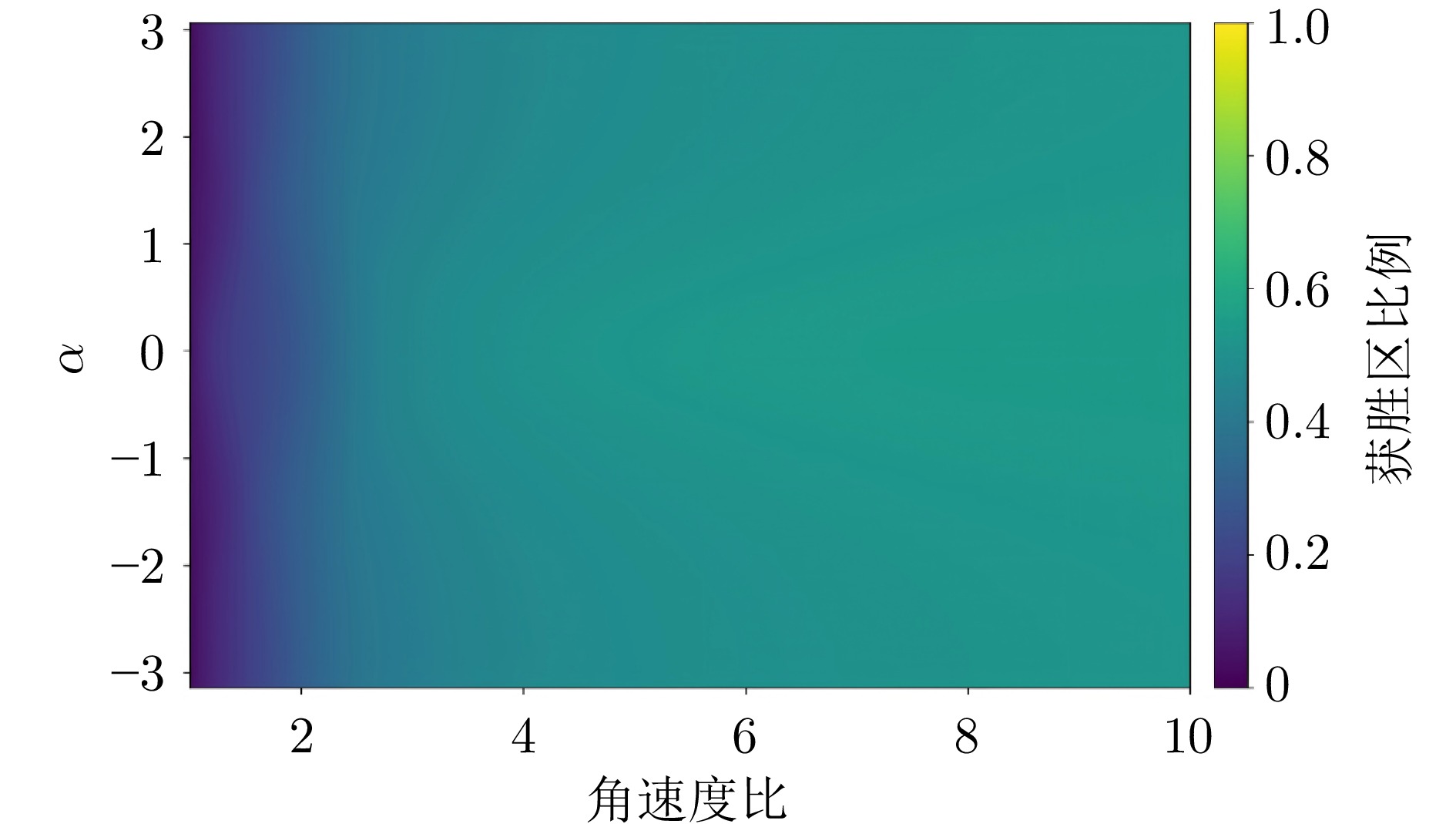
图 8 终端获胜区比例随角速度比与相对航向角$ \alpha $的联合变化热力图
Fig. 8 Heatmap of the joint variation in the terminal winning region proportion with the angular speed ratio and the relative heading angle $ \alpha $
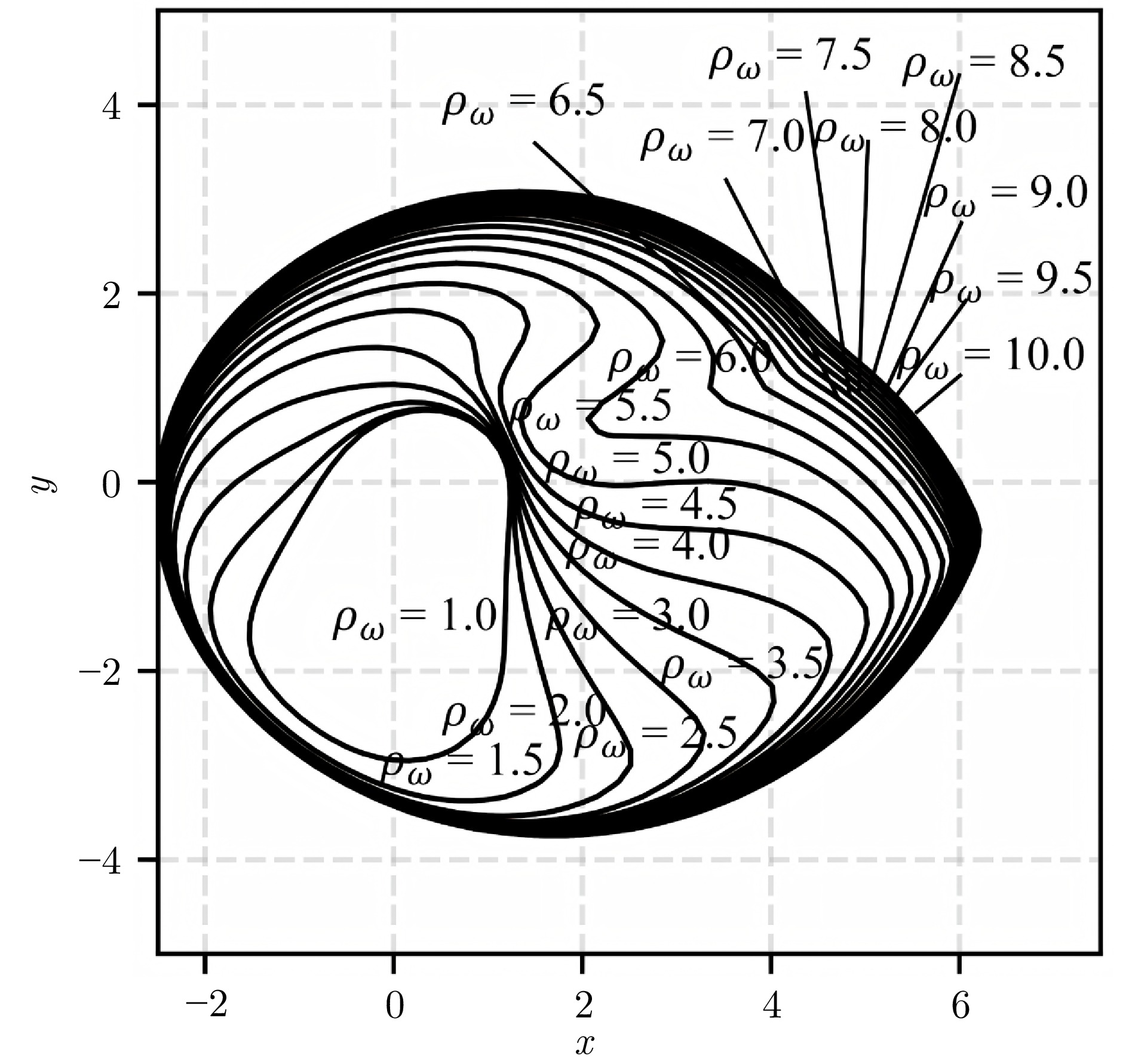
图 9 固定$ \tau=3 $、$ z=1 $、$ \alpha=\pi/4 $时, 不同角速度比对应的$ x $-$ y $平面零水平集轮廓
Fig. 9 Zero level set contours on the $ x $-$ y $ plane for different angular speed ratios with fixed $ \tau=3 $, $ z=1 $, and $ \alpha=\pi/4 $
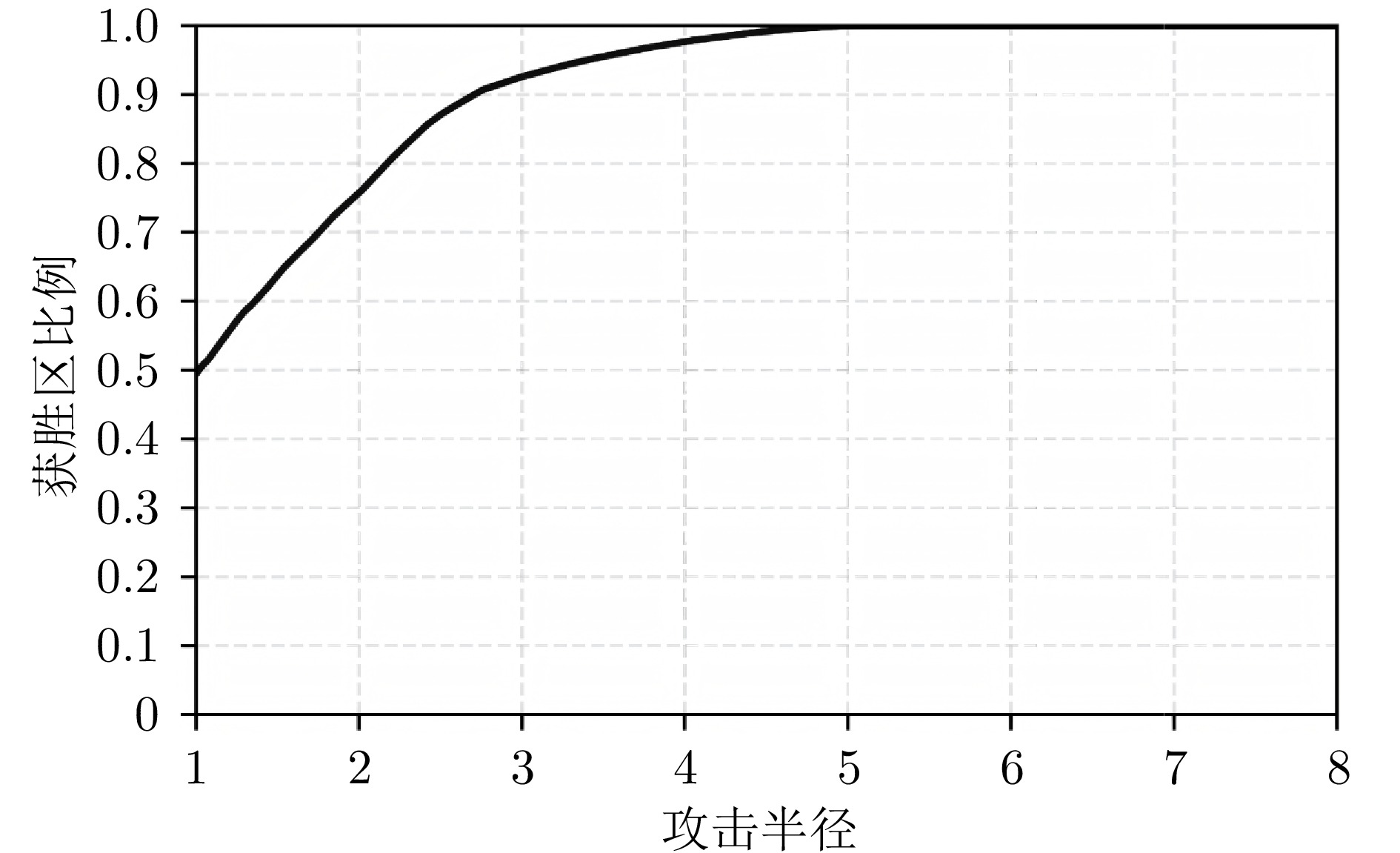
图 10 终端总体获胜区比例随攻击半径$ l $的变化
Fig. 10 Variation of the overall terminal winning region proportion with the attack radius $ l $
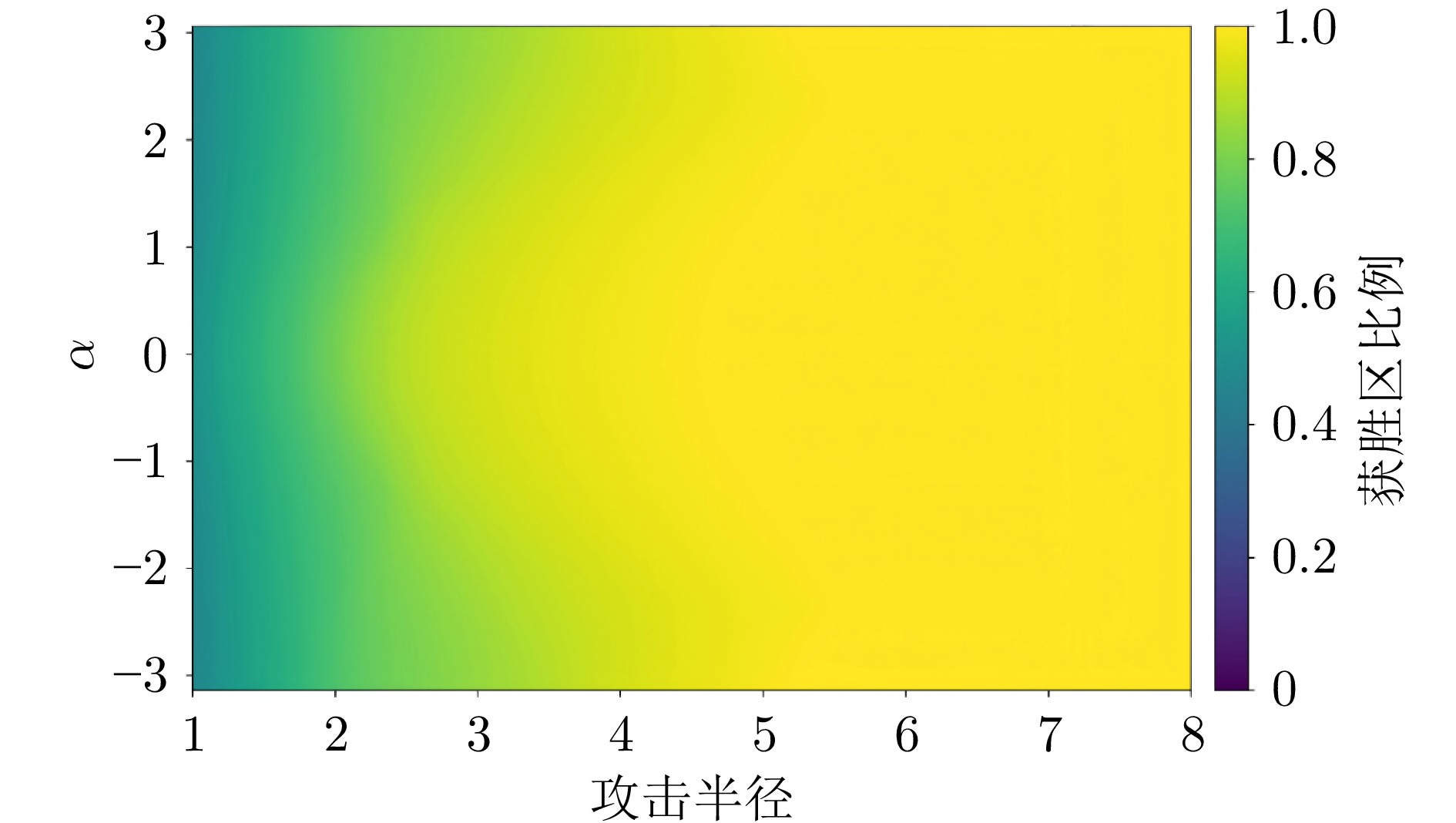
图 11 终端获胜区比例随攻击半径与相对航向角$ \alpha $的联合变化热力图
Fig. 11 Heatmap of the joint variation in the terminal winning region proportion with the attack radius and the relative heading angle $ \alpha $
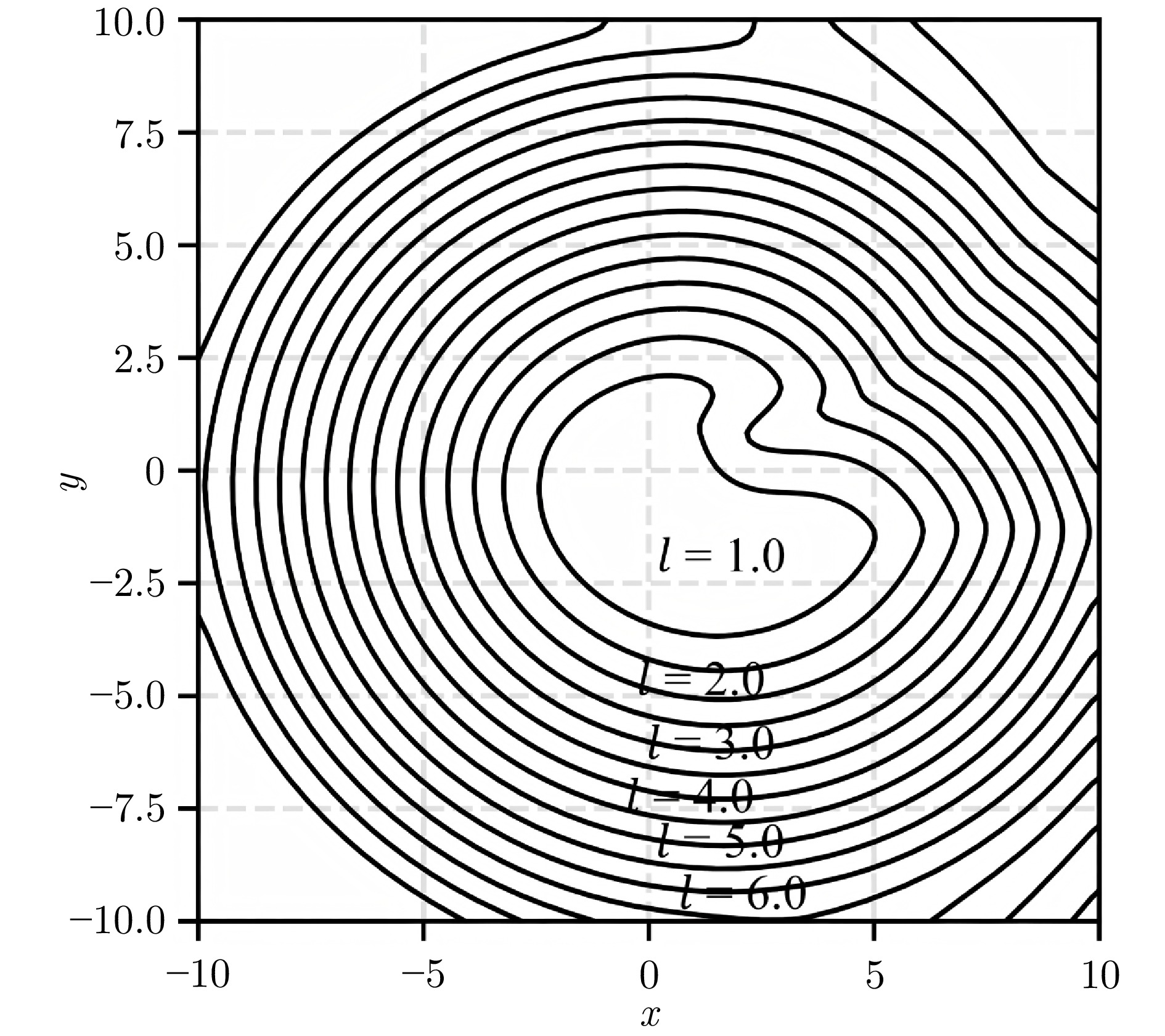
图 12 固定$ \tau=3 $、$ z=1 $、$ \alpha=\pi/4 $时, 不同攻击半径对应的$ x $-$ y $平面零水平集轮廓
Fig. 12 Zero level set contours on the $ x $-$ y $ plane for different attack radii with fixed $ \tau=3 $, $ z=1 $, and $ \alpha=\pi/4 $
表 1 原始模型与平滑模型获胜区差异指标
Table 1 Difference metrics between the winning regions of the original and smooth models
指标 数值 四维获胜区比例(原始模型) $0.526\,\;581$ 四维获胜区比例(平滑模型) $0.482\,\;500$ 四维获胜区比例差 $0.044\,\;081$ 四维交并比 $0.833\,\;958$ 固定切片交并比 $0.843\,\;700$ 二维零水平集平均对称距离 $0.723\,\;710$  下载: 导出CSV
表 2 代表性阈值下的敏感层驻留统计
Table 2 Residence statistics of sensitive layers under representative thresholds
统计对象 均值 中位数 $95\%$分位 边界敏感层驻留比例 $4.08\%$ $3.00\%$ $10.10\%$ 归一化切换层驻留比例 $66.89\%$ $72.75\%$ $100.00\%$ 交集敏感层驻留比例 $2.75\%$ $2.40\%$ $8.30\%$ 交集进入次数 $1.41$ $1.00$ $4.00$
下载: 导出CSV
-
[1] Chung T H, Hollinger G A, Isler V. Search and pursuit-evasion in mobile robotics: A survey. Autonomous Robots, 2011, 31(4): 299−316 doi: 10.1007/s10514-011-9241-4 [2] Duan H B, Liu S Q. Unmanned air/ground vehicles heterogeneous cooperative techniques: Current status and prospects. Science China Technological Sciences, 2010, 53(5): 1349−1355 doi: 10.1007/s11431-010-0122-4 [3] Munasinghe I, Perera A, Deo R C. A comprehensive review of UAV-UGV collaboration: Advancements and challenges. Journal of Sensor and Actuator Networks, 2024, 13(6): Article No. 81 doi: 10.3390/jsan13060081 [4] Waslander S L. Unmanned aerial and ground vehicle teams: Recent work and open problems. Autonomous Control Systems and Vehicles. Tokyo: Springer, 2013. 21–36 [5] 迟嵩禹, 李帅, 王晨, 谢广明. 追逃博弈问题研究综述. 自动化学报, 2025, 51(4): 705−726 doi: 10.16383/j.aas.c240396Chi Song-Yu, Li Shuai, Wang Chen, Xie Guang-Ming. A review of research on pursuit-evasion games. Acta Automatica Sinica, 2025, 51(4): 705−726 doi: 10.16383/j.aas.c240396 [6] 周萌, 李建宇, 王昶, 王晶, 王力. 多机器人协同围捕方法综述. 自动化学报, 2024, 50(12): 2325−2358 doi: 10.16383/j.aas.c240114Zhou Meng, Li Jian-Yu, Wang Chang, Wang Jing, Wang Li. Multi-robot cooperative hunting: A survey. Acta Automatica Sinica, 2024, 50(12): 2325−2358 doi: 10.16383/j.aas.c240114 [7] Segal A, Miloh T. Barrier strategies and capture criteria in a 3D pursuit-evasion differential game. Optimal Control Applications and Methods, 1995, 16(5): 321−340 doi: 10.1002/j.1099-1514.1995.tb00024.x [8] 于飞, 李擎, 原鑫. 无人战车追逃定性微分对策中界栅的确定. 现代电子技术, 2018, 41(15): 161−164 doi: 10.16652/j.issn.1004-373x.2018.15.036Yu Fei, Li Qing, Yuan Xin. Determination of barrier in pursuit-evasion qualitative differential game of unmanned combat vehicle. Modern Electronics Technique, 2018, 41(15): 161−164 doi: 10.16652/j.issn.1004-373x.2018.15.036 [9] Bu S, Liang L, Wang Z, Wang Y. Qualitative analysis of visibility-based game with constrained attack range. In: Proceedings of the 14th Asian Control Conference. Dalian, China: IEEE, 2024. 709–714 [10] 陈曦, 杨迪, 牛康, 李佳讯, 于剑桥. 带有时间与探测约束的到达-回避博弈. 航空学报, 2023, 44(17): Article No. 328215 doi: 10.7527/S1000-6893.2022.28215Chen Xi, Yang Di, Niu Kang, Li Jia-Xun, Yu Jian-Qiao. Reach-avoid game with time limit and detection range. Acta Aeronautica et Astronautica Sinica, 2023, 44(17): Article No. 328215 doi: 10.7527/S1000-6893.2022.28215 [11] Zha W, Chen J, Peng Z, Gu D. Construction of barrier in a fishing game with point capture. IEEE Transactions on Cybernetics, 2017, 47(6): 1409−1422 doi: 10.1109/TCYB.2016.2546381 [12] Garcia E, Casbeer D W, Pachter M. The complete differential game of active target defense. Journal of Optimization Theory and Applications, 2021, 191: 675−699 doi: 10.1007/s10957-021-01816-z [13] 张泽君, 王恩美, 陈泽帅, 李晨龙, 章健淳, 余翔. 考虑测量误差的高超声速飞行器抗干扰追逃博弈. 航空学报, 2026, 47(9): Article No. 533305 doi: 10.7527/S1000-6893.2026.33305Zhang Ze-Jun, Wang En-Mei, Chen Ze-Shuai, Li Chen-Long, Zhang Jian-Chun, Yu Xiang. Anti-disturbance pursuit-evasion game for hypersonic vehicles under measurement errors. Acta Aeronautica et Astronautica Sinica, 2026, 47(9): Article No. 533305 doi: 10.7527/S1000-6893.2026.33305 [14] Li S, Wang C, Xie G. Pursuit-evasion differential games of players with different speeds in spaces of different dimensions. In: Proceedings of the 2022 American Control Conference. Atlanta, GA, USA: IEEE, 2022. 1299–1304 [15] Chen N, Li L, Mao W. Equilibrium strategy of the pursuit-evasion game in three-dimensional space. IEEE/CAA Journal of Automatica Sinica, 2024, 11(2): 446−458 doi: 10.1109/JAS.2023.123996 [16] Fang X, Cheng C, Xie L. 3-D multi-player pursuit-evasion game with a faster evader. In: Proceedings of the 39th Chinese Control Conference. Shenyang, China: IEEE, 2020. 118–123 [17] 李兆航, 温昶煊, 乔栋, 庞博. 基于可达集的航天器多对一轨道博弈几何求解. 航空学报, 2024, 45(S1): Article No. 730803Li Zhao-Hang, Wen Chang-Xuan, Qiao Dong, Pang Bo. Geometrical solution of multi-pursuer/one-evader orbital pursuit-evasion game based on reachable set theory. Acta Aeronautica et Astronautica Sinica, 2024, 45(S1): Article No. 730803 [18] von Moll A, Garcia E, Casbeer D W, Suresh M, Swar S C. Multiple-pursuer, single-evader border defense differential game. Journal of Aerospace Information Systems, 2020, 17(8): 407−416 doi: 10.2514/1.I010740 [19] Yang K, Shen A, Xu N W, Deng F, Lu M B, Chen C. A review of reinforcement learning approaches for pursuit-evasion games. Chinese Journal of Aeronautics, 2026, 39(6): Article No. 103940 doi: 10.1016/j.cja.2025.103940 [20] 李艺春, 刘泽娇, 洪艺天, 王继超, 王健瑞, 李毅, 等. 基于多智能体强化学习的博弈综述. 自动化学报, 2025, 51(3): 540−558 doi: 10.16383/j.aas.c240478Li Yi-Chun, Liu Ze-Jiao, Hong Yi-Tian, Wang Ji-Chao, Wang Jian-Rui, Li Yi, et al. Multi-agent reinforcement learning based game: A survey. Acta Automatica Sinica, 2025, 51(3): 540−558 doi: 10.16383/j.aas.c240478 [21] Wang Y D, Dong L, Sun C Y. Cooperative control for multi-player pursuit-evasion games with reinforcement learning. Neurocomputing, 2020, 412: 101−114 doi: 10.1016/j.neucom.2020.06.031 [22] Wan K F, Wu D W, Zhai Y W, Li B, Gao X G, Hu Z J. An improved approach towards multi-agent pursuit-evasion game decision-making using deep reinforcement learning. Entropy, 2021, 23(11): Article No. 1433 doi: 10.3390/e23111433 [23] Zhao L R, Zhang Y L, Dang Z H. PRD-MADDPG: An efficient learning-based algorithm for orbital pursuit-evasion game with impulsive maneuvers. Advances in Space Research, 2023, 72(2): 211−230 doi: 10.1016/j.asr.2023.03.014 [24] Mitchell I M, Bayen A M, Tomlin C J. A time-dependent Hamilton-Jacobi formulation of reachable sets for continuous dynamic games. IEEE Transactions on Automatic Control, 2005, 50(7): 947−957 doi: 10.1109/TAC.2005.851439 [25] Aubin J P. Viability kernels and capture basins of sets under differential inclusions. SIAM Journal on Control and Optimization, 2001, 40(3): 853−881 doi: 10.1137/S036301290036968X [26] Herbert S L, Bansal S, Ghosh S, Tomlin C J. Reachability-based safety guarantees using efficient initializations. In: Proceedings of the 58th IEEE Conference on Decision and Control. Nice, France: IEEE, 2019. 4810–4816 [27] Meng T, Liu S, Fung S W, Osher S. Recent advances in numerical solutions for Hamilton-Jacobi PDEs. Communications on Applied Mathematics and Computation, DOI: 10.1007/s42967-026-00570-1 [28] Bryson S, Levy D. Mapped WENO and weighted power ENO reconstructions in semi-discrete central schemes for Hamilton-Jacobi equations. Applied Numerical Mathematics, 2006, 56(9): 1211−1224 doi: 10.1016/j.apnum.2006.03.005 -

 下载:
下载:

计量
- 文章访问数: 11
- HTML全文浏览量: 11
- 被引次数: 0
