


Dynamic Event-Triggered Distributed Average Tracking for Cluster Unmanned Aerial Vehicles in Low-Altitude Countermeasures
-
摘要: 摘要应涵盖全文. 摘要内容包括研究目的、方法、结果等, 注意不是标题的罗列, 能独立成文, 不能出现公式号和文献号. 英文摘要的书写, 请按英语习惯, 无文法及拼写错误, 用词准确. 无人机技术的普及与滥用带来严峻空防挑战, 民用无人机“黑飞”威胁公共安全与基础设施, 军用无人机及蜂群作战突破传统防空体系, 单一防御手段已难以应对, 提升对非合作无人机的协同跟踪与处置能力迫在眉睫. 飞网协同围捕技术作为无人机反制核心方案之一, 要求多无人机协同估计目标轨迹中心并自主编队完成捕获, 而分布式平均跟踪是实现该目标的关键理论. 本文针对此问题, 提出无需相对速度测量和变量初始化的集群无人机系统动态事件触发分布式平均跟踪算法; 理论分析证实, 该算法可实现分布式平均跟踪目标且闭环系统不存在芝诺现象; 最后以集群无人机跟踪非合作无人机集群为实例, 验证了算法的有效性与实用性.Abstract: The popularization and abuse of unmanned aerial vehicle (UAV) technology have brought severe challenges to air defense. Civil UAVs with unauthorized flights threaten public security and infrastructure, while military UAVs and swarm combat have broken through the traditional air defense system, making a single defense method insufficient to deal with such threats. Therefore, it is extremely urgent to enhance the collaborative tracking and handling capabilities for non-cooperative UAVs. As one of the core solutions for UAV countermeasure, the cooperative encirclement technology based on flying net requires multiple UAVs to collaboratively estimate the trajectory center of the target and form teams autonomously to achieve capture, and distributed average tracking (DAT) is the key theory to realize this goal. Aiming at this problem, this paper proposes a dynamic event-triggered DAT algorithm for cluster UAV systems without relative velocity measurement and variable initialization. Theoretical analysis verifies that the proposed algorithm can achieve the goal of DAT and there is no Zeno behavior in the closed-loop system. Finally, the effectiveness and practicability of the algorithm are verified by an example of cluster UAVs tracking non-cooperative UAV clusters.
-
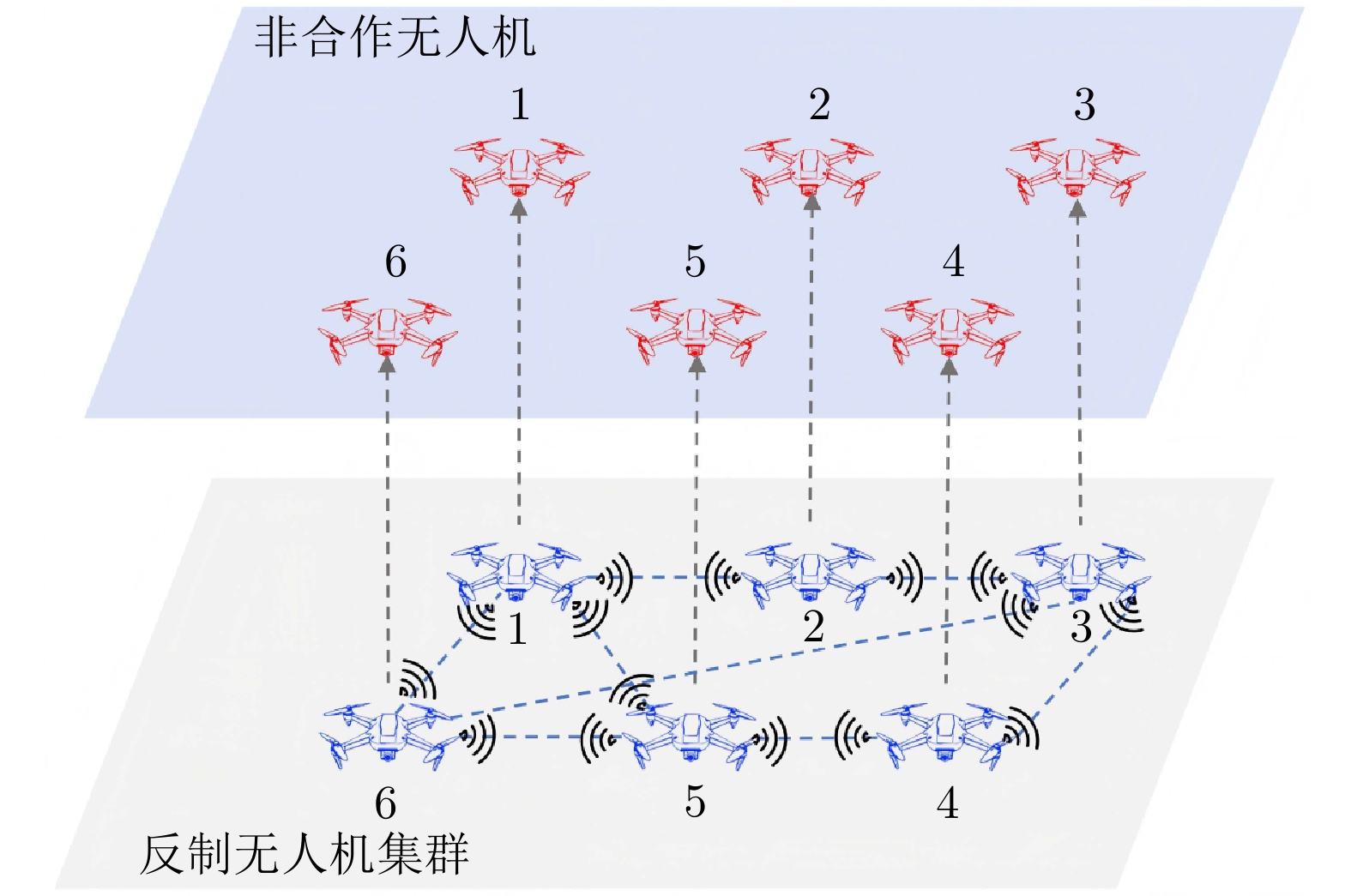
图 1 无人机集群系统目标观测及通信关系示意图
Fig. 1 Schematic diagram of the target observation and communication relationship in the UAV cluster system
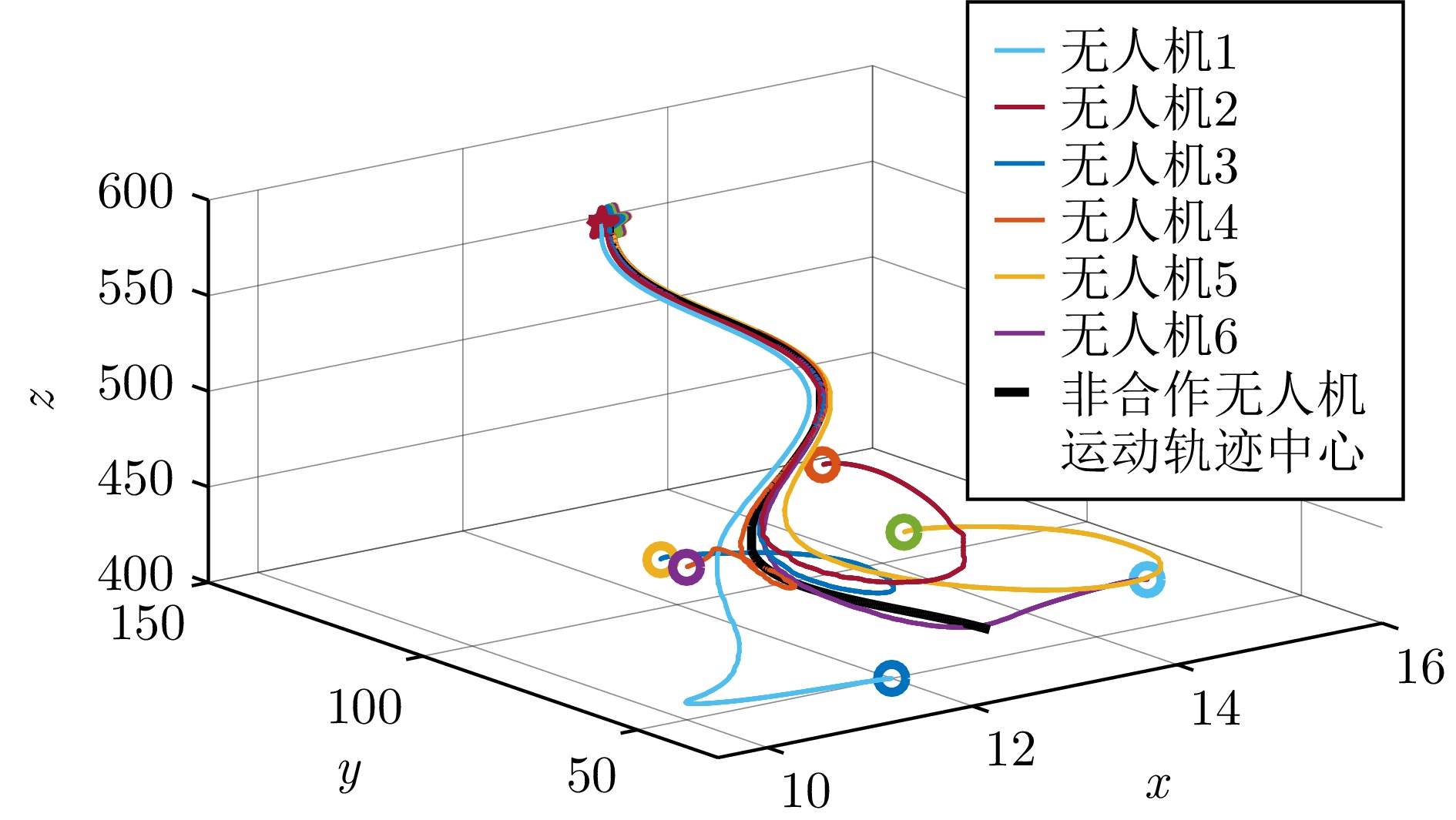
图 2 在示例1参数下,每架无人机的运动轨迹和非合作无人机的平均运动轨迹
Fig. 2 Motion trajectories of each UAV and the average motion trajectory of the non-cooperative UAVs under the parameters in Example 1
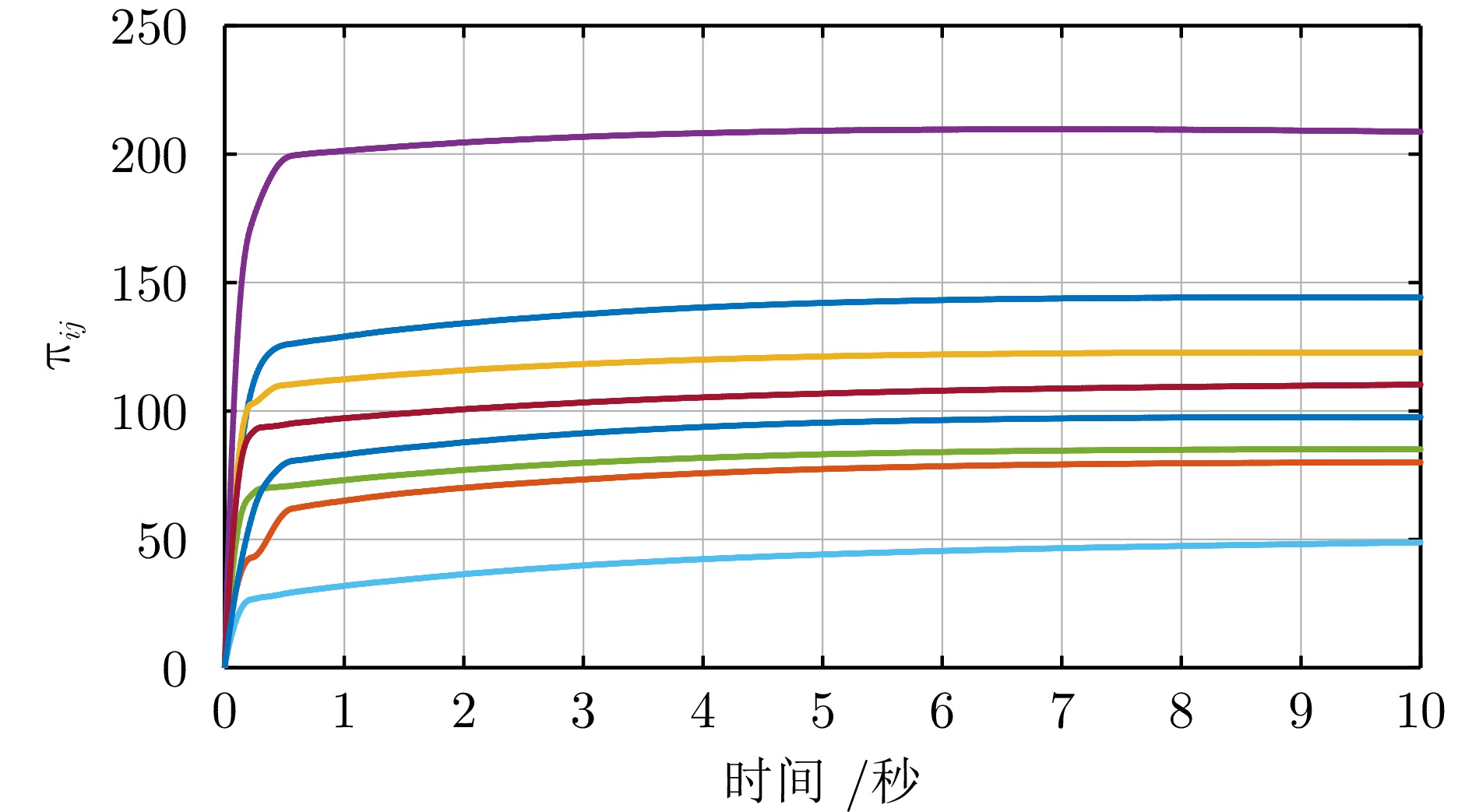
图 4 在示例1参数下, 动态耦合增益$\pi_{ij}$的状态演化
Fig. 4 State evolution of the dynamic coupling gain $\pi_{ij}$ under the parameter in Example 1
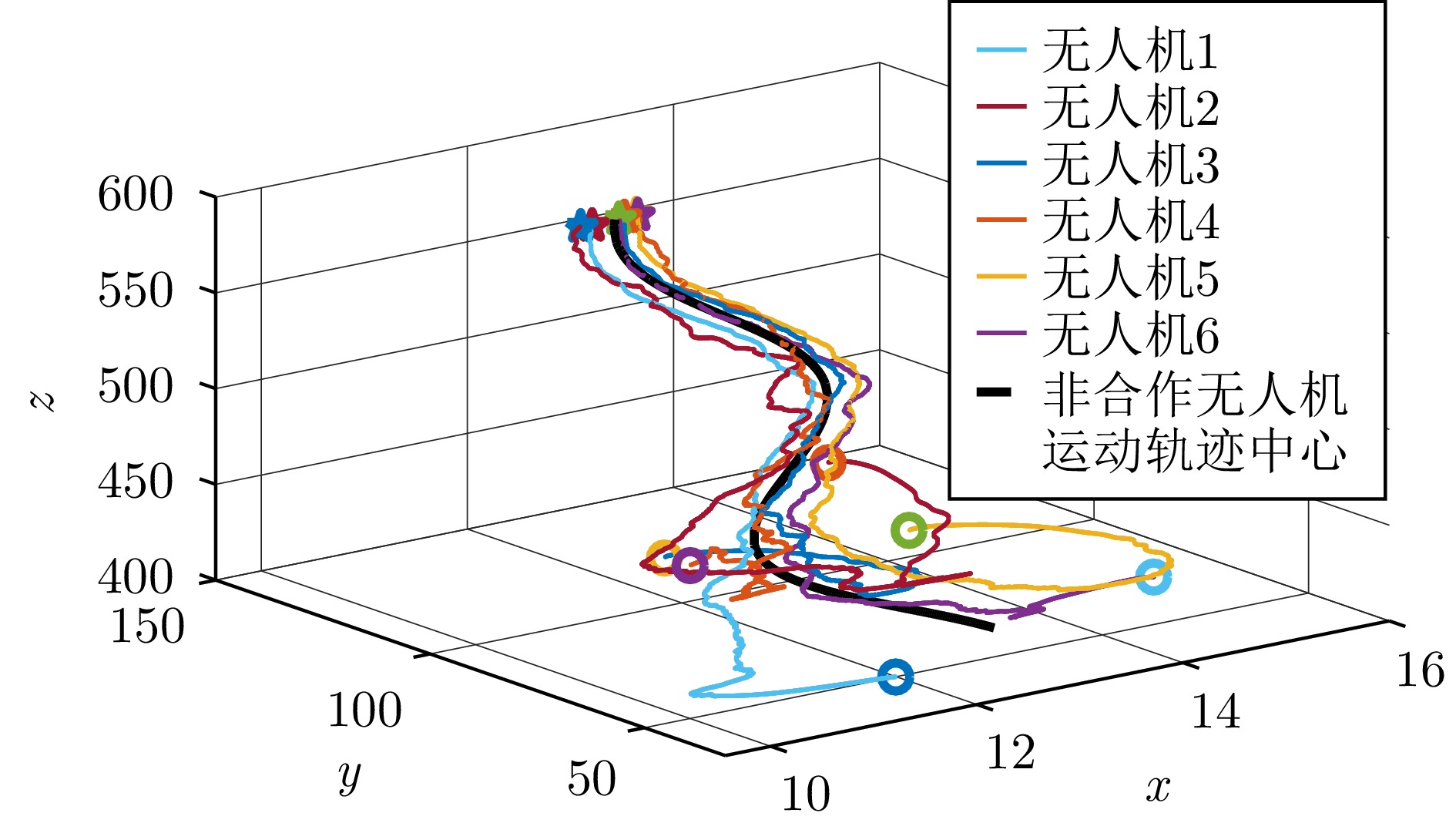
图 5 在示例2参数下,每架无人机的运动轨迹和非合作无人机的平均运动轨迹
Fig. 5 Motion trajectories of each UAV and the average motion trajectory of the non-cooperative UAVs under the parameters in Example 2
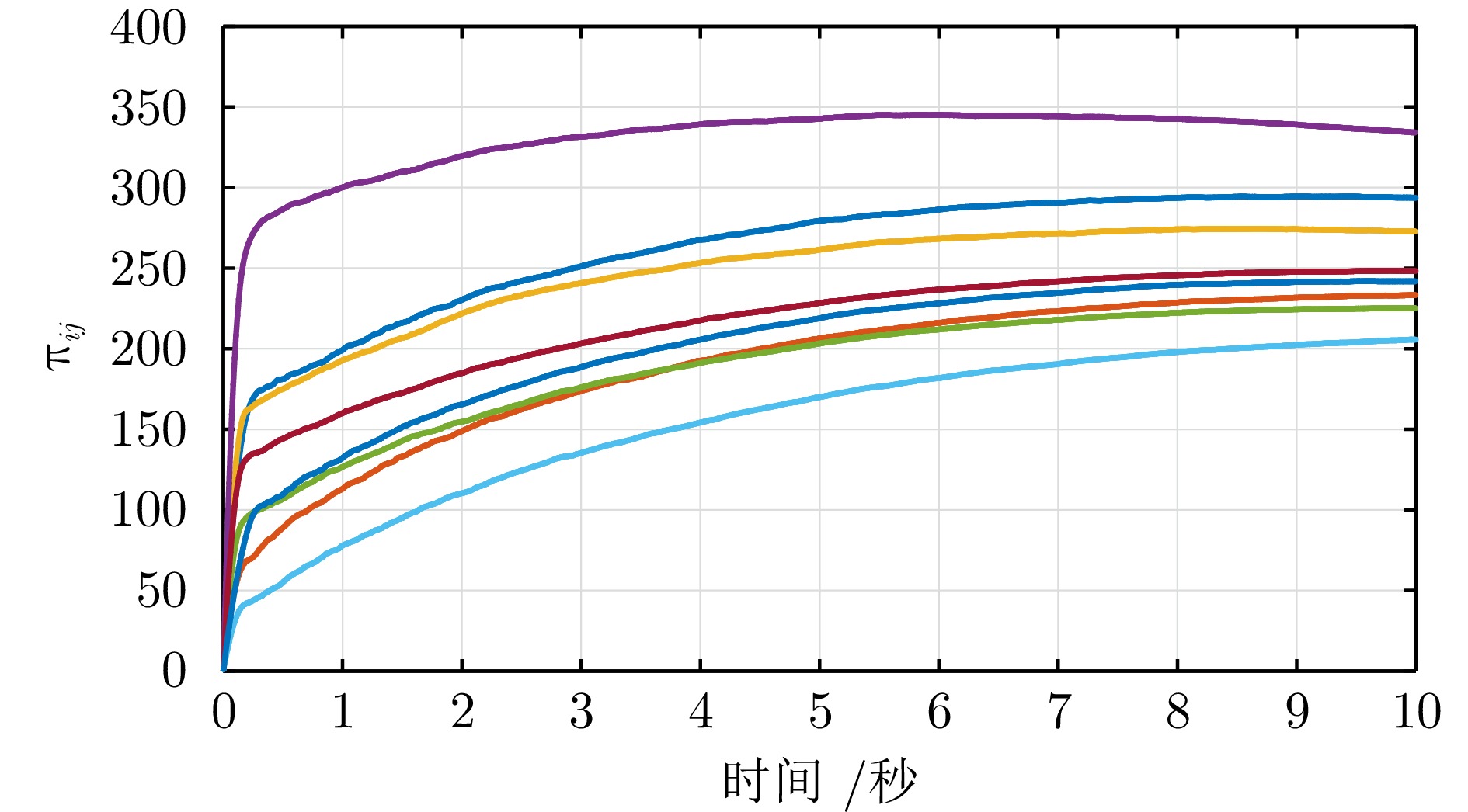
图 7 在示例2参数下, 动态耦合增益$\pi_{ij}$的状态演化
Fig. 7 State evolution of the dynamic coupling gain $\pi_{ij}$ under the parameter in Example 2
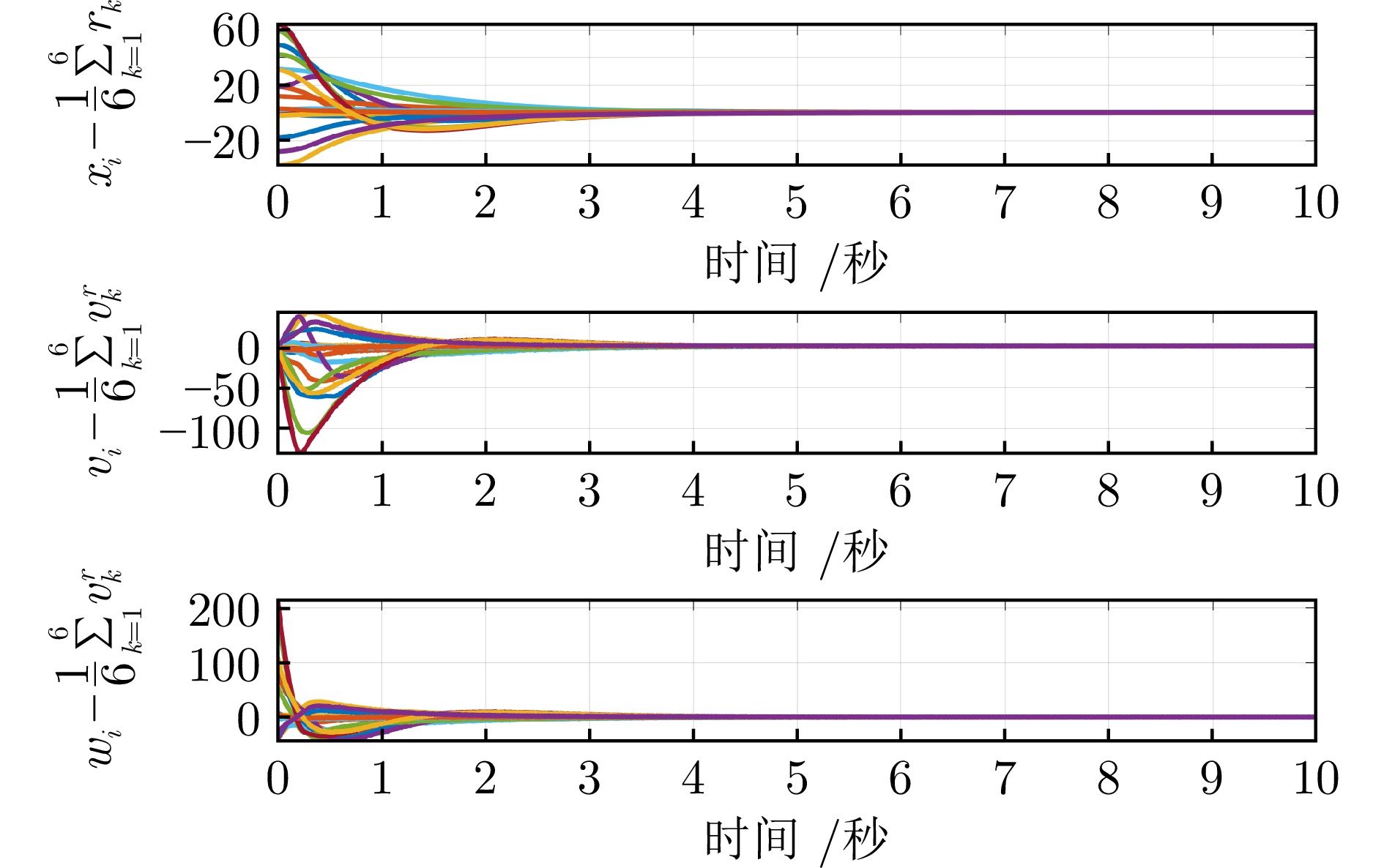
图 3 在示例1参数下, 无人机位置和速度的跟踪误差
Fig. 3 Tracking errors of the position and velocity of each UAV under the parameters in Example 1
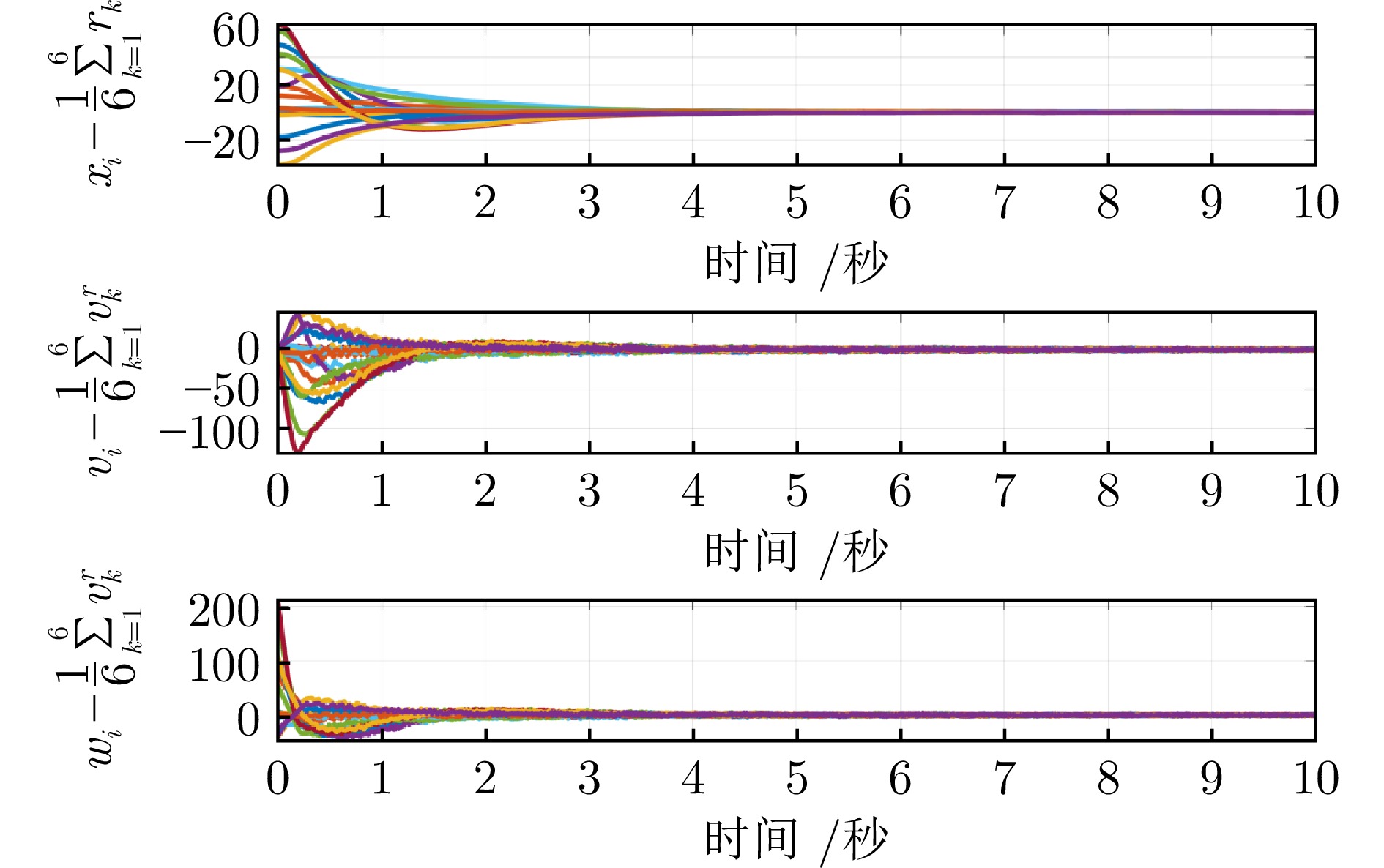
图 6 在示例2参数下, 无人机位置和速度的跟踪误差
Fig. 6 Tracking errors of the position and velocity of each UAV under the parameters in Example 2
表 1 不同参数选择下, 每架无人机的通信次数
Table 1 The number of communications of each UAV under different parameter selections
无人机 示例1 示例2 1 3729 1171 2 2537 581 3 4579 1239 4 5143 741 5 6403 1399 6 3293 983  下载: 导出CSV
-
[1] Zheng C L, Mi Y Z, Guo H Q, Chen H B, Zhao S Y. Vision-based cooperative MAV-capturing-MAV. In: Proceedings of the 2025 IEEE/RSJ International Conference on Intelligent Robots and Systems (IROS), Hangzhou, China: IEEE, 2025. 21227-21234 [2] Zheng C L, Mi Y Z, Guo H Q, Chen H B, Lin Z Y, Zhao S Y. Optimal spatial–temporal triangulation for bearing-only cooperative motion estimation. Automatica, 2025, 175: 112216 doi: 10.1016/j.automatica.2025.112216 [3] Wen G H, Fu J J, Wang B W, Wang X D, Shen H. Robust formation tracking of ASVs with nonconservative collision avoidance: A control barrier function-based approach. IEEE Transactions on Industrial Electronics, DOI: 10.1109/TIE.2025.3649849 [4] Liu F, Yuan S, Nguyen T M, Meng W, Xie L H. Aerial target encirclement and interception with noisy range observations. Automatica, 2026, 183: 112600 doi: 10.1016/j.automatica.2025.112600 [5] Kia S S, Scoy B V, Cortés J, Freeman R A, Lynch K M, Martinez S. Tutorial on dynamic average consensus: The problem, its applications, and the algorithms. IEEE Control Systems Magazine, 2019, 39(3): 40−72 doi: 10.1109/MCS.2019.2900783 [6] Zhu M, Martínez S. Discrete-time dynamic average consensus. Automatica, 2010, 46(2): 322−329 doi: 10.1016/j.automatica.2009.10.021 [7] Montijano E, Montijano J I, Sagues C, Martínez S. Robust discrete time dynamic average consensus. Automatica, 2014, 50(12): 3131−3138 doi: 10.1016/j.automatica.2014.10.005 [8] Nosrati S, Shafiee M, Menhaj M B. Dynamic average consensus via nonlinear protocols. Automatica, 2012, 48(9): 2262−2270 doi: 10.1016/j.automatica.2012.06.031 [9] Kia S S, Cortés J, Martínez S. Dynamic average consensus under limited control authority and privacy requirements. International Journal of Robust and Nonlinear Control, 2015, 25(13): 1941−1966 doi: 10.1002/rnc.3178 [10] Kia S S, Cortés J, Martínez S. Distributed event-triggered communication for dynamic average consensus in networked systems. Automatica, 2015, 59: 112−119 doi: 10.1016/j.automatica.2015.06.011 [11] George J, Freeman R A. Robust dynamic average consensus algorithms. IEEE Transactions on Automatic Control, 2019, 64(11): 4615−4622 doi: 10.1109/TAC.2019.2901819 [12] Spanos D P, Olfati-Saber R, Murray R M. Dynamic consensus on mobile networks. In: Proceedings of the 16th IFAC World Congress. Prague, Czech Republic: Elsevier, 2005. 1−6 [13] Freeman R A, Yang P, Lynch K M. Stability and convergence properties of dynamic average consensus estimators. In: Proceedings of the 45th IEEE Conference on Decision and Control (CDC). San Diego, CA, USA: IEEE, 2006. 338−343 [14] Bai H, Freeman R A, Lynch K M. Robust dynamic average consensus of time-varying inputs. In: Proceedings of the 49th IEEE Conference on Decision and Control (CDC). Atlanta, GA, USA: IEEE, 2010. 3104−3109 [15] Chen F, Cao Y, Ren W. Distributed average tracking of multiple time-varying reference signals with bounded derivatives. IEEE Transactions on Automatic Control, 2012, 57(12): 3169−3174 doi: 10.1109/TAC.2012.2199176 [16] Cao R H, Liu Y F, Zhao Y, Wu D O, Chen G R. Dynamic average consensus over strongly connected digraphs based on integral surplus. IEEE Transactions on Automatic Control, 2025, 70(12): 8329−8336 doi: 10.1109/TAC.2025.3584699 [17] Cao R H, Zhao Y, Liu Y F, Huang P F. Privacy-protected and prescribed-time dynamic average consensus over directed networks: An integral surplus-based approach. IEEE Transactions on Automatic Control, 2025, 70(12): 7968−7983 doi: 10.1109/TAC.2025.3578246 [18] Cao R H, Zhao Y. Distributed average tracking over directed communication networks: A nonsmooth surplus approach. IEEE Transactions on Automatic Control, 2026, 71(4): 2450−2465 doi: 10.1109/TAC.2025.3629024 [19] Chen F, Ren W, Lan W Y, Chen G R. Distributed average tracking for reference signals with bounded accelerations. IEEE Transactions on Automatic Control, 2015, 60(3): 863−869 doi: 10.1109/TAC.2014.2337451 [20] Ghapani S, Rahili S, Ren W. Distributed average tracking for second-order agents with nonlinear dynamics. In: Proceedings of the 2016 American Control Conference (ACC). Boston, MA, USA: IEEE, 2016. 4636-4641 [21] Sheida G, Salar R, Ren W. Distributed average tracking of physical second-order agents with heterogeneous unknown nonlinear dynamics without constraint on input signals. IEEE Transactions on Automatic Control, 2019, 64(3): 1178−1184 doi: 10.1109/TAC.2018.2840452 [22] Ghapani S, Ren W, Chen F, Song Y D. Distributed average tracking for double-integrator multi-agent systems with reduced requirement on velocity measurements. Automatica, 2017, 81: 1−7 doi: 10.1016/j.automatica.2017.02.043 [23] Hong H F, Wen G H, Yu X H, Yu W W. Robust distributed average tracking for disturbed second-order multiagent systems. IEEE Transactions on Systems, Man, and Cybernetics: Systems, 2022, 52(5): 3187−3199 doi: 10.1109/TSMC.2021.3064152 [24] Zhao Y, Liu Y F, Wen G H, Huang T W. Finite-time distributed average tracking for second-order nonlinear systems. IEEE Transactions on Neural Networks and Learning Systems, 2019, 30(6): 1780−1789 doi: 10.1109/TNNLS.2018.2873676 [25] Zhao Y, Liu Y F, Li Z K, Duan Z S. Distributed average tracking for multiple signals generated by linear dynamical systems: An edge-based framework. Automatica, 2017, 75: 158−166 doi: 10.1016/j.automatica.2016.09.005 [26] Wen G H, Yu X H, Fu J J, Wang H, Yu W W. Fast distributed average tracking in multi-agent networks: The case with general linear agent dynamics. IEEE Transactions on Control of Network Systems, 2020, 8(2): 997−1009 [27] Zhao Y, Liu Y F, Wen G H, Yu X H, Chen G R. Distributed average tracking for Lipschitz-type of nonlinear dynamical systems. IEEE Transactions on Cybernetics, 2019, 49(12): 4140−4152 doi: 10.1109/TCYB.2018.2859352 [28] Chen F, Feng G, Liu L, Ren W. Distributed average tracking of networked Euler-Lagrange systems. IEEE Transactions on Automatic Control, 2015, 60(2): 547−552 doi: 10.1109/TAC.2014.2343111 [29] Zhao Y, Xian C X, Wen G H, Huang P F, Ren W. Design of distributed event-triggered average tracking algorithms for homogeneous and heterogeneous multiagent systems. IEEE Transactions on Automatic Control, 2022, 67(3): 1269−1284 doi: 10.1109/TAC.2021.3060714 [30] Chen F, Ren W. A connection between dynamic region-following formation control and distributed average tracking. IEEE Transactions on Cybernetics, 2017, 48(6): 1760−1772 doi: 10.1109/tcyb.2017.2714688 [31] Saim M, Ghapani S, Ren W, Munawar K, Al-Saggaf U M. Distributed average tracking in multi-agent coordination: Extensions and experiments. IEEE Systems Journal, 2018, 12(3): 2428−2436 doi: 10.1109/JSYST.2017.2685465 [32] Seyboth G S, Dimarogonas D V, Johansson K H. Event-based broadcasting for multi-agent average consensus. Automatica, 2013, 49(1): 245−252 doi: 10.1016/j.automatica.2012.08.042 [33] Ding Y, Ren W, Zhao Y. Robust distributed average tracking for double-integrator agents without velocity measurements under event-triggered communication. IEEE Transactions on Control of Network Systems, 2021, 8(2): 828−837 doi: 10.1109/TCNS.2020.3038844 [34] Xian C X, Zhao Y, Wu Z G, Wen G H, Pan J A. Event-triggered distributed average tracking control for Lipschitz-type nonlinear multiagent systems. IEEE Transactions on Cybernetics, 2023, 53(2): 779−792 doi: 10.1109/TCYB.2022.3159250 [35] Girard A. Dynamic triggering mechanisms for event-triggered control. IEEE Transactions on Automatic Control, 2015, 60(7): 1992−1997 doi: 10.1109/TAC.2014.2366855 [36] Yi X L, Liu K, Dimarogonas D V, Johansson K H. Dynamic event-triggered and self-triggered control for multi-agent systems. IEEE Transactions on Automatic Control, 2019, 64(8): 3300−3307 doi: 10.1109/TAC.2018.2874703 [37] Xu W Y, He W L, Ho D W, Kurths J. Fully distributed observer-based consensus protocol: Adaptive dynamic event-triggered schemes. Automatica, 2022, 139: 110188 doi: 10.1016/j.automatica.2022.110188 [38] 孙梦薇, 任璐, 刘剑, 孙长银. 切换拓扑下动态事件触发多智能体系统固定时间一致性. 自动化学报, 2023, 49(6): 1295−1305 doi: 10.16383/j.aas.c211123Sun M W, Ren L, Liu J, Sun C Y. Dynamic event-triggered fixed-time consensus control of multi-agent systems under switching topologies. Acta Automatica Sinica, 2023, 49(6): 1295−1305 doi: 10.16383/j.aas.c211123 [39] Xu T, Duan Z S, Wen G H, Sun Z Y. A novel dynamic event-triggered mechanism for dynamic average consensus. Automatica, 2024, 161: 111495 doi: 10.1016/j.automatica.2023.111495 [40] 范泉涌, 张乃宗, 唐勇, 许斌. 基于动态事件触发通信协议的多智能体系统自适应可靠控制. 自动化学报, 2024, 50(5): 924−936 doi: 10.16383/j.aas.c230766Fan Q Y, Zhang N Z, Tang Y, Xu B. Adaptive reliable control of multi-agent systems based on dynamic event-triggered communication protocol. Acta Automatica Sinica, 2024, 50(5): 924−936 doi: 10.16383/j.aas.c230766 [41] Shi X Y, Cheng Y H, Yin C, Dadras S, Huang X G. Design of fractional-order backstepping sliding mode control for quadrotor UAV. Asian Journal of Control, 2019, 21(1): 156−171 doi: 10.1002/asjc.1946 [42] Deplano D, Franceschelli M, Giua A. Dynamic min and maxconsensus and size estimation of anonymous multiagent networks. IEEE Transactions on Automatic Control, 2023, 68(1): 202−213 doi: 10.1109/TAC.2021.3135452 [43] Khalil H K. Nonlinear systems: 3rd ed. Upper Saddle River, NJ, USA: Prentice Hall, 2002 -

 下载:
下载:

计量
- 文章访问数: 108
- HTML全文浏览量: 86
- 被引次数: 0
