


TPT-Former-based study of critical node vulnerability and attack strategies in complex UAV swarms
-
摘要: 针对复杂无人机群易受通信干扰与节点摧毁影响的问题, 研究资源受限条件下的关键节点识别与攻击策略. 首先构建无人机群图模型, 模拟覆盖多种拓扑与运行状态的数据集, 并基于连通性与任务性能变化形成任务退化导向标注. 其次在拓扑先验与任务状态增强Transformer (Topology-Prior and Task-state enhanced Transformer, TPT-Former) 框架下融合拓扑先验与任务状态信息, 提出关键节点评估模型, 并采用加权回归损失提升预测精度. 最后在攻击数量与成本双约束下, 设计基于学习型关键性评分的贪心攻击策略, 并与度中心性、介数中心性及传统图注意力网络 (graph attention network, GAT) 策略对比. 结果表明, 所提方法在关键性预测与单位资源破坏效能方面优于对比方法, 可为无人机群抗毁性评估与拓扑加固提供参考.
-
关键词:
- 复杂无人机群 /
- 关键节点 /
- 图神经网络 /
- TPT-Former /
- 资源受限攻击
Abstract: To address the susceptibility of complex unmanned aerial vehicle (UAV) swarms to communication interference and node destruction, this study investigates critical node identification and attack strategies under resource constraints. First, we develop a graph-based representation of UAV swarms and generate a dataset via simulation spanning diverse topologies and operational states where task-degradation-oriented labels are assigned according to changes in network connectivity and mission performance. Second, within the proposed Topology-Prior and Task-state enhanced Transformer (TPT-Former) framework, we fuse topological priors with task-state information to build a critical-node evaluation model, and employ a weighted regression loss to improve the accuracy of criticality prediction. Finally, under joint constraints on the number of attacked nodes and the total attack cost, we design a greedy attack strategy guided by learned criticality scores and compare it with degree centrality, betweenness centrality, and conventional graph attention network (GAT) strategies. Experimental results show that the proposed approach outperforms the baselines in both criticality prediction and damage efficiency per unit resource, providing practical support for UAV-swarm survivability assessment and topology reinforcement.-
Key words:
- complex UAV swarm /
- critical node /
- graph neural network /
- TPT-Former /
- resource-constrained attack
-
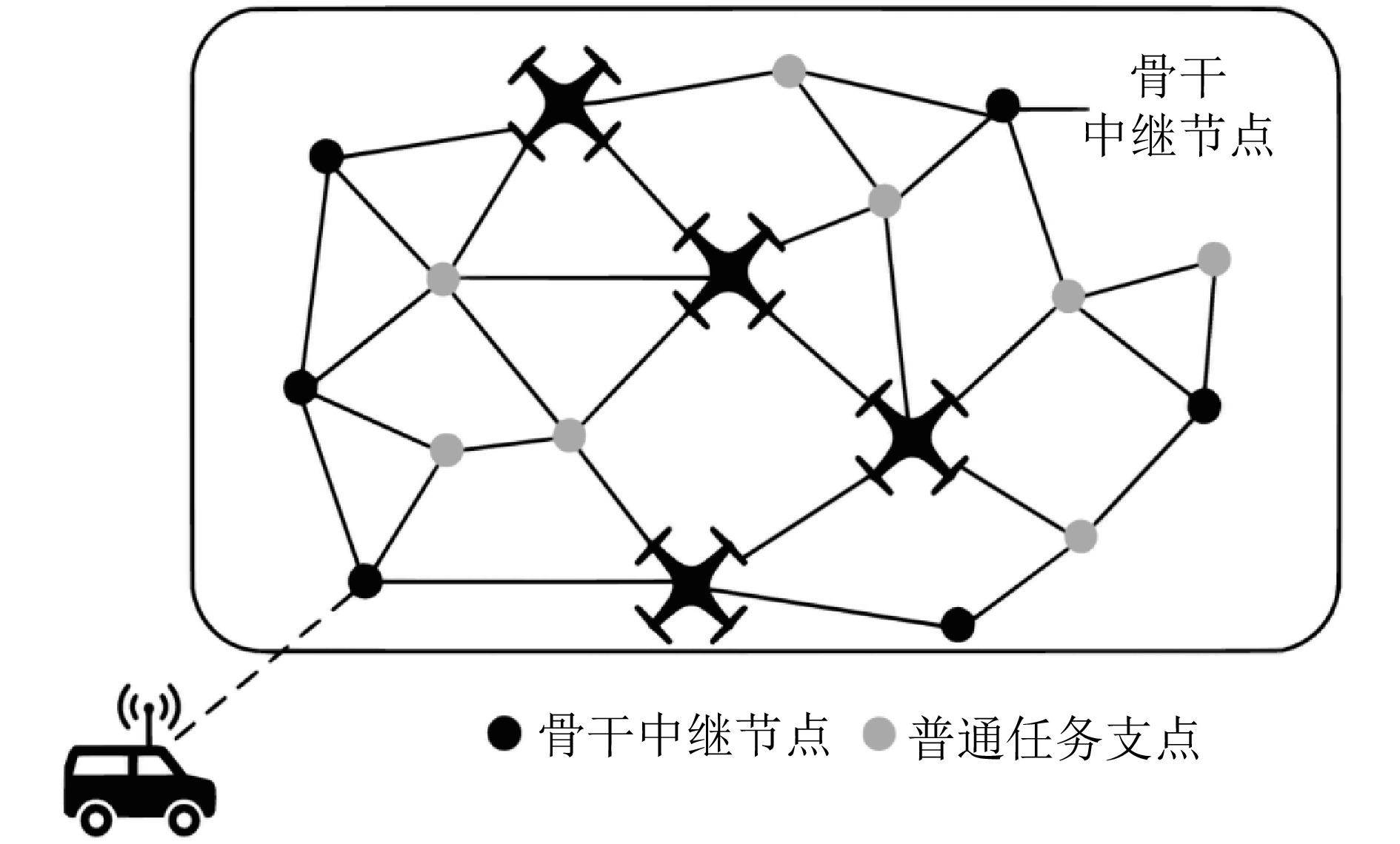
图 1 城市灾后巡检场景下复杂无人机群任务示意图
Fig. 1 Illustration of a complex UAV swarm mission in an urban post-disaster inspection scenario
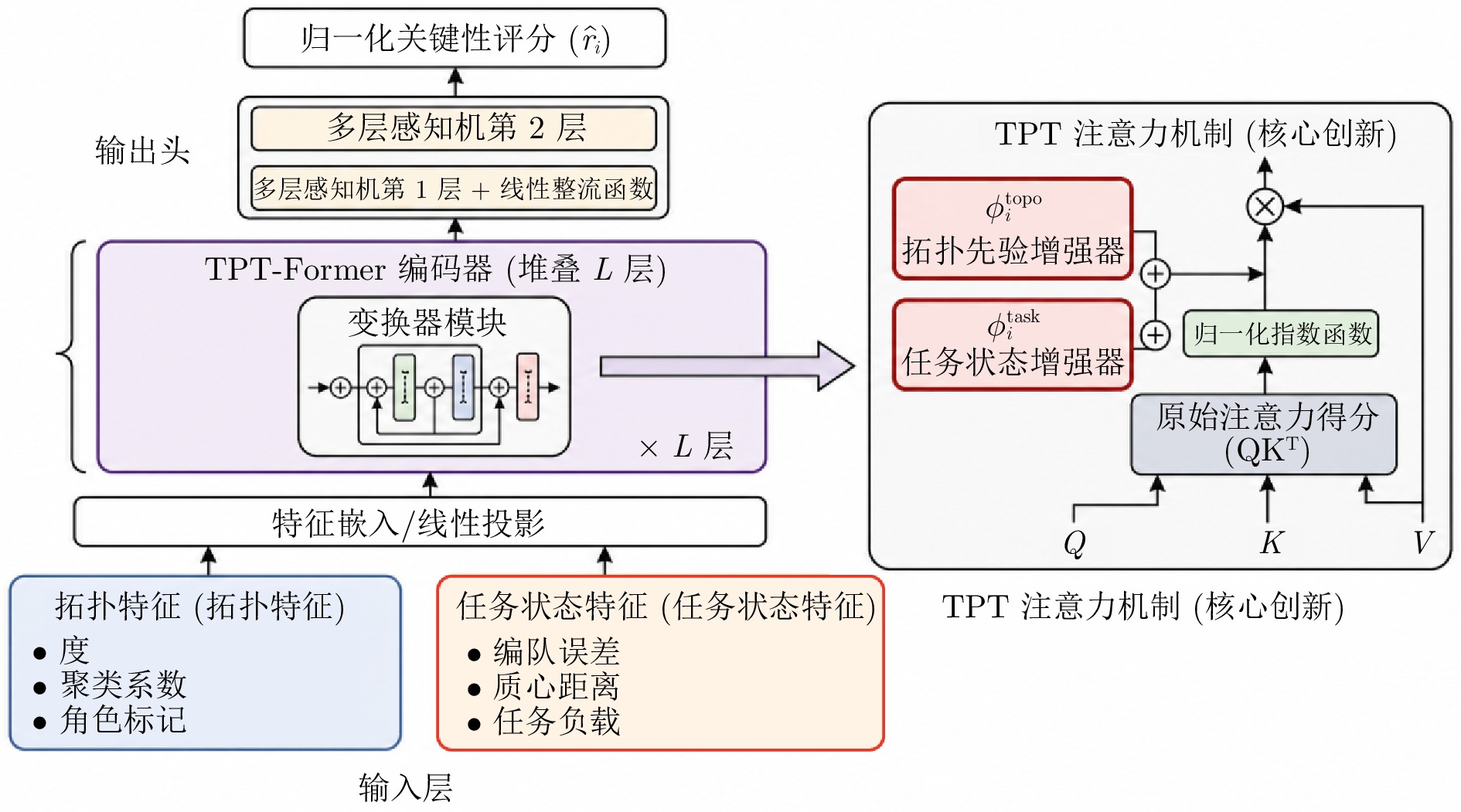
图 2 TPT-Former关键节点评估模型结构示意图
Fig. 2 Architecture of the proposed TPT-Former for critical node evaluation
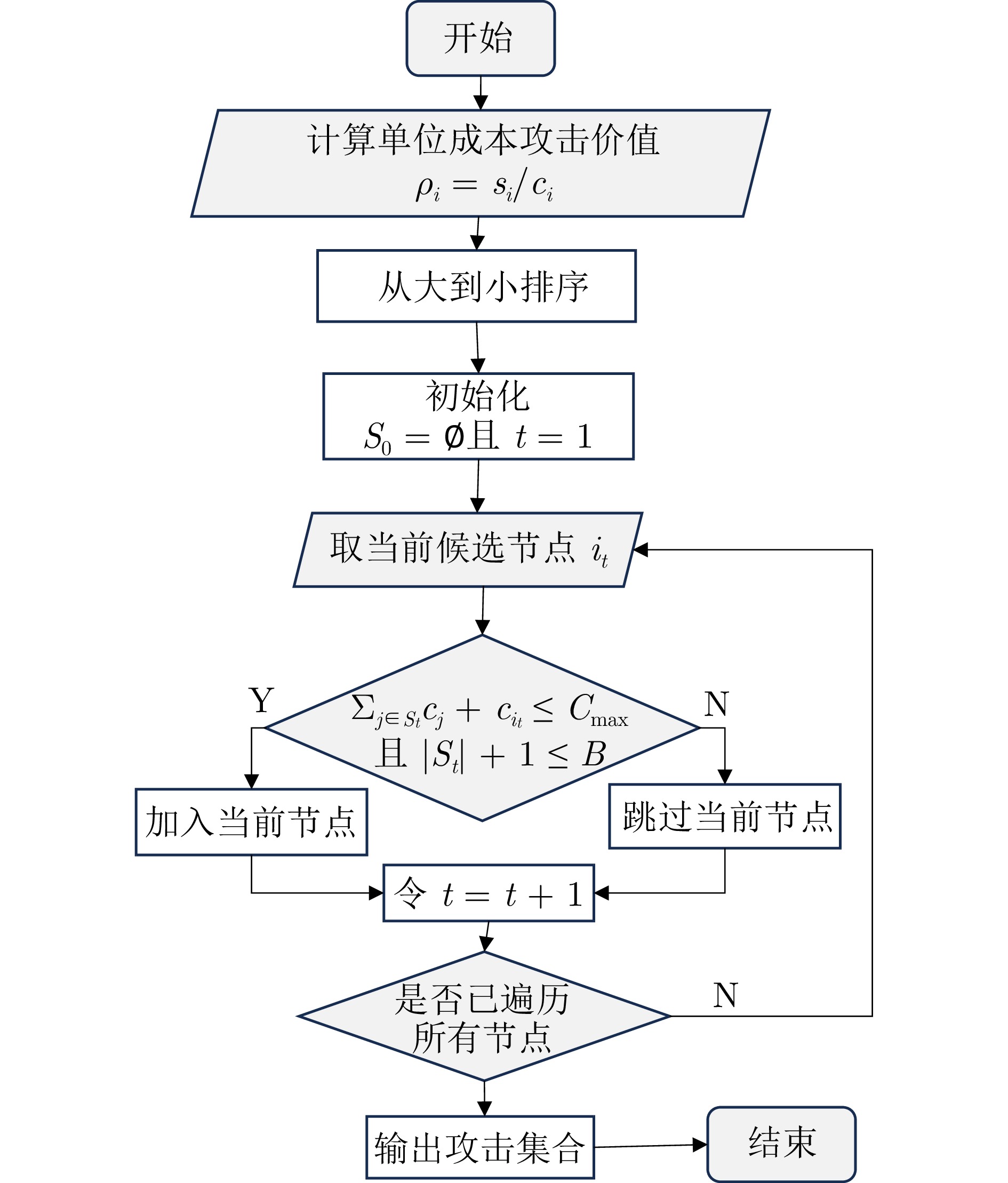
图 3 基于单位成本攻击价值的贪心选点过程示意图
Fig. 3 Greedy node-selection procedure based on cost-aware attack value
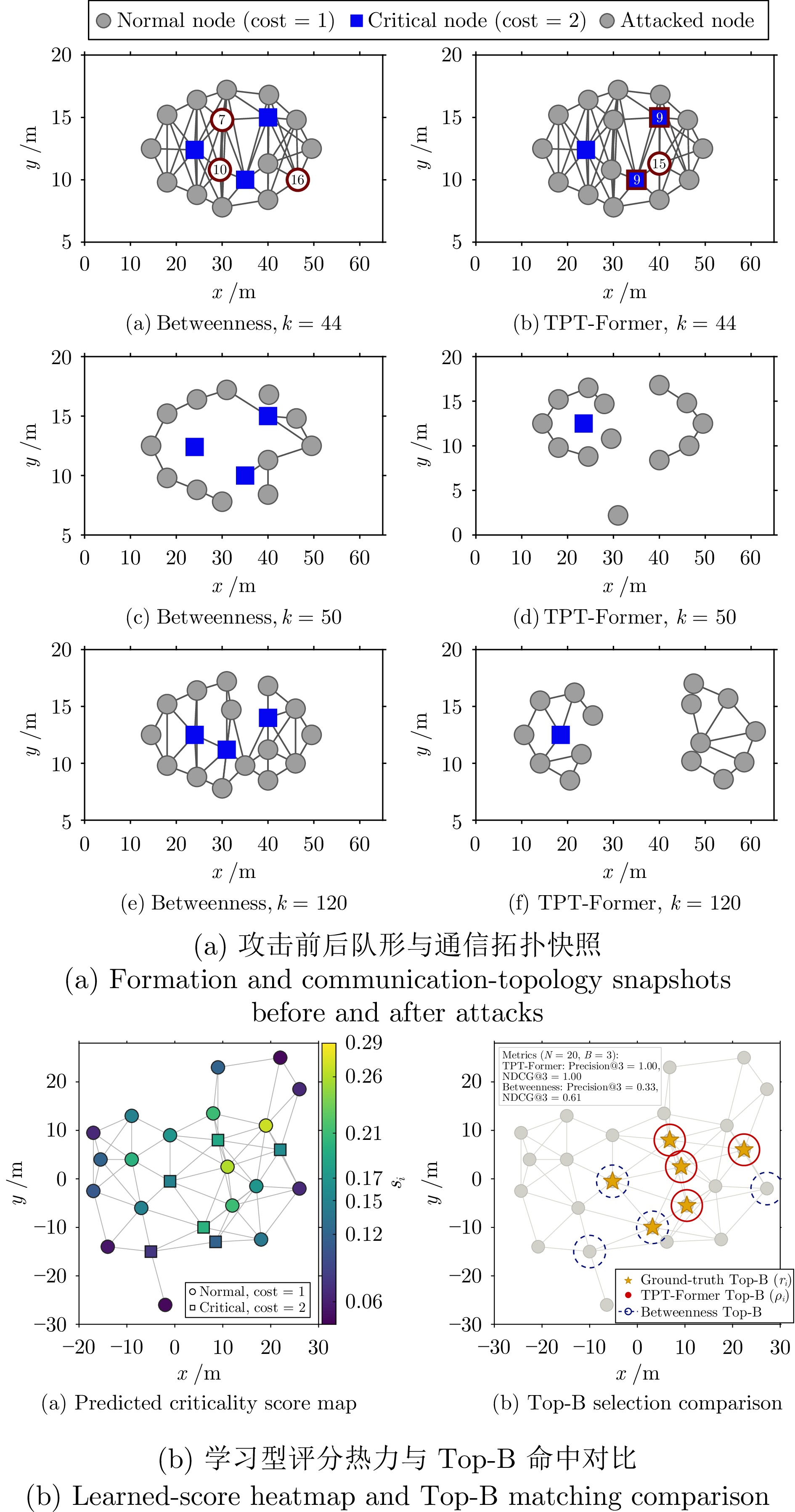
图 4 代表性场景下选点差异的可视化结果
Fig. 4 Visualization result of node selection differences in a representative scene
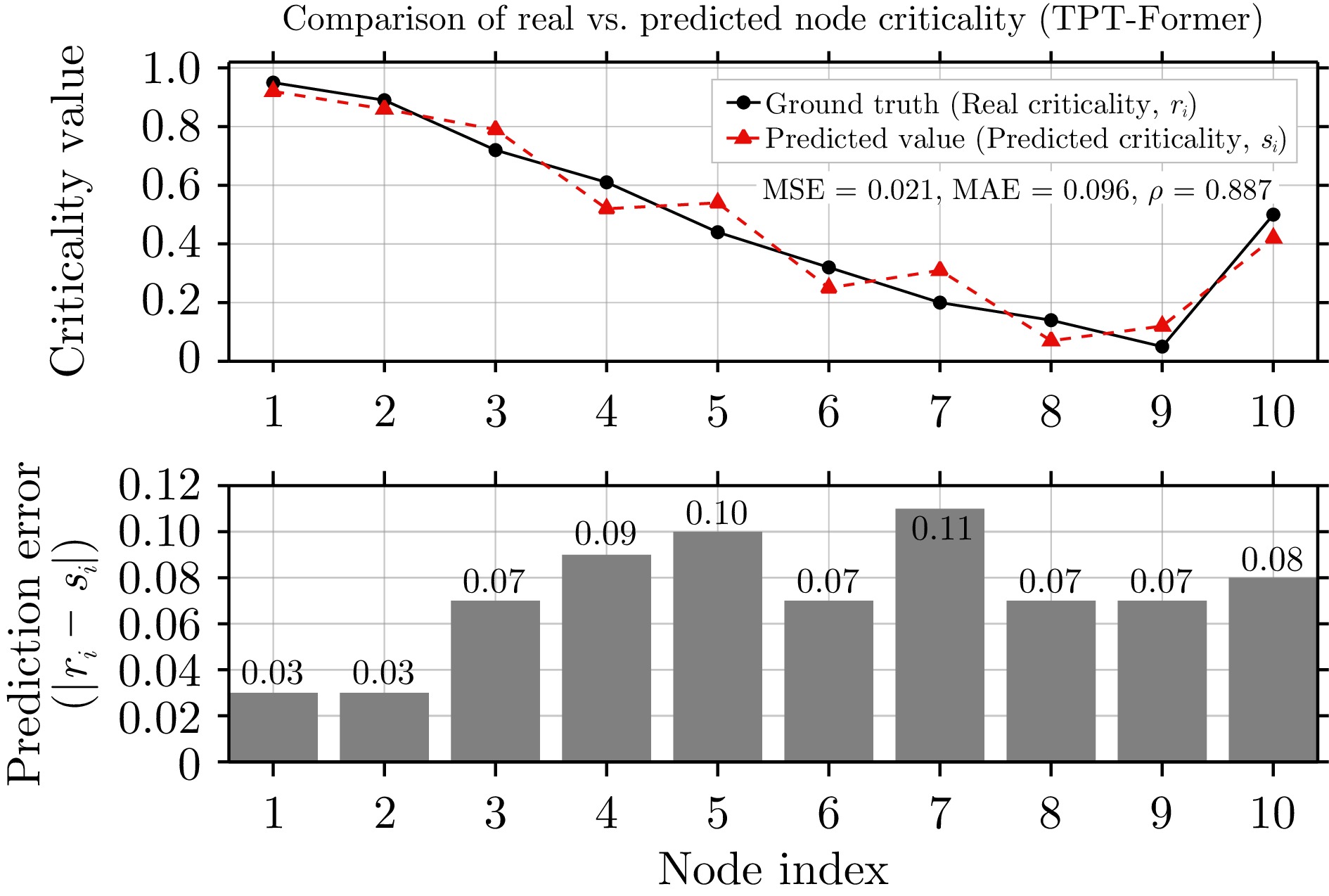
图 5 真实关键性标签与模型预测评分对比
Fig. 5 Comparison between ground-truth criticality and predicted scores
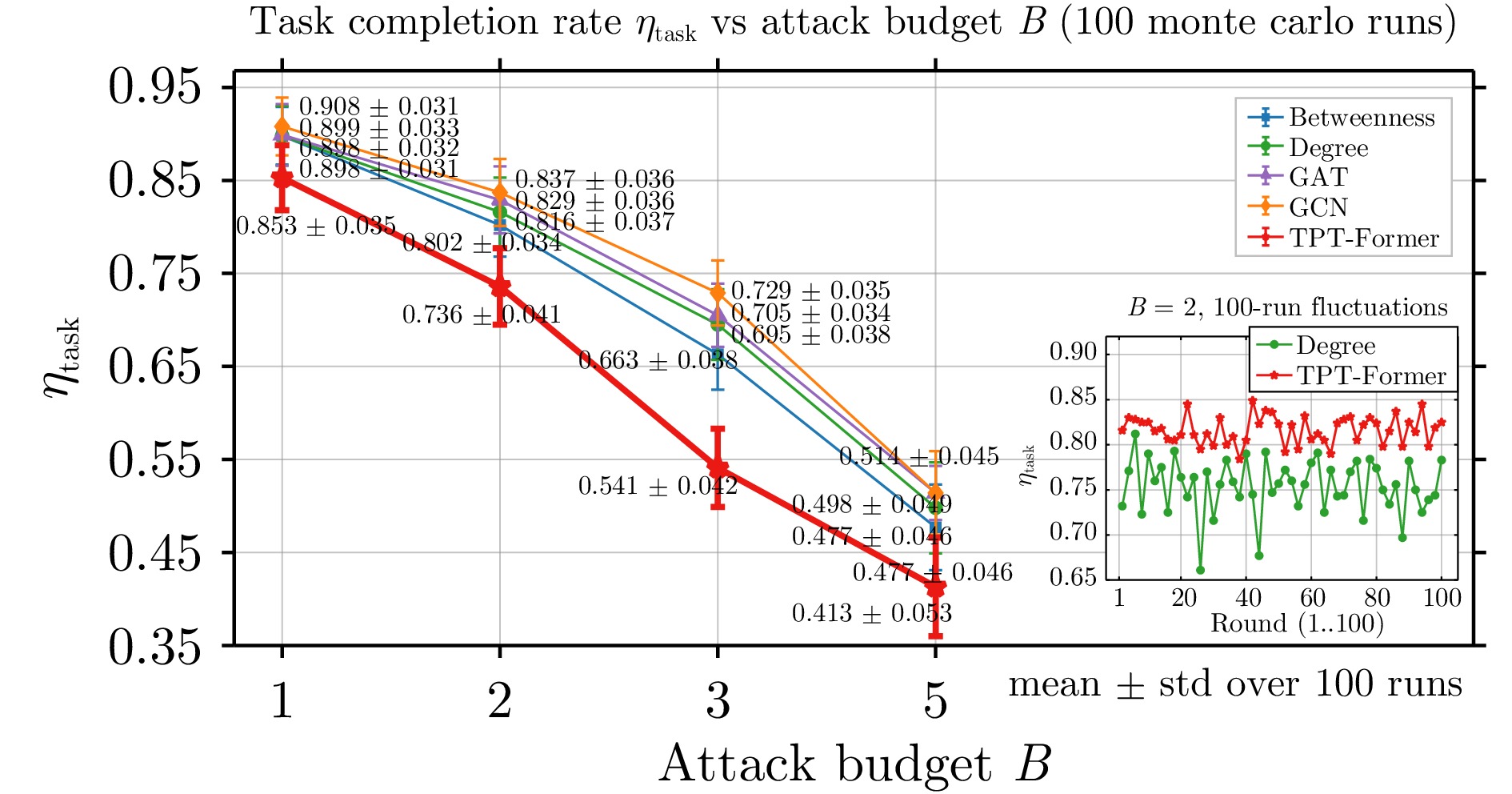
图 7 不同攻击策略下任务完成率随攻击预算($ B $)变化曲线
Fig. 7 Variation curves of task success rate with attack budget ($ B $) under different strategies
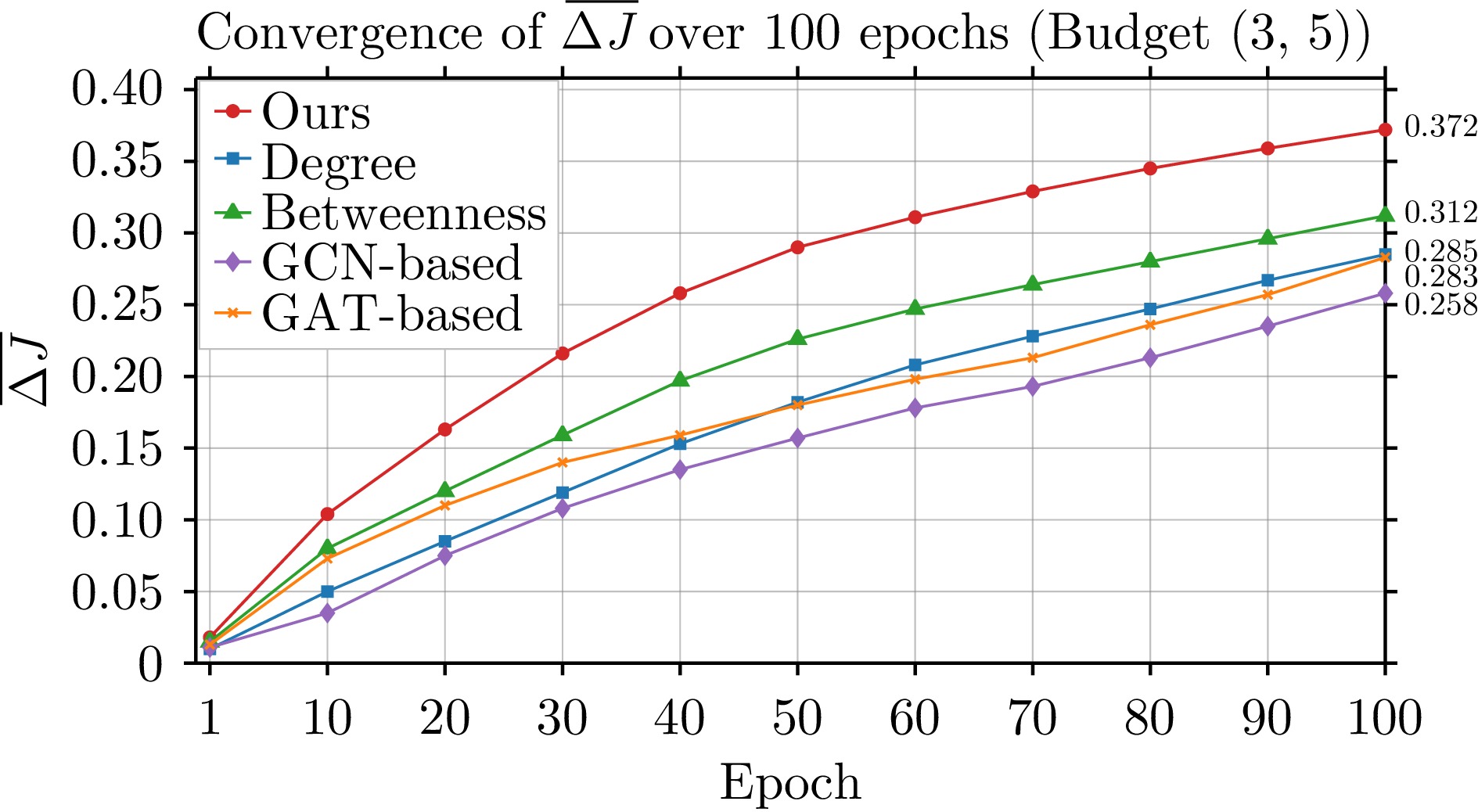
图 8 典型预算$ (B,\;C_{\max})=(3,\;5) $下综合性能退化量的收敛曲线
Fig. 8 Convergence curves of comprehensive performance degradation under the typical budget $ (B,\;C_{\max})=(3,\;5) $
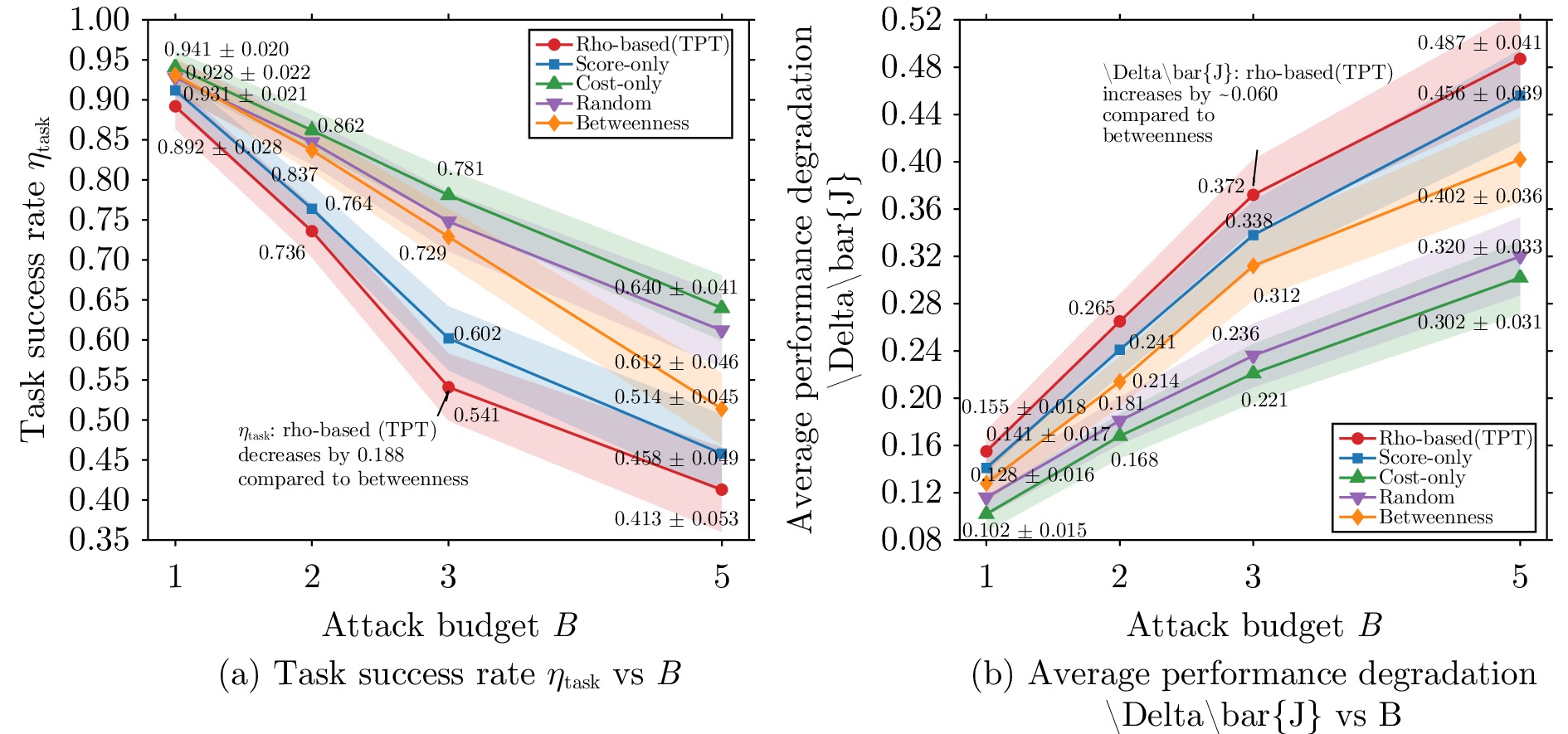
图 9 策略消融曲线: $ \eta_{\mathrm{task}} $与$ \overline{\Delta J} $
Fig. 9 Strategy ablation results for $ \eta_{\mathrm{task}} $ and $ \overline{\Delta J} $
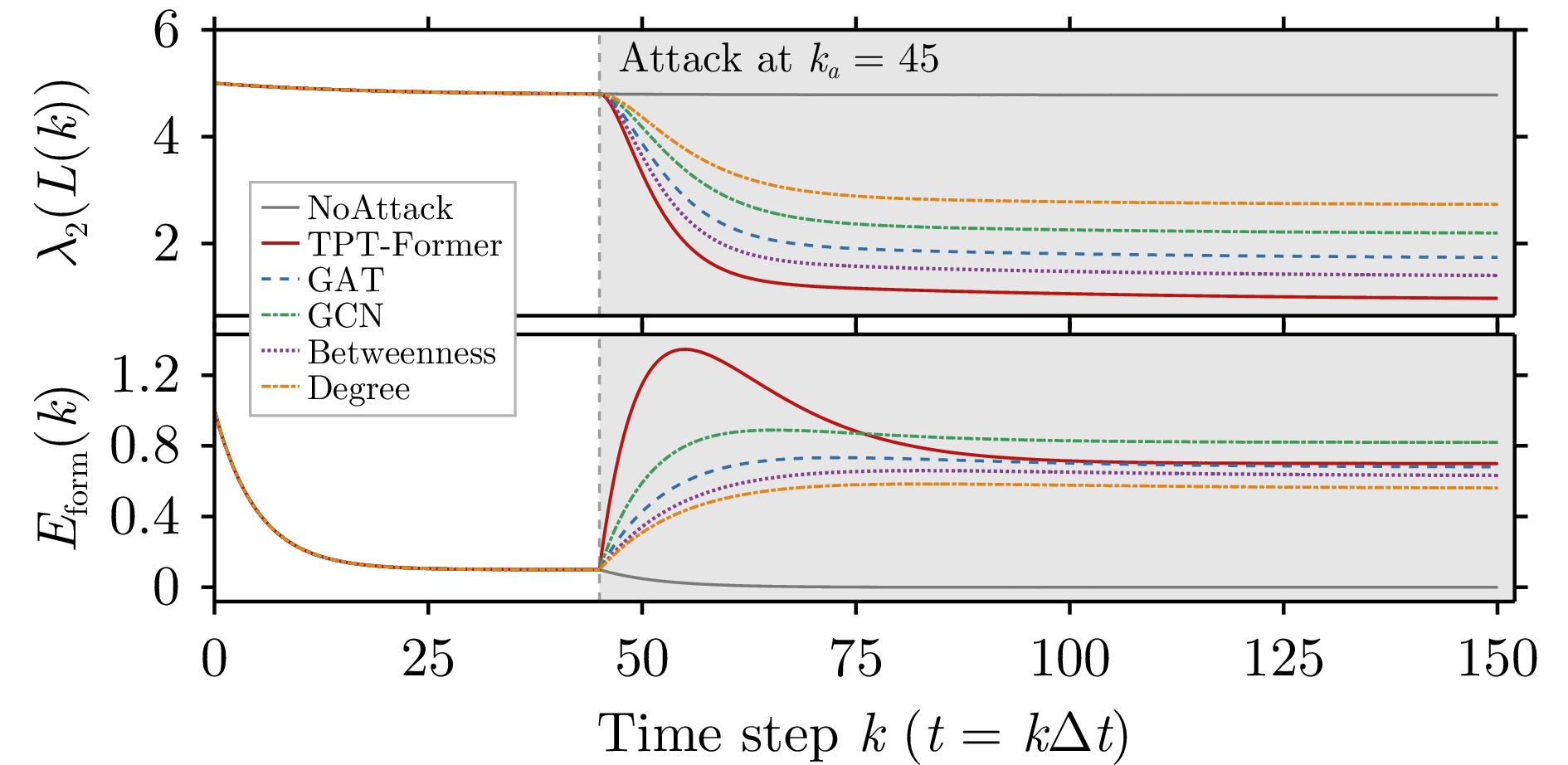
图 10 攻击后代数连通度与编队误差的时域演化($ k_a=45 $)
Fig. 10 Time-domain evolution of algebraic connectivity and formation error after attacks ($ k_a=45 $)
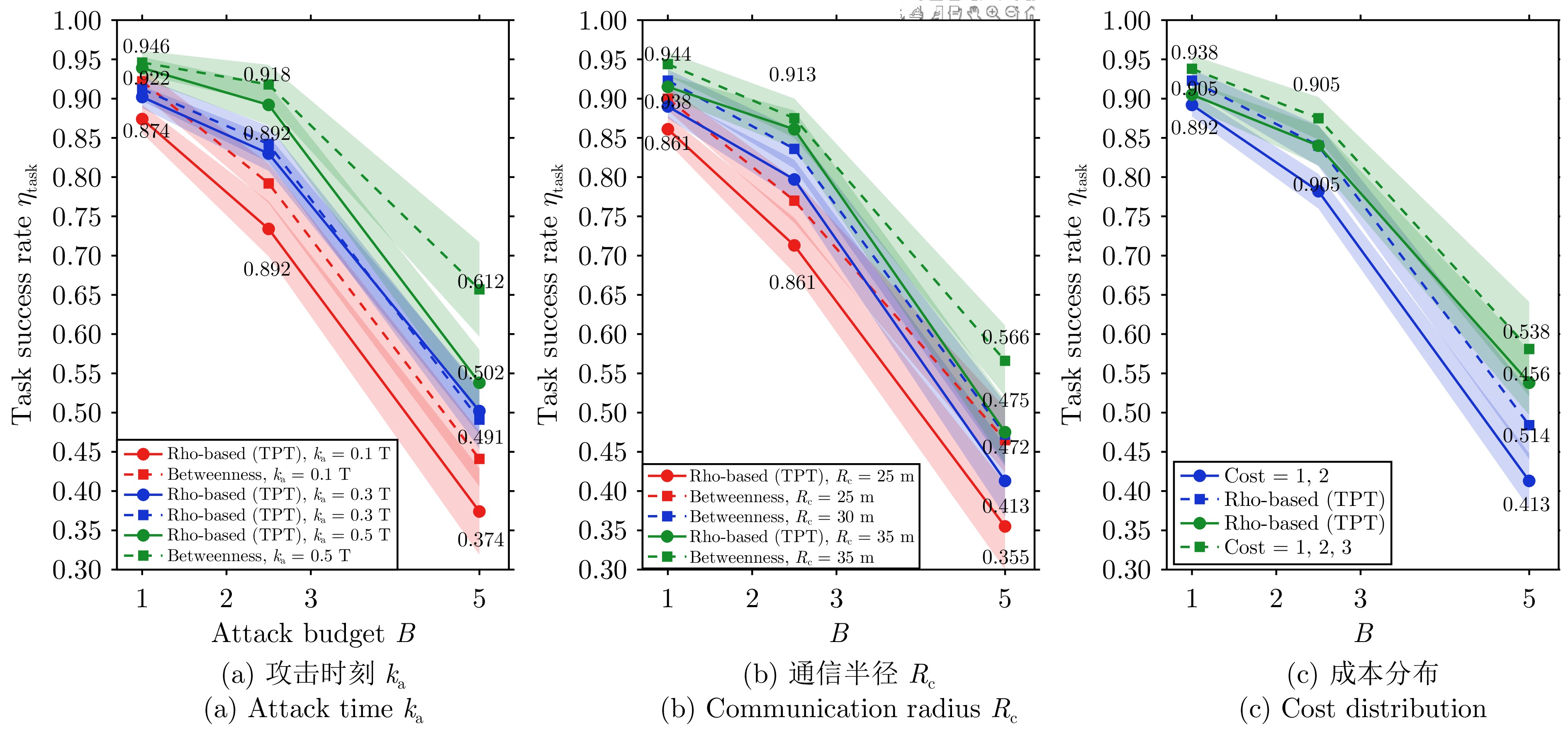
图 11 攻击时刻、通信半径与成本分布的敏感性分析
Fig. 11 Sensitivity analysis of attack time, communication radius, and cost distribution
表 1 模型与训练超参数设置
Table 1 Model and training hyperparameter settings
超参数 取值 编码器层数$ L $ / 头数$ H $ 4 / 4 隐藏维度$ d $ / 谱维度$ d_{\mathrm{pe}} $ 128 / 8 丢弃率Dropout 0.1 优化器 AdamW 初始学习率 / 权重衰减 $ 1\times10^{-3} $ / $ 1\times10^{-4} $ 批大小 / 最大训练轮数 16 / 200 早停耐心值 20 $ \lambda_{\mathrm{imp}} $ / $ \lambda $ 2.0 / $ 1\times10^{-4} $  下载: 导出CSV
表 2 测试集上综合代价三项分量的窗口平均贡献占比
Table 2 Window-averaged contribution ratios of the three composite-cost components on the test set
代价分量 平均贡献占比 标准差 $ w_1E_{\mathrm{form}} $ $ 31.2\% $ $ 6.8\% $ $ w_2\phi(\lambda_2({\boldsymbol{L}})) $ $ 22.7\% $ $ 5.4\% $ $ w_3(1-\eta_{\mathrm{task}}) $ $ 46.1\% $ $ 7.3\% $
下载: 导出CSV
表 3 不同节点规模下的谱编码与模型运行耗时
Table 3 Spectral-encoding and model runtimes for different numbers of nodes
节点数$ N $ 谱编码 (ms) 训练 (s/轮) 推理 (ms/图) 20 1.8487 2.4139 0.7408 30 3.2514 3.6795 1.0823 40 5.1305 5.1458 1.4674
下载: 导出CSV
表 4 不同模型在测试集关键性预测任务上的性能对比
Table 4 Performance comparison of different models for criticality prediction on the test set
模型 $ \mathrm{MSE}_{\mathrm{test}} $ $ \mathrm{MAE}_{\mathrm{test}} $ $ \rho_{\mathrm{Spearman}} $ GCN 0.032 0.123 0.781 GAT 0.028 0.112 0.819 TPT-Former 0.021 0.096 0.887 去除拓扑先验 0.024 0.103 0.864 去除任务状态 0.025 0.107 0.856 去除$ h_i $ 0.026 0.109 0.842 去除$ (h_i,\;l_i) $ 0.029 0.114 0.828
下载: 导出CSV
表 5 测试集Top-$ B $命中性能统计
Table 5 Top-$ B $ matching performance statistics on the test set
指标 $ B=1 $ $ B=2 $ $ B=3 $ Precision@$ B $ 0.66$ \pm $0.08 0.60$ \pm $0.07 0.55$ \pm $0.06 NDCG@$ B $ 0.78$ \pm $0.06 0.76$ \pm $0.05 0.74$ \pm $0.04
下载: 导出CSV
-
[1] 王耀南, 华和安, 张辉, 钟杭, 樊叶心, 梁鸿涛, 等. 性能函数引导的无人机集群深度强化学习控制方法. 自动化学报, 2025, 51(5): 905−916 doi: 10.16383/j.aas.c240519Wang Yao-Nan, Hua He-An, Zhang Hui, Zhong Hang, Fan Ye-Xin, Liang Hong-Tao, et al. Performance-function-guided deep reinforcement learning control method for UAV swarms. Acta Automatica Sinica, 2025, 51(5): 905−916 doi: 10.16383/j.aas.c240519 [2] 方浩, 赵欣悦, 陈杰. 无人飞行器集群自主控制: 预设性能驱动的安全编队控制. 自动化学报, 2025, 51(5): 931−941 doi: 10.16383/j.aas.c240603Fang Hao, Zhao Xin-Yue, Chen Jie. Autonomous control of UAV swarms: Prescribed-performance-driven safe formation control. Acta Automatica Sinica, 2025, 51(5): 931−941 doi: 10.16383/j.aas.c240603 [3] 姜斌, 马亚杰, 薛舒心. 无人飞行器集群自主控制: 基于联盟形成博弈的任务分配. 自动化学报, 2025, 51(5): 942−959 doi: 10.16383/j.aas.c240593Jiang Bin, Ma Ya-Jie, Xue Shu-Xin. Autonomous control of UAV swarms: Task allocation based on coalition formation games. Acta Automatica Sinica, 2025, 51(5): 942−959 doi: 10.16383/j.aas.c240593 [4] 陈谋, 刘伟, 张鹏. 性能约束下的四旋翼无人机协同吊挂系统分布式避碰跟踪控制. 自动化学报, 2024, 50(12): 2392−2406 doi: 10.16383/j.aas.c240349Chen Mou, Liu Wei, Zhang Peng. Distributed collision-avoidance tracking control for cooperative quadrotor payload transportation systems under performance constraints. Acta Automatica Sinica, 2024, 50(12): 2392−2406 doi: 10.16383/j.aas.c240349 [5] Ames A D, Xu X, Grizzle J W, Tabuada P. Control barrier function based quadratic programs for safety critical systems. IEEE Transactions on Automatic Control, 2017, 62(8): 3861−3876 doi: 10.1109/TAC.2017.2720131 [6] Rimon E, Koditschek D E. Exact robot navigation using artificial potential functions. IEEE Transactions on Robotics and Automation, 1992, 8(5): 501−518 doi: 10.1109/70.163777 [7] Liu Y, Montenbruck J M, Zelazo D, Odelga M, Rajappa S, Bülthoff H H, et al. A distributed control approach to formation balancing and maneuvering of multiple multirotor UAVs. IEEE Transactions on Robotics, 2018, 34(4): 870−882 doi: 10.1109/TRO.2018.2853606 [8] Salzmann T, Kaufmann E, Arrizabalaga J, Pavone M, Scaramuzza D, Ryll M. Real-time neural MPC: Deep learning model predictive control for quadrotors and agile robotic platforms. IEEE Robotics and Automation Letters, 2023, 8(4): 2397−2404 doi: 10.1109/LRA.2023.3246839 [9] Tian E, Fan M, Ma L, Yue D. Stochastic important-data-based attack power allocation against remote state estimation in sensor networks. IEEE Transactions on Automatic Control, 2025, 70(3): 2012−2019 doi: 10.1109/TAC.2024.3477009 [10] Liu G, Tian E, Xie X. Critical-metrics-based attack strategy and resilient H∞ state estimator design for multi-area power systems. IEEE Transactions on Smart Grid, 2025, 16(2): 1619−1628 doi: 10.1109/TSG.2024.3454637 [11] Pasqualetti F, Dörfler F, Bullo F. Attack detection and identification in cyber-physical systems. IEEE Transactions on Automatic Control, 2013, 58(11): 2715−2729 doi: 10.1109/TAC.2013.2266831 [12] Fawzi H, Tabuada P, Diggavi S. Secure estimation and control for cyber-physical systems under adversarial attacks. IEEE Transactions on Automatic Control, 2014, 59(6): 1454−1467 doi: 10.1109/TAC.2014.2303233 [13] Hu J, Li J, Yan H, Liu H. Optimized distributed filtering for saturated systems with amplify-and-forward relays over sensor networks: A dynamic event-triggered approach. IEEE Transactions on Neural Networks and Learning Systems, 2024, 35(12): 17742−17753 doi: 10.1109/TNNLS.2023.3308192 [14] Hu J, Chen W, Wu Z, Chen D, Yi X. Design of protocol-based finite-time memory fault detection scheme with circuit system application. IEEE Transactions on Systems, Man, and Cybernetics: Systems, 2024, 54(5): 3110−3123 doi: 10.1109/TSMC.2024.3354940 [15] Hu X, Ye D. Event-based privacy-consensus control for multiagent systems: An enhanced framework for fault tolerance and protection against eavesdropping. Applied Mathematics and Computation, 2025, 500: 129446 doi: 10.1016/j.amc.2025.129446 [16] Wu Z, Pan S, Chen F, Long G, Zhang C, Yu P S. A comprehensive survey on graph neural networks. IEEE Transactions on Neural Networks and Learning Systems, 2021, 32(1): 4−24 doi: 10.1109/TNNLS.2020.2978386 [17] Chen J, Chen S, Bai M, Pu J, Zhang J, Gao J. Graph decoupling attention Markov networks for semisupervised graph node classification. IEEE Transactions on Neural Networks and Learning Systems, 2023, 34(12): 9859−9873 doi: 10.1109/TNNLS.2022.3161453 [18] Qin J, Zhang G, Zheng W X, Kang Y. Neural network-based adaptive consensus control for a class of nonaffine nonlinear multiagent systems with actuator faults. IEEE Transactions on Neural Networks and Learning Systems, 2019, 30(12): 3633−3644 doi: 10.1109/TNNLS.2019.2901563 [19] Liu Y, Yang G H. Neural learning-based fixed-time consensus tracking control for nonlinear multiagent systems with directed communication networks. IEEE Transactions on Neural Networks and Learning Systems, 2021, 32(2): 639−652 doi: 10.1109/TNNLS.2020.2978854 [20] Yang X, Zhang H, Wang Z. Data-based optimal consensus control for multiagent systems with policy gradient reinforcement learning. IEEE Transactions on Neural Networks and Learning Systems, 2022, 33(8): 3872−3883 doi: 10.1109/TNNLS.2021.3054685 -

 下载:
下载:

计量
- 文章访问数: 13
- HTML全文浏览量: 13
- 被引次数: 0
