


-
摘要: 近年来, 随着大模型在多模态领域的快速发展, 文本属性图学习也迎来了新的范式. 文本属性图中包含图结构与丰富的节点/边文本属性信息, 广泛存在于社交网络、论文引用网络与知识图谱等场景. 然而, 传统图神经网络通常依赖浅层文本嵌入作为初始节点表示, 难以充分捕捉上下文依赖与复杂语义信息, 并在图结构与文本语义的融合上存在天然局限. 为克服这一瓶颈, 近年来研究者开始探索利用大模型强大的语言理解、知识记忆与推理能力来提升文本属性图学习的效果, 推动了该领域的新一轮发展. 本文系统梳理大模型驱动的文本属性图学习研究进展, 围绕图生成、图预测、图推理三大核心任务, 回顾代表性方法与主要范式, 并总结现有研究中常用的数据集与评测基准. 在文本属性图研究中, 当前在图生成、图预测与图推理三大任务中分别面临结构与属性表达效率不足、生成方法匮乏, 评估体系与可扩展性不完善, 以及复杂关系建模与多跳推理受限等挑战. 结合上述问题提出未来发展方向, 期望为后续研究提供系统化参考与整体性视角, 进一步促进大模型与图学习的深度耦合.Abstract: In recent years, the rapid advancement of large models in multimodal learning has introduced new paradigms for text-attributed graph learning. Text-attributed graphs, which combine graph structures with rich textual attribute information on nodes and edges, are widely found in scenarios such as social networks, paper citation networks, and knowledge graphs. However, traditional graph neural networks typically rely on shallow text embeddings as initial node representations, making it difficult to capture contextual dependencies and complex semantic information, and they face inherent limitations in integrating graph structures with textual semantics. To address this bottleneck, recent studies leverage the powerful language understanding, knowledge retention, and reasoning capabilities of large models to enhance text-attributed graph learning, promoting further development in this field. This paper provides a systematic review of recent advances in large model-driven text-attributed graph learning, covering representative methods and major paradigms across three core tasks: Graph generation, graph prediction, and graph reasoning. We also summarize commonly used datasets and evaluation benchmarks. In text-attributed graph research, current work in the three core tasks faces persistent challenges: Inefficient structure-attribute representation and limited graph generation methods, inadequate evaluation frameworks and scalability in graph prediction, and constrained capacities for complex relational modeling and multi-hop reasoning in graph reasoning. Building on these challenges, we outline future research directions to provide a structured reference and holistic perspective, fostering deeper integration of large models and graph learning.
-
Key words:
- large models /
- text-attributed graphs /
- graph neural networks /
- large language models
-
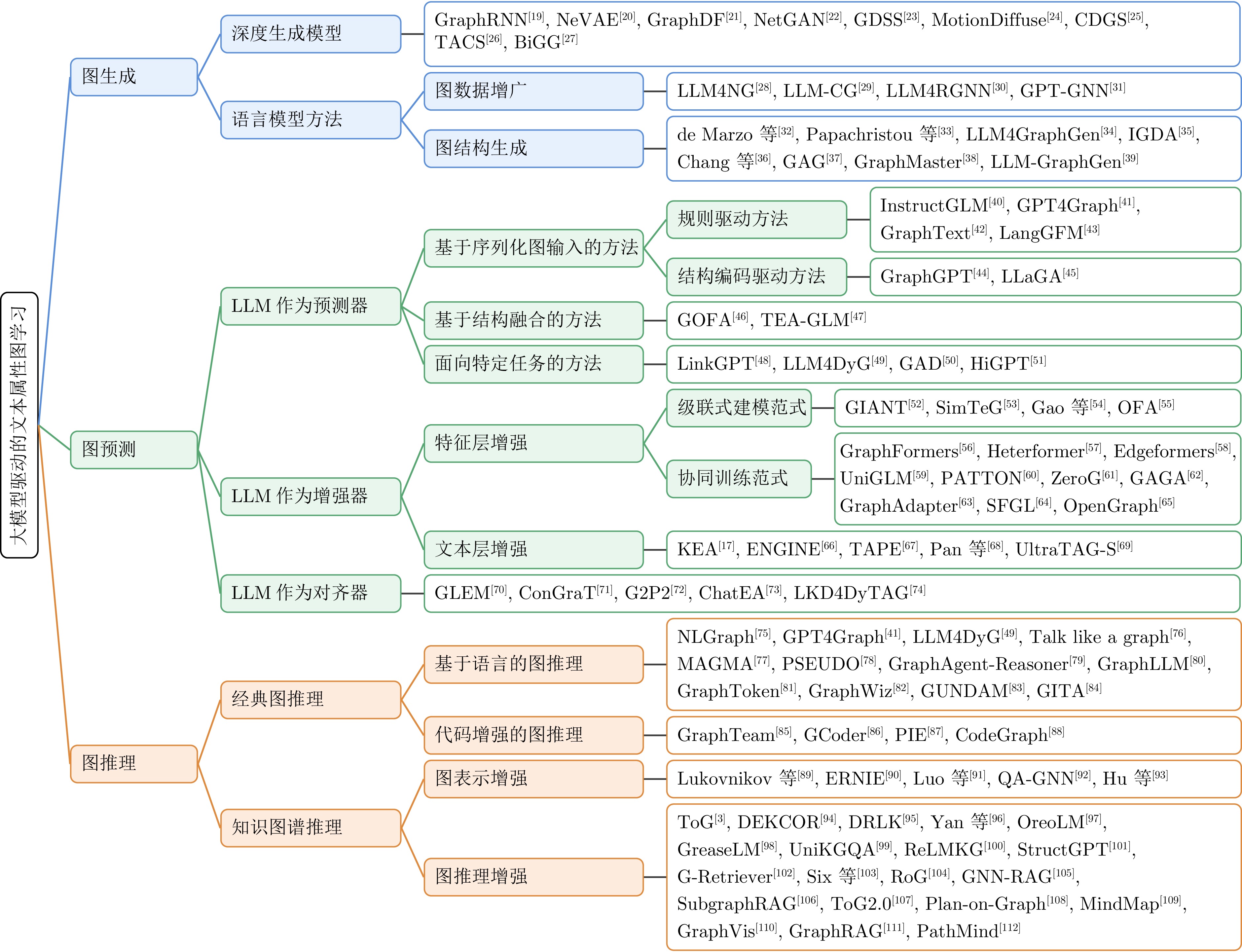
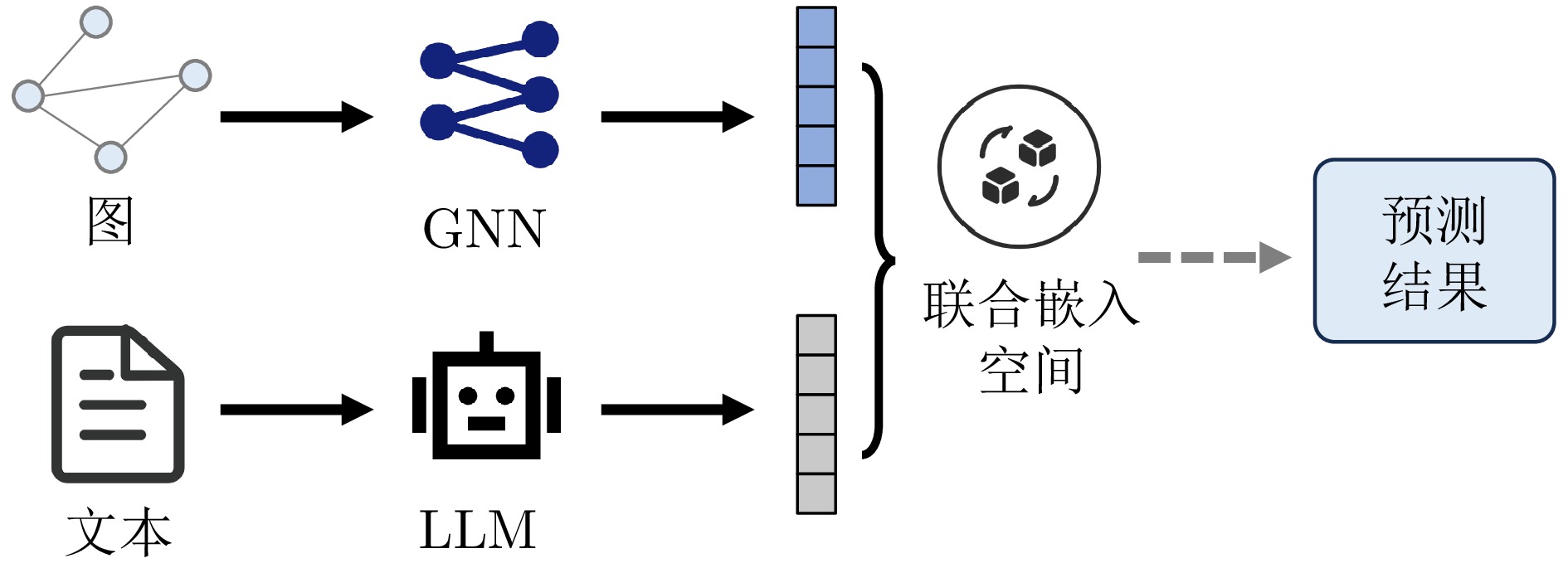
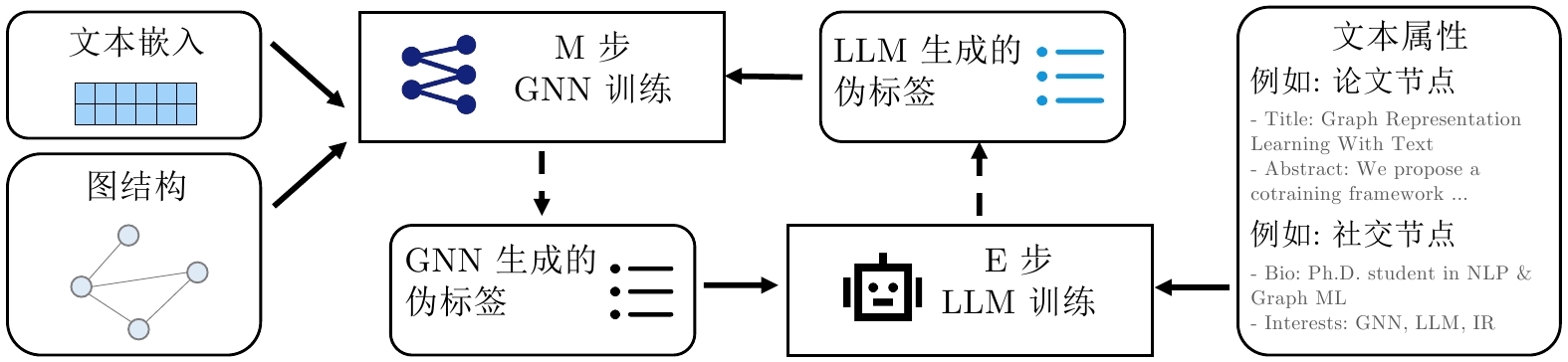
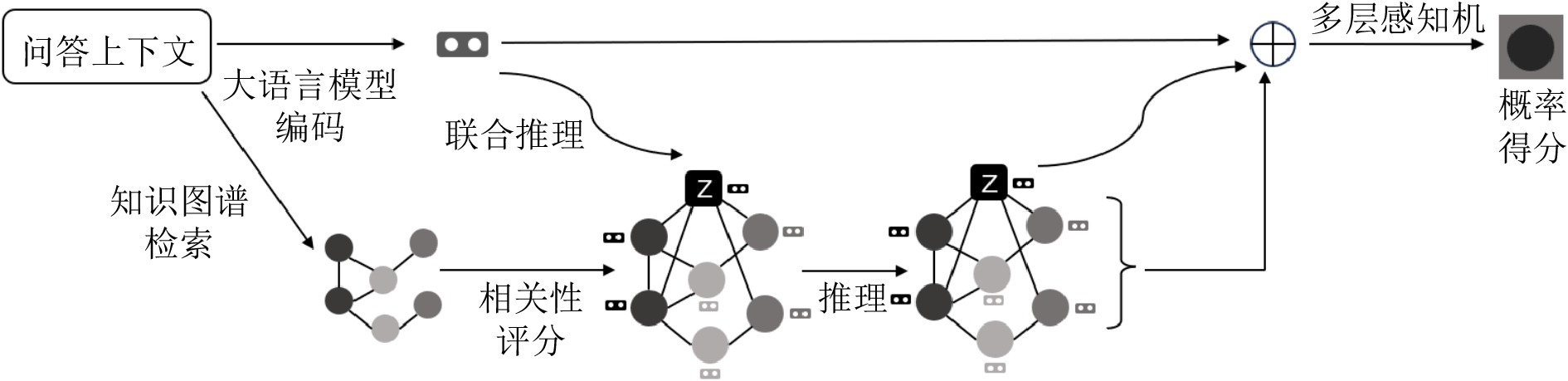
图 1 大模型驱动的文本属性图学习研究框架
Fig. 1 Research framework of large-model-driven text-attributed graph learning
表 1 三类范式的核心定位与优缺点对比
Table 1 Comparison of core roles and advantages/disadvantages of three paradigms
范式 核心角色定位 优点 缺点 LLM作为
预测器LLM直接作为主要预测器, 通过提示词完成任务 1)无需显式GNN建模, 端到端简单
2)零样本/少样本能力强
3)天然支持跨任务、跨图泛化1)难以高效建模复杂图结构关系
2)推理成本高, 难以规模化
3)预测不稳定, 易受提示词和上下文长度影响LLM作为
增强器LLM用于增强节点语义, 最终预测由GNN完成 1)充分保留GNN的结构建模优势
2)推理阶段无需或极少依赖LLM, 效率高、成本低
3)更适合大规模图数据与工业场景
4)结构归纳偏置明确, 预测稳定性强1) LLM能力仅作为“辅助”, 未充分发挥其推理能力
2)若协同训练不足, 语义与结构对齐仍可能受限LLM作为
对齐器LLM用于对齐文本、结构、标签等多模态语义空间 1)可统一不同图、不同任务的表示空间
2)提升跨图、跨域泛化能力
3)有利于构建通用预训练模型1)训练流程复杂, 通常需要大规模预训练
2)对数据多样性和设计假设依赖性较强
3)对资源和工程能力要求高 下载: 导出CSV
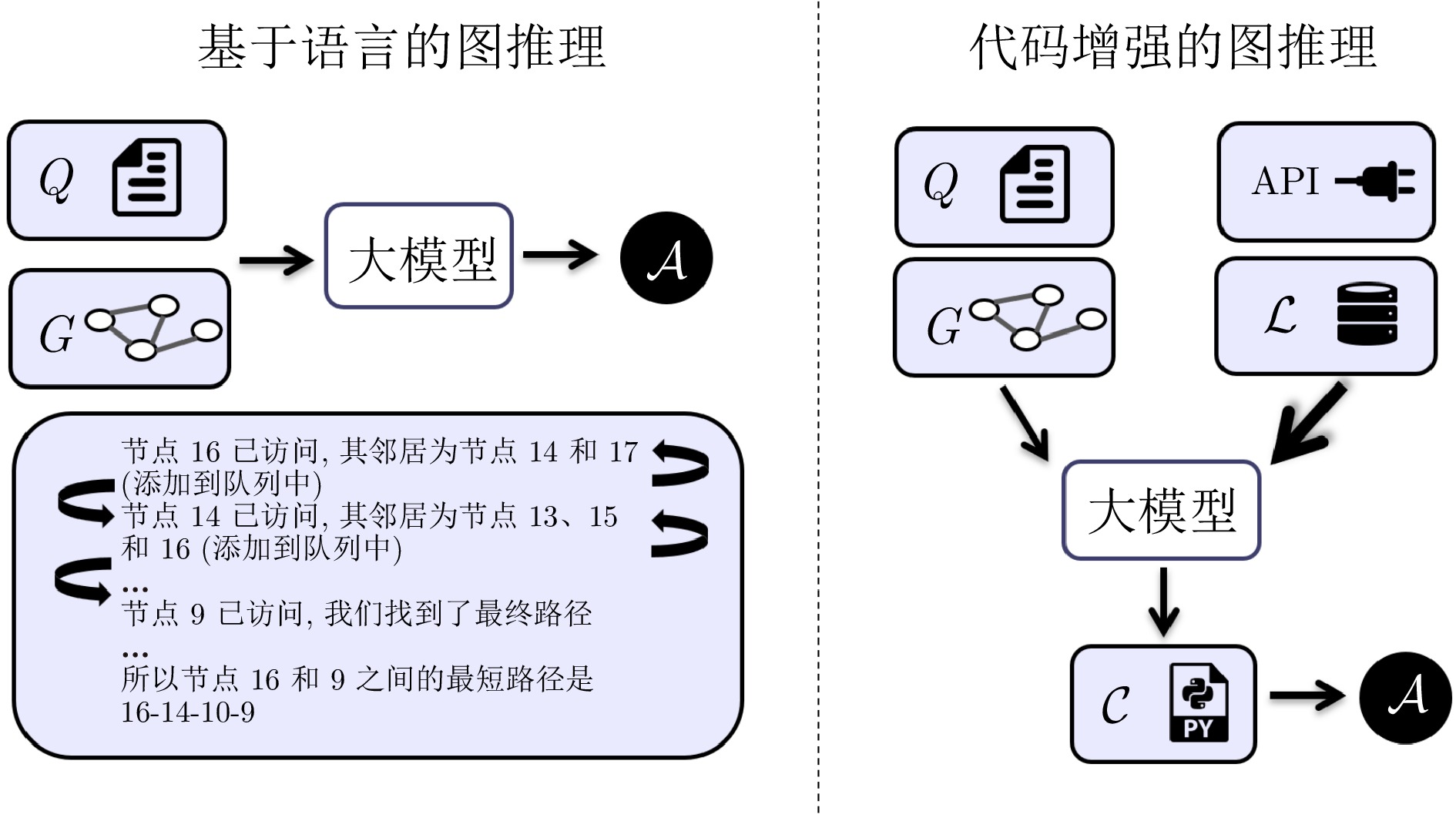
表 2 经典图推理方法对比
Table 2 Comparison of classical graph reasoning methods
方法 指令微调 推理路径 代码增强 图编码方法 NLGraph[75] × × × 自然语言描述 GPT4Graph[41] × × × 自然语言描述 LLM4DyG[49] × × × 自然语言描述 Talk like a graph[76] × × × 多种自然语言描述 GraphAgent-Reasoner[79] × √ × 自然语言描述 PSEUDO[78] × √ × 伪代码增强 GraphLLM[80] √ × × GNN编码(graph token) GraphToken[81] √ × × GNN编码(soft token) GraphWiz[82] √ √ × 自然语言描述 GUNDAM[83] √ √ × 自然语言描述 GITA[84] √ × × 多模态(视觉+文本) GraphTeam[85] × × √ 自然语言描述 GCoder[86] √ × √ 自然语言描述 PIE[87] × × √ 自然语言描述 CodeGraph[88] × × √ 自然语言描述
下载: 导出CSV
表 3 基于语言模型的图生成常用数据集
Table 3 Common datasets in graph generation models based on language models
数据集 节点数 边数 领域 节点类型 边类型 文献 WARRIOR[205] 100.0 K 285.0 K 社交 原始文本 原始文本 [205] IMDB-text[204] 125.714 K 1.5 M 社交 原始文本 原始文本 [204] Cora-text[10] 48.8 K 110.8 K 社交 原始文本 原始文本 [37, 204] WeiboTech[204] 20.767 K 109.3 K 社交 原始文本 原始文本 [204, 206] WeiboDaily[204] 66.5 K 354.1 K 社交 原始文本 原始文本 [204, 206] Metoo[164] 1 K 32.0 K 社交 原始文本 无 [164, 207] Roe[208] 1 K 121.5 K 社交 原始文本 原始文本 [164, 207] MovieLens-1M[209] 6.0 K/3.9 K 32.0 M 推荐 原始文本 原始文本 [176, 178, 210−211] Amazon review[212] 54.5 M/48.2 M 571.54 M 推荐 原始文本 原始文本 [178, 211, 213 ] Steam[214] 2.6 M/15.5 K 7.793 M 推荐 原始文本 原始文本 [178, 210] Lastfm[215] 1.9 K/17.6 K 266.0 K 推荐 原始文本 无 [216−218]
下载: 导出CSV
表 4 常用图预测数据集统计信息
Table 4 Statistics of commonly used graph prediction datasets
数据集 节点数 边数 类别数 任务类型 领域 特征类型 Cora[227] 2.7 K 5.4 K 7 节点分类 学术 词袋(BoW) Citeseer[227] 3.3 K 4.7 K 6 节点分类 学术 词袋(BoW) Pubmed[227] 19.7 K 44.3 K 3 节点分类 学术 词袋(BoW) Coauthor-CS[227] 18.3 K 81.9 K 15 节点分类 学术 词袋(BoW) Coauthor-Physics[227] 34.5 K 248 K 5 节点分类 学术 词袋(BoW) Amazon-Photo[227] 7.5 K 119 K 10 节点分类 电商 词袋(BoW) Amazon-Computers[227] 13.4 K 245.8 K 8 节点分类 电商 词袋(BoW) ogbn-Product[9] 54 K 74.4 K 47 节点分类 电商 词袋(BoW) WikiCS[227] 11.7 K 216.1 K 10 节点分类 Wikipedia GloVe ogbn-Arxiv-TA[227] 169.3 K 1.2 M 40 节点分类 学术 原始文本 Books-Children[227] 76.9 K 1.6 M 24 节点分类 电商 原始文本 Books-History[227] 41.6 K 358.6 K 12 节点分类 电商 原始文本 Electronics-Computers[227] 87.2 K 721.1 K 10 节点分类 电商 原始文本 Electronics-Photo[227] 48.3 K 500.9 K 12 节点分类 电商 原始文本 Sports-Fitness[227] 173.1 K 1.8 M 13 节点分类 电商 原始文本 CitationV8[227] 1.1 M 6.1 M — 链接预测 学术 原始文本 GoodReads[227] 676.1 K 8.6 M — 链接预测 图书 原始文本 MAG-Mathematics[48, 60] 19.9 K 34.7 K — 链接预测 学术 原始文本 MAG-Geology[48, 60] 20.5 K 51.5 K — 链接预测 学术 原始文本 Reddit[8] 33.4 K 198.4 K 2 节点分类 社交 原始文本 Instagram[8] 11.3 K 144 K 2 节点分类 社交 原始文本 Stackoverflow[58] 129.3 K 281.7 K — 链接预测 技术社区 原始文本 Twitter[16] 176.3 K 2.4 M 2 节点分类, 链接预测 社交 原始文本
下载: 导出CSV
表 5 知识图谱推理数据集
Table 5 Knowledge graph reasoning datasets
数据集 知识图谱源 问题数 多跳 多实体 年份 WebQuestions[228] Freebase 5810 √ × 2013 SimpleQuestions[229] Freebase 108442 × × 2015 ComplexQuestions[230] Freebase 2100 √ √ 2016 GraphQuestions[231] Freebase 5166 √ √ 2016 WebQuestionsSP[232] Freebase 4737 √ × 2016 The 30M Factoid QA[233] Freebase 30 M × × 2016 SimpleQuestionsWikidata[234] Wikidata 21957 × × 2017 LC-QuAD 1.0[235] DBpedia 5000 √ √ 2017 ComplexWebQuestions[236] Freebase 34689 √ √ 2018 QALD-9[237] DBpedia 558 √ √ 2018 PathQuestion[238] Freebase 7106 √ × 2018 MetaQA[239] WikiMovies 407513 √ × 2018 SimpleDBpediaQA[240] DBpedia 43086 × × 2018 LC-QuAD 2.0[241] Wikidata 30000 √ √ 2019 FreebaseQA[242] Freebase 28348 × × 2019 Event-QA[243] EventKG 1000 √ √ 2020 GrailQA[244] Freebase 64331 √ √ 2021
下载: 导出CSV
-
[1] Song X R, Lian J X, Huang H, Wu M Q, Jin H, Xie X. Friend recommendations with self-rescaling graph neural networks. In: Proceedings of the 28th ACM SIGKDD Conference on Knowledge Discovery and Data Mining. Washington, USA: Association for Computing Machinery, 2022. 3909−3919 [2] Xie Q Q, Zhu Y T, Huang J M, Du P, Nie J Y. Graph neural collaborative topic model for citation recommendation. ACM Transactions on Information Systems (TOIS), 2022, 40(3): Article No. 48 doi: 10.1145/3473973 [3] Sun J S, Xu C J, Tang L M Y, Wang S Z, Lin C, Gong Y Y, et al. Think-on-graph: Deep and responsible reasoning of large language model on knowledge graph. In: Proceedings of the 12th International Conference on Learning Representations. Vienna, Austria: OpenReview.net, 2024. [4] Réau M, Renaud N, Xue L C, Bonvin A M J J. DeepRank-GNN: A graph neural network framework to learn patterns in protein-protein interfaces. Bioinformatics, 2023, 39(1): Article No. btac759 doi: 10.1093/bioinformatics/btac759 [5] Zhang S, Tong H H, Xu J J, Maciejewski R. Graph convolutional networks: Algorithms, applications and open challenges. In: Proceedings of the 7th International Conference on Computational Data and Social Networks. Shanghai, China: Springer, 2018. 79−91 [6] Veličković P, Cucurull G, Casanova A, Romero A, Liò P, Bengio Y. Graph attention networks. In: Proceedings of the 6th International Conference on Learning Representations. Vancouver, Canada: OpenReview.net, 2018. [7] Hamilton W L, Ying R, Leskovec J. Inductive representation learning on large graphs. In: Proceedings of the 31st International Conference on Neural Information Processing Systems. Long Beach, USA: Curran Associates Inc., 2017. 1025−1035 [8] Li Y H, Wang P S, Zhu X, Chen A C, Jiang H Y, Cai D, et al. GLBench: A comprehensive benchmark for graph with large language models. In: Proceedings of the 38th International Conference on Neural Information Processing Systems. Vancouver, Canada: Curran Associates Inc., 2024. Article No. 1340 [9] Hu W H, Fey M, Zitnik M, Dong Y X, Ren H Y, Liu B W, et al. Open graph benchmark: Datasets for machine learning on graphs. In: Proceedings of the 34th International Conference on Neural Information Processing Systems. Vancouver, Canada: Curran Associates Inc., 2020. Article No. 1855 [10] Sen P, Namata G, Bilgic M, Getoor L, Gallagher B, Eliassi-Rad T. Collective classification in network data. AI Magazine, 2008, 29(3): 93−106 doi: 10.1609/aimag.v29i3.2157 [11] Miaschi A, Dell'Orletta F. Contextual and non-contextual word embeddings: An in-depth linguistic investigation. In: Proceedings of the 5th Workshop on Representation Learning for NLP. Virtual Event: Association for Computational Linguistics, 2020. 110−119Miaschi A, Dell'Orletta F. Contextual and non-contextual word embeddings: An in-depth linguistic investigation. In: Proceedings of the 5th Workshop on Representation Learning for NLP. Virtual Event: Association for Computational Linguistics, 2020. 110−119 [12] Ethayarajh K. How contextual are contextualized word representations? Comparing the geometry of BERT, ELMo, and GPT-2 embeddings. In: Proceedings of the Conference on Empirical Methods in Natural Language Processing and the 9th International Joint Conference on Natural Language Processing (EMNLP-IJCNLP). Hong Kong, China: Association for Computational Linguistics, 2019. 55−65 [13] Touvron H, Martin L, Stone K, Albert P, Almahairi A, Babaei Y, et al. Llama 2: Open foundation and fine-tuned chat models. arXiv preprint arXiv: 2307.09288, 2023. [14] Chowdhery A, Narang S, Devlin J, Bosma M, Mishra G, Roberts A, et al. PaLM: Scaling language modeling with pathways. Journal of Machine Learning Research, 2023, 24(1): Article No. 240 [15] Li Y G, Liang F, Zhao L C, Cui Y F, Ouyang W L, Shao J, et al. Supervision exists everywhere: A data efficient contrastive language-image pre-training paradigm. In: Proceedings of the 10th International Conference on Learning Representations. Virtual Event: OpenReview.net, 2022.Li Y G, Liang F, Zhao L C, Cui Y F, Ouyang W L, Shao J, et al. Supervision exists everywhere: A data efficient contrastive language-image pre-training paradigm. In: Proceedings of the 10th International Conference on Learning Representations. Virtual Event: OpenReview.net, 2022. [16] Jin B W, Liu G, Han C, Jiang M, Ji H, Han J W. Large language models on graphs: A comprehensive survey. IEEE Transactions on Knowledge and Data Engineering, 2024, 36(12): 8622−8642 doi: 10.1109/TKDE.2024.3469578 [17] Chen Z K, Mao H T, Li H, Jin W, Wen H Z, Wei X C, et al. Exploring the potential of large language models (LLMs) in learning on graphs. ACM SIGKDD Explorations Newsletter, 2023, 25(2): 42−61 [18] Li Z F, Gou Z X, Zhang X N, Liu Z Y, Li S R, Hu Y T, et al. TEG-DB: A comprehensive dataset and benchmark of textual-edge graphs. In: Proceedings of the 38th International Conference on Neural Information Processing Systems. Vancouver, Canada: Curran Associates Inc., 2024. Article No. 1949 [19] You J X, Ying R, Ren X, Hamilton W L, Leskovec J. GraphRNN: Generating realistic graphs with deep auto-regressive models. In: Proceedings of the 35th International Conference on Machine Learning. Stockholm, Sweden: PMLR, 2018. 5708−5717 [20] Samanta B, De A, Jana G, Chattaraj P K, Ganguly N, Rodriguez M G. NeVAE: A deep generative model for molecular graphs. In: Proceedings of the 33rd AAAI Conference on Artificial Intelligence. Honolulu, USA: AAAI, 2019. 1110−1117 [21] Luo Y Z, Yan K Q, Ji S W. GraphDF: A discrete flow model for molecular graph generation. In: Proceedings of the 38th International Conference on Machine Learning. Virtual Event: PMLR, 2021. 7192−7203 [22] Bojchevski A, Shchur O, Zügner D, Günnemann S. NetGAN: Generating graphs via random walks. In: Proceedings of the 35th International Conference on Machine Learning. Stockholm, Sweden: PMLR, 2018. 610−619 [23] Jo J, Lee S, Hwang S J. Score-based generative modeling of graphs via the system of stochastic differential equations. In: Proceedings of the 39th International Conference on Machine Learning. Baltimore, USA: PMLR, 2022. 10362−10383 [24] Zhang M Y, Cai Z A, Pan L, Hong F Z, Guo X Y, Yang L, et al. MotionDiffuse: Text-driven human motion generation with diffusion model. IEEE Transactions on Pattern Analysis and Machine Intelligence, 2024, 46(6): 4115−4128 doi: 10.1109/TPAMI.2024.3355414 [25] Huang H, Sun L L, Du B W, Lv W F. Conditional diffusion based on discrete graph structures for molecular graph generation. In: Proceedings of the 37th AAAI Conference on Artificial Intelligence. Washington, USA: AAAI, 2023. 4302−4311 [26] Jung H, Park Y, Schmid L, Jo J, Lee D, Kim B, et al. Conditional synthesis of 3D molecules with time correction sampler. In: Proceedings of the 38th International Conference on Neural Information Processing Systems. Vancouver, Canada: Curran Associates Inc., 2024. Article No. 2417 [27] Dai H J, Nazi A, Li Y J, Dai B, Schuurmans D. Scalable deep generative modeling for sparse graphs. In: Proceedings of the 37th International Conference on Machine Learning. Virtual Event: PMLR, 2020. 2302−2312Dai H J, Nazi A, Li Y J, Dai B, Schuurmans D. Scalable deep generative modeling for sparse graphs. In: Proceedings of the 37th International Conference on Machine Learning. Virtual Event: PMLR, 2020. 2302−2312 [28] Yu J X, Ren Y X, Gong C H, Tan J Q, Li X, Zhang X C. Leveraging large language models for node generation in few-shot learning on text-attributed graphs. In: Proceedings of the 39th AAAI Conference on Artificial Intelligence. Philadelphia, USA: AAAI, 2025. 13087−13095 [29] Liu B, Qi G L. LLM-CG: Large language model-enhanced constraint graph for distantly supervised relation extraction. Neurocomputing, 2025, 655: Article No. 131426 doi: 10.1016/j.neucom.2025.131426 [30] Zhang Z J, Wang X, Zhou H C, Yu Y, Zhang M M, Yang C, et al. Can large language models improve the adversarial robustness of graph neural networks? In: Proceedings of the 31st ACM SIGKDD Conference on Knowledge Discovery and Data Mining. Toronto, Canada: Association for Computing Machinery, 2025. 2008−2019 [31] Hu Z N, Dong Y X, Wang K S, Chang K W, Sun Y Z. GPT-GNN: Generative pre-training of graph neural networks. In: Proceedings of the 26th ACM SIGKDD International Conference on Knowledge Discovery & Data Mining. Virtual Event: Association for Computing Machinery, 2020. 1857−1867Hu Z N, Dong Y X, Wang K S, Chang K W, Sun Y Z. GPT-GNN: Generative pre-training of graph neural networks. In: Proceedings of the 26th ACM SIGKDD International Conference on Knowledge Discovery & Data Mining. Virtual Event: Association for Computing Machinery, 2020. 1857−1867 [32] de Marzo G, Pietronero L, Garcia D. Emergence of scale-free networks in social interactions among large language models. arXiv preprint arXiv: 2312.06619, 2023. [33] Papachristou M, Yuan Y. Network formation and dynamics among multi-LLMs. arXiv preprint arXiv: 2402.10659, 2025. [34] Yao Y, Wang X, Zhang Z Y, Qin Y J, Zhang Z W, Chu X, et al. Exploring the potential of large language models in graph generation. arXiv preprint arXiv: 2403.14358, 2024. [35] Havrilla A, Alvarez-Melis D, Fusi N. IGDA: Interactive graph discovery through large language model agents. arXiv preprint arXiv: 2502.17189, 2025. [36] Chang S, Chaszczewicz A, Wang E, Josifovska M, Pierson E, Leskovec J. LLMs generate structurally realistic social networks but overestimate political homophily. In: Proceedings of the 19th International AAAI Conference on Web and Social Media. Copenhagen, Denmark: AAAI, 2025. 341−371 [37] Ji J R, Lei R L, Bi J L, Wei Z W, Chen X, Lin Y K, et al. LLM-based multi-agent systems are scalable graph generative models. In: Proceedings of the Findings of the Association for Computational Linguistics. Vienna, Austria: Association for Computational Linguistics, 2025. 1492−1523 [38] Du E J, Li X K, Jin T, Zhang Z H, Li R H, Wang G R. GraphMaster: Automated graph synthesis via LLM agents in data limited environments. In: Proceedings of the 39th Conference on Neural Information Processing Systems. Mexico City, Mexico: Curran Associates Inc., 2025. [39] Wang Y, Rossi R A, Park N, Ahmed N K, Koutra D, Dernoncourt F, et al. Demystifying the power of large language models in graph generation. In: Proceedings of the Findings of the Association for Computational Linguistics: NAACL 2025. New Mexico, USA: Association for Computational Linguistics, 2025. 8189−8204 [40] Ye R S, Zhang C Q, Wang R H, Xu S Y, Zhang Y F. Language is all a graph needs. In: Proceedings of the Findings of the Association for Computational Linguistics: EACL 2024. St. Julian's, Malta: Association for Computational Linguistics, 2024. 1955−1973 [41] Guo J Y, Du L, Liu H Y, Zhou M Y, He X Y, Han S. GPT4Graph: Can large language models understand graph structured data? An empirical evaluation and benchmarking. arXiv preprint arXiv: 2305.15066, 2023. [42] Zhao J N, Zhuo L, Shen Y K, Qu M, Liu K, Bronstein M, et al. GraphText: Graph reasoning in text space. arXiv preprint arXiv: 2310.01089, 2023. [43] Lin T Q J, Yan P W, Song K S, Jiang Z R, Kang Y Y, Lin J, et al. LangGFM: A large language model alone can be a powerful graph foundation model. arXiv preprint arXiv: 2410.14961, 2024. [44] Tang J B, Yang Y H, Wei W, Shi L, Su L X, Cheng S Q, et al. GraphGPT: Graph instruction tuning for large language models. In: Proceedings of the 47th International ACM SIGIR Conference on Research and Development in Information Retrieval. Washington, USA: Association for Computing Machinery, 2024. 491−500 [45] Chen R J, Zhao T, Jaiswal A K, Shah N, Wang Z Y. LLaGA: Large language and graph assistant. In: Proceedings of the 41st International Conference on Machine Learning. Vienna, Austria: PMLR, 2024. 7809−7823 [46] Kong L C, Feng J R, Liu H, Huang C S, Huang J X, Chen Y X, et al. GOFA: A generative one-for-all model for joint graph language modeling. In: Proceedings of the 13th International Conference on Learning Representations. Singapore: OpenReview.net, 2025. [47] Wang D, Zuo Y, Li F Z, Wu J J. LLMs as zero-shot graph learners: Alignment of GNN representations with LLM token embeddings. In: Proceedings of the 38th International Conference on Neural Information Processing Systems. Vancouver, Canada: Curran Associates Inc., 2024. Article No. 193 [48] He Z M, Zhu J, Qian S Y, Chai J, Koutra D. LinkGPT: Teaching large language models to predict missing links. arXiv preprint arXiv: 2406.04640, 2024. [49] Zhang Z Y, Wang X, Zhang Z W, Li H Y, Qin Y J, Zhu W W. LLM4DyG: Can large language models solve spatial temporal problems on dynamic graphs? In: Proceedings of the 30th ACM SIGKDD Conference on Knowledge Discovery and Data Mining. Barcelona, Spain: Association for Computing Machinery, 2024. 4350−4361 [50] Lei R L, Ji J R, Ding H P, Yi L, Wei Z W, Liu Y C, et al. Exploring the potential of large language models as predictors in dynamic text-attributed graphs. arXiv preprint arXiv: 2503.03258, 2025. [51] Tang J B, Yang Y H, Wei W, Shi L, Xia L, Yin D W, et al. HiGPT: Heterogeneous graph language model. In: Proceedings of the 30th ACM SIGKDD Conference on Knowledge Discovery and Data Mining. Barcelona, Spain: Association for Computing Machinery, 2024. 2842−2853 [52] Chien E, Chang W C, Hsieh C J, Yu H F, Zhang J, Milenkovic O, et al. Node feature extraction by self-supervised multi-scale neighborhood prediction. In: Proceedings of the 10th International Conference on Learning Representations. Virtual Event: OpenReview.net, 2022.Chien E, Chang W C, Hsieh C J, Yu H F, Zhang J, Milenkovic O, et al. Node feature extraction by self-supervised multi-scale neighborhood prediction. In: Proceedings of the 10th International Conference on Learning Representations. Virtual Event: OpenReview.net, 2022. [53] Duan K Y, Liu Q, Chua T S, Yan S C, Ooi W T, Xie Q Z, et al. SimTeG: A frustratingly simple approach improves textual graph learning. arXiv preprint arXiv: 2308.02565, 2023. [54] Gao H, Huang W X, Wu F G, Zhao J S, Zheng C W, Liu H P. LLM enhancers for GNNs: An analysis from the perspective of causal mechanism identification. In: Proceedings of the 42nd International Conference on Machine Learning. Vancouver, Canada: PMLR, 2025. 18585−18611Gao H, Huang W X, Wu F G, Zhao J S, Zheng C W, Liu H P. LLM enhancers for GNNs: An analysis from the perspective of causal mechanism identification. In: Proceedings of the 42nd International Conference on Machine Learning. Vancouver, Canada: PMLR, 2025. 18585−18611 [55] Liu H, Feng J R, Kong L C, Liang N Y, Tao D C, Chen Y X, et al. One for all: Towards training one graph model for all classification tasks. In: Proceedings of the 12th International Conference on Learning Representations. Vienna, Austria: OpenReview.net, 2024. [56] Yang J H, Liu Z, Xiao S T, Li C Z, Lian D F, Agrawal S, et al. GraphFormers: GNN-nested Transformers for representation learning on textual graph. In: Proceedings of the 35th International Conference on Neural Information Processing Systems. Virtual Event: Curran Associates Inc., 2021. Article No. 2206Yang J H, Liu Z, Xiao S T, Li C Z, Lian D F, Agrawal S, et al. GraphFormers: GNN-nested Transformers for representation learning on textual graph. In: Proceedings of the 35th International Conference on Neural Information Processing Systems. Virtual Event: Curran Associates Inc., 2021. Article No. 2206 [57] Jin B W, Zhang Y, Zhu Q, Han J W. Heterformer: Transformer-based deep node representation learning on heterogeneous text-rich networks. In: Proceedings of the 29th ACM SIGKDD Conference on Knowledge Discovery and Data Mining. Long Beach, USA: Association for Computing Machinery, 2023. 1020−1031 [58] Jin B W, Zhang Y, Meng Y, Han J W. Edgeformers: Graph-empowered Transformers for representation learning on textual-edge networks. In: Proceedings of the 11th International Conference on Learning Representations. Kigali, Rwanda: OpenReview.net, 2023. [59] Fang Y, Fan D Z, Ding S R, Liu N H, Tan Q Y. UniGLM: Training one unified language model for text-attributed graphs embedding. In: Proceedings of the 18th ACM International Conference on Web Search and Data Mining. Hannover, Germany: Association for Computing Machinery, 2025. 973−981 [60] Jin B W, Zhang W T, Zhang Y, Meng Y, Zhang X Y, Zhu Q, et al. PATTON: Language model pretraining on text-rich networks. In: Proceedings of the 61st Annual Meeting of the Association for Computational Linguistics. Toronto, Canada: Association for Computational Linguistics, 2023. 7005−7020 [61] Li Y H, Wang P S, Li Z X, Yu J X, Li J. ZeroG: Investigating cross-dataset zero-shot transferability in graphs. In: Proceedings of the 30th ACM SIGKDD Conference on Knowledge Discovery and Data Mining. Barcelona, Spain: Association for Computing Machinery, 2024. 1725−1735 [62] Xie H Y, Hu L J, Yu L, Huang T H, Li L F, Li M, et al. Efficient text-attributed graph learning through selective annotation and graph alignment. arXiv preprint arXiv: 2506.07168, 2025. [63] Huang X W, Han K Q, Yang Y, Bao D Z, Tao Q J, Chai Z W, et al. Can GNN be good adapter for LLMs? In: Proceedings of the ACM Web Conference. Singapore: Association for Computing Machinery, 2024. 893−904 [64] Lu J L, Liu Y X, Zhang Y T, Fu Y. Scale-free graph-language models. In: Proceedings of the 13th International Conference on Learning Representations. Singapore: OpenReview.net, 2025. [65] Xia L H, Kao B, Huang C. OpenGraph: Towards open graph foundation models. In: Proceedings of the Findings of the Association for Computational Linguistics. Miami, USA: Association for Computational Linguistics, 2024. 2365−2379 [66] Zhu Y, Wang Y K, Shi H Z, Tang S L. Efficient tuning and inference for large language models on textual graphs. In: Proceedings of the 33rd International Joint Conference on Artificial Intelligence. Jeju, South Korea: ijcai.org, 2024. Article No. 634 [67] He X X, Bresson X, Laurent T, Perold A, LeCun Y, Hooi B. Harnessing explanations: LLM-to-LM interpreter for enhanced text-attributed graph representation learning. In: Proceedings of the 12th International Conference on Learning Representations. Vienna, Austria: OpenReview.net, 2024. [68] Pan B, Zhang Z, Zhang Y F, Hu Y T, Zhao L. Distilling large language models for text-attributed graph learning. In: Proceedings of the 33rd ACM International Conference on Information and Knowledge Management. Boise, USA: Association for Computing Machinery, 2024. 1836−1845 [69] Zhang Z H, Li X K, Li R H, Li Z J, Zhou B, Wang G R. Toward general and robust LLM-enhanced text-attributed graph learning. In: Proceedings of the International Conference on Multimedia Retrieval. Amsterdam, The Netherlands: Association for Computing Machinery, 2026. 1477−1485 [70] Zhao J N, Qu M, Li C Z, Yan H, Liu Q, Li R, et al. Learning on large-scale text-attributed graphs via variational inference. In: Proceedings of the 11th International Conference on Learning Representations. Kigali, Rwanda: OpenReview.net, 2023. [71] Brannon W, Kang W N J N, Fulay S, Jiang H, Roy B, Roy D, et al. ConGraT: Self-supervised contrastive pre training for joint graph and text embeddings. In: Proceedings of the TextGraphs-17: Graph-based Methods for Natural Language Processing. Bangkok, Thailand: Association for Computational Linguistics, 2024. 19−39 [72] Wen Z H, Fang Y. Augmenting low-resource text classification with graph-grounded pre-training and prompting. In: Proceedings of the 46th International ACM SIGIR Conference on Research and Development in Information Retrieval. Taipei, China: Association for Computing Machinery, 2023. 506−516 [73] Jiang X H, Shen Y H, Shi Z C, Xu C J, Li W, Li Z X, et al. Unlocking the power of large language models for entity alignment. In: Proceedings of the 62nd Annual Meeting of the Association for Computational Linguistics. Bangkok, Thailand: Association for Computational Linguistics, 2024. 7566−7583 [74] Roy A, Yan N, Mortazavi M. LLM-driven knowledge distillation for dynamic text-attributed graphs. arXiv preprint arXiv: 2502.10914, 2025. [75] Wang H, Feng S B, He T X, Tan Z X, Han X C, Tsvetkov Y. Can language models solve graph problems in natural language? In: Proceedings of the 37th International Conference on Neural Information Processing Systems. New Orleans, USA: Curran Associates Inc., 2023. Article No. 1345 [76] Fatemi B, Halcrow J, Perozzi B. Talk like a graph: Encoding graphs for large language models. In: Proceedings of the 12th International Conference on Learning Representations. Vienna, Austria: OpenReview.net, 2024. [77] Taylor A K, Cuturrufo A, Yathish V, Ma M D, Wang W. Are large-language models graph algorithmic reasoners? arXiv preprint arXiv: 2410.22597, 2024. [78] Skianis K, Nikolentzos G, Vazirgiannis M. Graph reasoning with large language models via pseudo-code prompting. arXiv preprint arXiv: 2409.17906, 2024. [79] Hu Y W, Lei R L, Huang X Y, Wei Z W, Liu Y C. Scalable and accurate graph reasoning with LLM-based multi-agents. arXiv preprint arXiv: 2410.05130, 2025. [80] Chai Z W, Zhang T J, Wu L, Han K Q, Hu X H, Huang X W, et al. GraphLLM: Boosting graph reasoning ability of large language model. IEEE Transactions on Big Data, 2026, 12(2): 475−483 doi: 10.1109/TBDATA.2025.3627488 [81] Perozzi B, Fatemi B, Zelle D, Tsitsulin A, Kazemi M, Al-Rfou R, et al. Let your graph do the talking: Encoding structured data for LLMs. arXiv preprint arXiv: 2402.05862, 2024. [82] Chen N, Li Y H, Tang J H, Li J. GraphWiz: An instruction-following language model for graph computational problems. In: Proceedings of the 30th ACM SIGKDD Conference on Knowledge Discovery and Data Mining. Barcelona, Spain: Association for Computing Machinery, 2024. 353−364 [83] Ouyang S, Hu Y L, Chen G, Liu Y. GUNDAM: Aligning large language models with graph understanding. arXiv preprint arXiv: 2409.20053, 2024. [84] Wei Y B, Fu S, Jiang W S, Zhang Z J, Zeng Z X, Wu Q, et al. GITA: Graph to visual and textual integration for vision-language graph reasoning. In: Proceedings of the 38th International Conference on Neural Information Processing Systems. Vancouver, Canada: Curran Associates Inc., 2024. Article No. 2 [85] Li X, Chu Q Z, Chen Y B, Liu Y, Liu Y Q, Yu Z K, et al. GraphTeam: Facilitating large language model-based graph analysis via multi-agent collaboration. arXiv preprint arXiv: 2410.18032, 2025. [86] Zhang Q F, Hong X B, Tang J H, Chen N, Li Y H, Li W Z, et al. GCoder: Improving large language model for generalized graph problem solving. arXiv preprint arXiv: 2410.19084, 2024. [87] Gong C, Bian W R, Zhang Z J, Zheng W G. Pseudocode-injection magic: Enabling LLMs to tackle graph computational tasks. arXiv preprint arXiv: 2501.13731, 2025. [88] Cai Q L, Wang Z W, Diao S Z, Kwok J, Song Y Q. CodeGraph: Enhancing graph reasoning of LLMs with code. arXiv preprint arXiv: 2408.13863, 2024. [89] Lukovnikov D, Fischer A, Lehmann J. Pretrained Transformers for simple question answering over knowledge graphs. In: Proceedings of the 18th International Semantic Web Conference on the Semantic Web. Auckland, New Zealand: Springer, 2019. 470−486 [90] Zhang Z Y, Han X, Liu Z Y, Jiang X, Sun M S, Liu Q. ERNIE: Enhanced language representation with informative entities. In: Proceedings of the 57th Annual Meeting of the Association for Computational Linguistics. Florence, Italy: Association for Computational Linguistics, 2019. 1441−1451 [91] Luo D, Su J D, Yu S S. A BERT-based approach with relation-aware attention for knowledge base question answering. In: Proceedings of the International Joint Conference on Neural Networks (IJCNN). Glasgow, UK: IEEE, 2020. 1−8 [92] Yasunaga M, Ren H Y, Bosselut A, Liang P, Leskovec J. QA-GNN: Reasoning with language models and knowledge graphs for question answering. In: Proceedings of the Conference of the North American Chapter of the Association for Computational Linguistics: Human Language Technologies. Virtual Event: Association for Computational Linguistics, 2021. 535−546Yasunaga M, Ren H Y, Bosselut A, Liang P, Leskovec J. QA-GNN: Reasoning with language models and knowledge graphs for question answering. In: Proceedings of the Conference of the North American Chapter of the Association for Computational Linguistics: Human Language Technologies. Virtual Event: Association for Computational Linguistics, 2021. 535−546 [93] Hu N, Wu Y K, Qi G L, Min D H, Chen J Y, Pan J Z, et al. An empirical study of pre-trained language models in simple knowledge graph question answering. World Wide Web, 2023, 26(5): 2855−2886 doi: 10.1007/s11280-023-01166-y [94] Xu Y C, Zhu C G, Xu R C, Liu Y, Zeng M, Huang X D. Fusing context into knowledge graph for commonsense question answering. In: Proceedings of the Findings of the Association for Computational Linguistics: ACL-IJCNLP 2021. Virtual Event: Association for Computational Linguistics, 2021. 1201−1207Xu Y C, Zhu C G, Xu R C, Liu Y, Zeng M, Huang X D. Fusing context into knowledge graph for commonsense question answering. In: Proceedings of the Findings of the Association for Computational Linguistics: ACL-IJCNLP 2021. Virtual Event: Association for Computational Linguistics, 2021. 1201−1207 [95] Zhang M, Dai R F, Dong M, He T T. DRLK: Dynamic hierarchical reasoning with language model and knowledge graph for question answering. In: Proceedings of the Conference on Empirical Methods in Natural Language Processing. Abu Dhabi, United Arab Emirates: Association for Computational Linguistics, 2022. 5123−5133 [96] Yan Y M, Li R M, Wang S R, Zhang H Z, Zan D G, Zhang F Z, et al. Large-scale relation learning for question answering over knowledge bases with pre-trained language models. In: Proceedings of the Conference on Empirical Methods in Natural Language Processing. Punta Cana, Dominican Republic: Association for Computational Linguistics, 2021. 3653−3660Yan Y M, Li R M, Wang S R, Zhang H Z, Zan D G, Zhang F Z, et al. Large-scale relation learning for question answering over knowledge bases with pre-trained language models. In: Proceedings of the Conference on Empirical Methods in Natural Language Processing. Punta Cana, Dominican Republic: Association for Computational Linguistics, 2021. 3653−3660 [97] Hu Z N, Xu Y C, Yu W H, Wang S H, Yang Z Y, Zhu C G, et al. Empowering language models with knowledge graph reasoning for open-domain question answering. In: Proceedings of the Conference on Empirical Methods in Natural Language Processing. Abu Dhabi, United Arab Emirates: Association for Computational Linguistics, 2022. 9562−9581 [98] Zhang X K, Bosselut A, Yasunaga M, Ren H Y, Liang P, Manning C D, et al. GreaseLM: Graph REASoning enhanced language models for question answering. In: Proceedings of the 10th International Conference on Learning Representations. Virtual Event: OpenReview.net, 2022.Zhang X K, Bosselut A, Yasunaga M, Ren H Y, Liang P, Manning C D, et al. GreaseLM: Graph REASoning enhanced language models for question answering. In: Proceedings of the 10th International Conference on Learning Representations. Virtual Event: OpenReview.net, 2022. [99] Jiang J H, Zhou K, Zhao X, Wen J R. UniKGQA: Unified retrieval and reasoning for solving multi-hop question answering over knowledge graph. In: Proceedings of the 11th International Conference on Learning Representations. Kigali, Rwanda: OpenReview.net, 2023. [100] Cao X, Liu Y. ReLMKG: Reasoning with pre-trained language models and knowledge graphs for complex question answering. Applied Intelligence, 2023, 53(10): 12032−12046 doi: 10.1007/s10489-022-04123-w [101] Jiang J H, Zhou K, Dong Z C, Ye K M, Zhao X, Wen J R. StructGPT: A general framework for large language model to reason over structured data. In: Proceedings of the Conference on Empirical Methods in Natural Language Processing. Singapore: Association for Computational Linguistics, 2023. 9237−9251 [102] He X X, Tian Y J, Sun Y F, Chawla N V, Laurent T, LeCun Y, et al. G-Retriever: Retrieval-augmented generation for textual graph understanding and question answering. In: Proceedings of the 38th International Conference on Neural Information Processing Systems. Vancouver, Canada: Curran Associates Inc., 2024. Article No. 4224 [103] Six V, Dufraisse E, de Chalendar G. Decompositional reasoning for graph retrieval with large language models. arXiv preprint arXiv: 2506.13380, 2025. [104] Luo L H, Li Y F, Haffari G, Pan S R. Reasoning on graphs: Faithful and interpretable large language model reasoning. In: Proceedings of the 12th International Conference on Learning Representations. Vienna, Austria: OpenReview.net, 2024. [105] Mavromatis C, Karypis G. GNN-RAG: Graph neural retrieval for efficient large language model reasoning on knowledge graphs. In: Proceedings of the Findings of the Association for Computational Linguistics. Vienna, Austria: Association for Computational Linguistics, 2025. 16682−16699 [106] Li M F, Miao S Q, Li P. Simple is effective: The roles of graphs and large language models in knowledge-graph-based retrieval-augmented generation. In: Proceedings of the 13th International Conference on Learning Representations. Singapore: OpenReview.net, 2025. [107] Ma S J, Xu C J, Jiang X H, Li M Z, Qu H R, Yang C H, et al. Think-on-graph 2.0: Deep and faithful large language model reasoning with knowledge-guided retrieval augmented generation. In: Proceedings of the 13th International Conference on Learning Representations. Singapore: OpenReview.net, 2025. [108] Chen L Y, Tong P R, Jin Z M, Sun Y, Ye J P, Xiong H. Plan-on-Graph: Self-correcting adaptive planning of large language model on knowledge graphs. In: Proceedings of the 38th International Conference on Neural Information Processing Systems. Vancouver, Canada: Curran Associates Inc., 2024. Article No. 1189 [109] Wen Y L, Wang Z F, Sun J M. MindMap: Knowledge graph prompting sparks graph of thoughts in large language models. In: Proceedings of the 62nd Annual Meeting of the Association for Computational Linguistics. Bangkok, Thailand: Association for Computational Linguistics, 2024. 10370−10388 [110] Deng Y H, Ye C C, Huang Z J, Ma M D, Kou Y W, Wang W. GraphVis: Boosting LLMs with visual knowledge graph integration. In: Proceedings of the 38th International Conference on Neural Information Processing Systems. Vancouver, Canada: Curran Associates Inc., 2024. Article No. 2155 [111] Edge D, Trinh H, Cheng N, Bradley J, Chao A, Mody A, et al. From local to global: A graph RAG approach to query-focused summarization. arXiv preprint arXiv: 2404.16130, 2025. [112] Liu Y, Lin X X, Shang Y M, Li Y X, Wang S, Cao Y N. PathMind: A retrieve-prioritize-reason framework for knowledge graph reasoning with large language models. In: Proceedings of the 40th AAAI Conference on Artificial Intelligence. Singapore: AAAI, 2026. 15386−15393 [113] Brown T B, Mann B, Ryder N, Subbiah M, Kaplan J, Dhariwal P, et al. Language models are few-shot learners. In: Proceedings of the 34th International Conference on Neural Information Processing Systems. Vancouver, Canada: Curran Associates Inc., 2020. Article No. 159 [114] Achiam J, Adler S, Agarwal S, Ahmad L, Akkaya I, Aleman F L, et al. GPT-4 technical report. arXiv preprint arXiv: 2303.08774, 2024. [115] Kaplan J, McCandlish S, Henighan T, Brown T B, Chess B, Child R, et al. Scaling laws for neural language models. arXiv preprint arXiv: 2001.08361, 2020. [116] Wei J, Tay Y, Bommasani R, Raffel C, Zoph B, Borgeaud S, et al. Emergent abilities of large language models. Transactions on Machine Learning Research, 2022: 1−30 doi: 10.2139/ssrn.6584019 [117] Kojima T, Gu S S, Reid M, Matsuo Y, Iwasawa Y. Large language models are zero-shot reasoners. In: Proceedings of the 36th International Conference on Neural Information Processing Systems. New Orleans, USA: Curran Associates Inc., 2022. Article No. 1613 [118] Wang X Z, Wei J, Schuurmans D, Le Q V, Chi E H, Narang S, et al. Self-consistency improves chain of thought reasoning in language models. In: Proceedings of the 11th International Conference on Learning Representations. Kigali, Rwanda: OpenReview.net, 2023. [119] Xie Y X, Kawaguchi K, Zhao Y R, Zhao J X, Kan M Y, He J X, et al. Self-evaluation guided beam search for reasoning. In: Proceedings of the 37th International Conference on Neural Information Processing Systems. New Orleans, USA: Curran Associates Inc., 2023. Article No. 1802 [120] Long J Y. Large language model guided tree-of-thought. arXiv preprint arXiv: 2305.08291, 2023. [121] Yao S Y, Yu D, Zhao J, Shafran I, Griffiths T L, Cao Y, et al. Tree of thoughts: Deliberate problem solving with large language models. In: Proceedings of the 37th International Conference on Neural Information Processing Systems. New Orleans, USA: Curran Associates Inc., 2023. Article No. 517 [122] Besta M, Blach N, Kubicek A, Gerstenberger R, Podstawski M, Gianinazzi L, et al. Graph of thoughts: Solving elaborate problems with large language models. In: Proceedings of the 38th AAAI Conference on Artificial Intelligence. Vancouver, Canada: AAAI, 2024. 17682−17690 [123] Yin S K, Fu C Y, Zhao S R, Li K, Sun X, Xu T, et al. A survey on multimodal large language models. arXiv preprint arXiv: 2306.13549, 2024. [124] Liu H T, Li C Y, Wu Q Y, Lee Y J. Visual instruction tuning. In: Proceedings of the 37th International Conference on Neural Information Processing Systems. New Orleans, USA: Curran Associates Inc., 2023. Article No. 1516 [125] Huang R J, Li M Z, Yang D C, Shi J T, Chang X K, Ye Z H, et al. AudioGPT: Understanding and generating speech, music, sound, and talking head. In: Proceedings of the 38th AAAI Conference on Artificial Intelligence. Vancouver, Canada: AAAI, 2024. 23802−23804 [126] OpenAI. Video Generation Models as World Simulators, Technical Report, OpenAI, USA, 2024. [127] Bonifati A, Holubová I, Prat-Pérez A, Sakr S. Graph generators: State of the art and open challenges. ACM Computing Surveys (CSUR), 2021, 53(2): Article No. 53 [128] Eigenschink P, Reutterer T, Vamosi S, Vamosi R, Sun C, Kalcher K. Deep generative models for synthetic data: A survey. IEEE Access, 2023, 11: 47304−47320 doi: 10.1109/ACCESS.2023.3275134 [129] Zang C X, Wang F. MoFlow: An invertible flow model for generating molecular graphs. In: Proceedings of the 26th ACM SIGKDD International Conference on Knowledge Discovery & Data Mining. Virtual Event: Association for Computing Machinery, 2020. 617−626Zang C X, Wang F. MoFlow: An invertible flow model for generating molecular graphs. In: Proceedings of the 26th ACM SIGKDD International Conference on Knowledge Discovery & Data Mining. Virtual Event: Association for Computing Machinery, 2020. 617−626 [130] Vignac C, Krawczuk I, Siraudin A, Wang B H, Cevher V, Frossard P. DiGress: Discrete denoising diffusion for graph generation. In: Proceedings of the 11th International Conference on Learning Representations. Kigali, Rwanda: OpenReview.net, 2023. [131] Liao R J, Li Y J, Song Y, Wang S L, Hamilton W L, Duvenaud D, et al. Efficient graph generation with graph recurrent attention networks. In: Proceedings of the 33rd International Conference on Neural Information Processing Systems. Vancouver, Canada: Curran Associates Inc., 2019. Article No. 383 [132] Simonovsky M, Komodakis N. GraphVAE: Towards generation of small graphs using variational autoencoders. In: Proceedings of the 27th International Conference on Artificial Neural Networks. Rhodes, Greece: Springer, 2018. 412−422 [133] Grover A, Zweig A, Ermon S. Graphite: Iterative generative modeling of graphs. In: Proceedings of the 36th International Conference on Machine Learning. Long Beach, USA: PMLR, 2019. 2434−2444 [134] Geng Z J, Xie S F, Xia Y C, Wu L J, Qin T, Wang J, et al. De Novo molecular generation via connection-aware motif mining. In: Proceedings of the 11th International Conference on Learning Representations. Kigali, Rwanda: OpenReview.net, 2023. [135] Dinh L, Sohl-Dickstein J, Bengio S. Density estimation using real NVP. In: Proceedings of the 5th International Conference on Learning Representations. Toulon, France: OpenReview.net, 2017. [136] Rezende D J, Mohamed S. Variational inference with normalizing flows. In: Proceedings of the 32nd International Conference on Machine Learning. Lille, France: PMLR, 2015. 1530−1538 [137] Wang H W, Wang J, Wang J L, Zhao M, Zhang W N, Zhang F Z, et al. GraphGAN: Graph representation learning with generative adversarial nets. In: Proceedings of the 32nd AAAI Conference on Artificial Intelligence. New Orleans, USA: AAAI, 2018. 2508−2515 [138] Yang C, Zhuang P Y, Shi W H, Luu A, Li P. Conditional structure generation through graph variational generative adversarial nets. In: Proceedings of the 33rd International Conference on Neural Information Processing Systems. Vancouver, Canada: Curran Associates Inc., 2019. Article No. 120 [139] Yang L, Zhang Z L, Zhang W T, Hong S D. Score-based graph generative modeling with self-guided latent diffusion. In: Proceedings of the 11th International Conference on Learning Representations. Kigali, Rwanda: OpenReview.net, 2023. [140] Huang H, Sun L L, Du B W, Fu Y J, Lv W F. GraphGDP: Generative diffusion processes for permutation invariant graph generation. In: Proceedings of the IEEE International Conference on Data Mining (ICDM). Orlando, USA: IEEE, 2022. 201−210 [141] You J X, Liu B W, Ying Z T, Pande V S, Leskovec J. Graph convolutional policy network for goal-directed molecular graph generation. In: Proceedings of the 32nd International Conference on Neural Information Processing Systems. Montréal, Canada: Curran Associates Inc., 2018. 6412−6422 [142] Popova M, Shvets M, Oliva J, Isayev O. MolecularRNN: Generating realistic molecular graphs with optimized properties. arXiv preprint arXiv: 1905.13372, 2019. [143] Gupta S, Manchanda S, Bedathur S, Ranu S. TIGGER: Scalable generative modelling for temporal interaction graphs. In: Proceedings of the 36th AAAI Conference on Artificial Intelligence. Virtual Event: AAAI, 2022. 6819−6828Gupta S, Manchanda S, Bedathur S, Ranu S. TIGGER: Scalable generative modelling for temporal interaction graphs. In: Proceedings of the 36th AAAI Conference on Artificial Intelligence. Virtual Event: AAAI, 2022. 6819−6828 [144] Jang Y, Lee S, Ahn S. A simple and scalable representation for graph generation. In: Proceedings of the 12th International Conference on Learning Representations. Vienna, Austria: OpenReview.net, 2024. [145] Cohen-Karlik E, Rozenberg E, Freedman D. Overcoming order in autoregressive graph generation for molecule generation. arXiv preprint arXiv: 2402.03387, 2024. [146] Zhang L M, Zhao L, Qin S, Pfoser D. TG-GAN: Deep generative models for continuously-time temporal graph generation. arXiv preprint arXiv: 2005.08323, 2020. [147] Wang C, Xue N W, Pradhan S. A transition-based algorithm for AMR parsing. In: Proceedings of the Conference of the North American Chapter of the Association for Computational Linguistics: Human Language Technologies. Denver, USA: Association for Computational Linguistics, 2015. 366−375 [148] Chen B, Sun L, Han X P. Sequence-to-action: End-to-end semantic graph generation for semantic parsing. In: Proceedings of the 56th Annual Meeting of the Association for Computational Linguistics. Melbourne, Australia: Association for Computational Linguistics, 2018. 766−777 [149] Tan X W, Zhou Y X, Pergola G, He Y L. Set-aligning framework for auto-regressive event temporal graph generation. In: Proceedings of the Conference of the North American Chapter of the Association for Computational Linguistics: Human Language Technologies. Mexico City, Mexico: Association for Computational Linguistics, 2024. 3872−3892 [150] Lu H, Wei Z Q, Wang X Z, Zhang K, Liu H. GraphGPT: A graph enhanced generative pretrained Transformer for conditioned molecular generation. International Journal of Molecular Sciences, 2023, 24(23): Article No. 16761 doi: 10.3390/ijms242316761 [151] Wang Y, Rossi R A, Park N, Chen H Y, Ahmed N K, Trivedi P, et al. A large-scale training paradigm for graph generative models. In: Proceedings of the 13th International Conference on Learning Representations. Singapore: OpenReview.net, 2025. [152] Tenorio V M, Zilberstein N, Segarra S, Marques A G. Graph guided diffusion: Unified guidance for conditional graph generation. arXiv preprint arXiv: 2505.19685, 2025. [153] Li M F, Kreacic E, Potluru V K, Li P. GraphMaker: Can diffusion models generate large attributed graphs? arXiv preprint arXiv: 2310.13833, 2024. [154] Zhang D C, Yang M L, Ying R, Lauw H W. Text-attributed graph representation learning: Methods, applications, and challenges. In: Proceedings of the ACM Web Conference. Singapore: Association for Computing Machinery, 2024. 1298−1301 [155] Wang L Y, Wang Y, Ni B, Zhao Y, Wang H Y, Ma Y, et al. SAVE-TAG: Semantic-aware vicinal risk minimization for long-tailed text-attributed graphs. arXiv preprint arXiv: 2410.16882, 2025. [156] Gao C, Lan X C, Li N, Yuan Y, Ding J T, Zhou Z L, et al. Large language models empowered agent-based modeling and simulation: A survey and perspectives. Humanities and Social Sciences Communications, 2024, 11(1): Article No. 1259 doi: 10.1057/s41599-024-03611-3 [157] Park J S, O'Brien J, Cai C J, Morris M R, Liang P, Bernstein M S. Generative agents: Interactive simulacra of human behavior. In: Proceedings of the 36th Annual ACM Symposium on User Interface Software and Technology. San Francisco, USA: Association for Computing Machinery, 2023. Article No. 2 [158] Li N, Gao C, Li M Y, Li Y, Liao Q M. EconAgent: Large language model-empowered agents for simulating macroeconomic activities. In: Proceedings of the 62nd Annual Meeting of the Association for Computational Linguistics. Bangkok, Thailand: Association for Computational Linguistics, 2024. 15523−15536 [159] Mou X Y, Ding X W, He Q, Wang L, Liang J C, Zhang X N, et al. From individual to society: A survey on social simulation driven by large language model-based agents. ACM Computing Surveys, 2026, 58(11): Article No. 280 doi: 10.1145/3800683 [160] Barabási A L, Albert R. Emergence of scaling in random networks. Science, 1999, 286(5439): 509−512 doi: 10.1126/science.286.5439.509 [161] Kleinberg J M, Kumar R, Raghavan P, Rajagopalan S, Tomkins A S. The web as a graph: Measurements, models, and methods. In: Proceedings of the 5th Annual International Conference on Computing and Combinatorics. Tokyo, Japan: Springer, 1999. 1−17 [162] Ioannides Y M. Random graphs and social networks: An economics perspective [Online], available: https://www.researchgate.net/publication/24137958, July 21, 2026Ioannides Y M. Random graphs and social networks: An economics perspective [Online], available: https://www.researchgate.net/publication/24137958, July 21, 2026 [163] Gao C, Lan X C, Lu Z H, Mao J Z, Piao J, Wang H D, et al. S3: Social-network simulation system with large language model-empowered agents. arXiv preprint arXiv: 2307.14984, 2025. [164] Mou X Y, Wei Z Y, Huang X J. Unveiling the truth and facilitating change: Towards agent-based large-scale social movement simulation. In: Proceedings of the Findings of the Association for Computational Linguistics. Bangkok, Thailand: Association for Computational Linguistics, 2024. 4789−4809 [165] Yang Z Y, Zhang Z B, Zheng Z R, Jiang Y X, Gan Z Y, Wang Z Y, et al. OASIS: Open agent social interaction simulations with one million agents. arXiv preprint arXiv: 2411.11581, 2025. [166] Rossetti G, Stella M, Cazabet R, Abramski K, Cau E, Citraro S, et al. Y social: An LLM-powered social media digital twin. arXiv preprint arXiv: 2408.00818, 2024. [167] Zhang X Q, Chen X Y, Liu Y H, Wang J Z, Hu Z X, Yan R. A large scale time-aware agents simulation for influencer selection in digital advertising campaigns. arXiv preprint arXiv: 2411.01143, 2024. [168] Liu Y H, Song Z R, Zhang J T, Zhang X Q, Chen X Y, Yan R. The stepwise deception: Simulating the evolution from true news to fake news with LLM agents. In: Proceedings of the Conference on Empirical Methods in Natural Language Processing. Suzhou, China: Association for Computational Linguistics, 2025. 26176−26192 [169] Ji J R, Li Y, Liu H T, Du Z C, Wei Z W, Qi Q, et al. SRAP-agent: Simulating and optimizing scarce resource allocation policy with LLM-based agent. In: Proceedings of the Findings of the Association for Computational Linguistics: EMNLP. Miami, USA: Association for Computational Linguistics, 2024. 267−293 [170] Leskovec J, Chakrabarti D, Kleinberg J, Faloutsos C, Ghahramani Z. Kronecker graphs: An approach to modeling networks. The Journal of Machine Learning Research, 2010, 11: 985−1042 [171] Park H, Kim M S. TrillionG: A trillion-scale synthetic graph generator using a recursive vector model. In: Proceedings of the ACM International Conference on Management of Data. Chicago, USA: Association for Computing Machinery, 2017. 913−928 [172] Gutfraind A, Safro I, Meyers L A. Multiscale network generation. In: Proceedings of the 18th International Conference on Information Fusion. Washington, USA: IEEE, 2015. 158−165 [173] Gao C, Zheng Y, Li N, Li Y F, Qin Y R, Piao J H, et al. A survey of graph neural networks for recommender systems: Challenges, methods, and directions. ACM Transactions on Recommender Systems, 2023, 1(1): Article No. 3 doi: 10.1145/3568022 [174] Ebrat D, Paradalis E, Rueda L. Lusifer: LLM-based user simulated feedback environment for online recommender systems. In: Proceedings of the 4th International Conference on Computing and Machine Intelligence (ICMI). MI, USA: IEEE, 2025. 1−6 [175] Corecco N, Piatti G, Lanzendörfer L A, Fan F X, Wattenhofer R. SUBER: An RL environment with simulated human behavior for recommender systems. In: Proceedings of the 27th European Conference on Artificial Intelligence. Santiago de Compostela, Spain: IOS Press, 2024. 2210−2217 [176] Wang L, Zhang J S, Yang H, Chen Z Y, Tang J K, Zhang Z Y, et al. User behavior simulation with large language model-based agents. ACM Transactions on Information Systems, 2025, 43(2): Article No. 55 doi: 10.18653/v1/2024.findings-emnlp.50 [177] Chen L Y, Dai Q Y, Zhang Z Y, Feng X Y, Zhang M Y, Tang P C, et al. RecUserSim: A realistic and diverse user simulator for evaluating conversational recommender systems. In: Proceedings of the Companion Proceedings of the ACM on Web Conference. Sydney, Australia: Association for Computing Machinery, 2025. 133−142 [178] Zhang A, Chen Y X, Sheng L H, Wang X, Chua T S. On generative agents in recommendation. In: Proceedings of the 47th International ACM SIGIR Conference on Research and Development in Information Retrieval. Washington, USA: Association for Computing Machinery, 2024. 1807−1817 [179] Ying C X, Cai T L, Luo S J, Zheng S X, Ke G L, He D, et al. Do Transformers really perform bad for graph representation? In: Proceedings of the 35th International Conference on Neural Information Processing Systems. Virtual Event: Curran Associates Inc., 2021. Article No. 2212Ying C X, Cai T L, Luo S J, Zheng S X, Ke G L, He D, et al. Do Transformers really perform bad for graph representation? In: Proceedings of the 35th International Conference on Neural Information Processing Systems. Virtual Event: Curran Associates Inc., 2021. Article No. 2212 [180] Yang C D, Liu H R, Wang D X, Zhang Z Q, Yang C, Shi C. FLAG: Fraud detection with LLM-enhanced graph neural network. In: Proceedings of the 31st ACM SIGKDD Conference on Knowledge Discovery and Data Mining. Toronto, Canada: Association for Computing Machinery, 2025. 5150−5160 [181] Huang T R, Wang Y L, Li Q T, He C L, Gao J L. Can LLMs find fraudsters? Multi-level LLM enhanced graph fraud detection. In: Proceedings of the 33rd ACM International Conference on Multimedia. Dublin, Ireland: Association for Computing Machinery, 2025. 1530−1538 [182] Xue C, Lu Y W, Yang C, Xing J M. RecMind: LLM-enhanced graph neural networks for personalized consumer recommendations. In: Proceedings of the IEEE International Conference on Consumer Electronics (ICCE). Dubai, United Arab Emirates: IEEE, 2026. 1−6 [183] Wei W, Ren X B, Tang J B, Wang Q Y, Su L X, Cheng S Q, et al. LLMRec: Large language models with graph augmentation for recommendation. In: Proceedings of the 17th ACM International Conference on Web Search and Data Mining. Merida, Mexico: Association for Computing Machinery, 2024. 806−815 [184] He X N, Deng K, Wang X, Li Y, Zhang Y D, Wang M. LightGCN: Simplifying and powering graph convolution network for recommendation. In: Proceedings of the 43rd International ACM SIGIR Conference on Research and Development in Information Retrieval. Virtual Event: Association for Computing Machinery, 2020. 639−648He X N, Deng K, Wang X, Li Y, Zhang Y D, Wang M. LightGCN: Simplifying and powering graph convolution network for recommendation. In: Proceedings of the 43rd International ACM SIGIR Conference on Research and Development in Information Retrieval. Virtual Event: Association for Computing Machinery, 2020. 639−648 [185] Wu L K, Qiu Z P, Zheng Z, Zhu H S, Chen E H. Exploring large language model for graph data understanding in online job recommendations. In: Proceedings of the 38th AAAI Conference on Artificial Intelligence. Vancouver, Canada: AAAI, 2024. 9178−9186 [186] Guo T, Hauptman E. Fine-tuning large language models for stock return prediction using newsflow. In: Proceedings of the Conference on Empirical Methods in Natural Language Processing: Industry Track. Miami, USA: Association for Computational Linguistics, 2024. 1028−1045 [187] Xu Z Y, Liu Y, Wang Y C, Bao R H, Harimoto K, Sun X. Modeling interactions between stocks using LLM-enhanced graphs for volume prediction. In: Proceedings of the 9th Financial Technology and Natural Language Processing (FinNLP), the 6th Financial Narrative Processing (FNP), and the 1st Workshop on Large Language Models for Finance and Legal (LLMFinLegal). Abu Dhabi, United Arab Emirates: Association for Computational Linguistics, 2025. 153−163 [188] Liu C, Wu B. Evaluating large language models on graphs: Performance insights and comparative analysis. arXiv preprint arXiv: 2308.11224, 2023. [189] Himsolt M. GML: A Portable Graph File Format, Technical Report, Universität Passau, Germany, 1997. [190] Brandes U, Eiglsperger M, Lerner J, Pich C. Graph markup language (GraphML) [Online], available: https://cs.brown.edu/people/rtamassi/gdhandbook/chapters/graphml.pdf, July 21, 2026Brandes U, Eiglsperger M, Lerner J, Pich C. Graph markup language (GraphML) [Online], available: https://cs.brown.edu/people/rtamassi/gdhandbook/chapters/graphml.pdf, July 21, 2026 [191] Liu N F, Lin K, Hewitt J, Paranjape A, Bevilacqua M, Petroni F, et al. Lost in the middle: How language models use long contexts. In: Proceedings of the Transactions of the Association for Computational Linguistics. Cambridge, USA: MIT Press, 2024. 157−173 [192] Luo Z H, Song X R, Huang H, Lian J X, Zhang C H, Jiang J Q, et al. GraphInstruct: Empowering large language models with graph understanding and reasoning capability. arXiv preprint arXiv: 2403.04483, 2025. [193] Gansner E R, North S C. An open graph visualization system and its applications to software engineering. Software: Practice and Experience, 2000, 30(11): 1203−1233 doi: 10.1002/1097-024X(200009)30:11<1203::AID-SPE338>3.0.CO;2-N [194] Tosi S. Matplotlib for Python Developers: Build Remarkable Publication Quality Plots the Easy Way. Birmingham: Packt Publishing, 2009. [195] Zhao H T, Liu S C, Ma C, Xu H N, Fu J, Deng Z H, et al. GIMLET: A unified graph-text model for instruction-based molecule zero-shot learning. In: Proceedings of the 37th International Conference on Neural Information Processing Systems. New Orleans, USA: Curran Associates Inc., 2023. Article No. 257 [196] Feng Y C, Zhou L, Ma C, Zheng Y K, He R K, Li Y X. Knowledge graph-based thought: A knowledge graph-enhanced LLM framework for pan-cancer question answering. GigaScience, 2025, 14: Article No. giae082 doi: 10.1101/2024.04.17.589873 [197] He J L, Guo Y Q, Lam L K, Leung W, He L X, Jiang Y A, et al. OpenTCM: A GraphRAG-empowered LLM-based system for traditional Chinese medicine knowledge retrieval and diagnosis. arXiv preprint arXiv: 2504.20118, 2025. [198] Wang S J, Fan W Q, Feng Y, Lin S R, Ma X Y, Wang S Q, et al. Knowledge graph retrieval-augmented generation for LLM-based recommendation. In: Proceedings of the 63rd Annual Meeting of the Association for Computational Linguistics. Vienna, Austria: Association for Computational Linguistics, 2025. 27152−27168 [199] Qiu Z C, Luo L H, Pan S R, Liew A W C. Unveiling user preferences: A knowledge graph and LLM-driven approach for conversational recommendation. arXiv preprint arXiv: 2411.14459, 2024. [200] Zhu Y C, Steck H, Liang D W, He Y H, Kallus N, Li J D. LLM-based conversational recommendation agents with collaborative verbalized experience. In: Proceedings of the Findings of the Association for Computational Linguistics. Suzhou, China: Association for Computational Linguistics, 2025. 2207−2220 [201] Pirmorad E. Exploring the in-context learning capabilities of LLMs for money laundering detection in financial graphs. In: Proceedings of the IEEE International Conference on Data Mining Workshops (ICDMW). Washington, USA: IEEE, 2025. 174−177 [202] He P L, Meng H N. A fast discovery model for production financial risk using large language model and knowledge graph. Journal of Circuits, Systems and Computers, 2025, 34(9): Article No. 2550206 doi: 10.1142/S0218126625502068 [203] Khanvilkar K, Kommuru K. Regulatory graphs and GenAI for real-time transaction monitoring and compliance explanation in banking. arXiv preprint arXiv: 2506.01093, 2025. [204] Peng J, Ji J R, Lei R L, Wei Z W, Liu Y C, Hong C T. GDGB: A benchmark for generative dynamic text-attributed graph learning. arXiv preprint arXiv: 2507.03267, 2026. [205] Ren R Y, Qiu P, Qu Y Q, Liu J, Zhao W X, Wu H, et al. BASES: Large-scale web search user simulation with large language model based agents. In: Proceedings of the Findings of the Association for Computational Linguistics. Miami, USA: Association for Computational Linguistics, 2024. 902−917 [206] Zhang X Q, Liu Y H, Wang J Z, Hu Z X, Chen X Y, Yan R. SAGraph: A large-scale social graph dataset with comprehensive context for influencer selection in marketing. In: Proceedings of the 48th International ACM SIGIR Conference on Research and Development in Information Retrieval. Padua, Italy: Association for Computing Machinery, 2025. 3733−3742 [207] Mou X Y, Qian C, Liu W, Yan L, Hu Y, Huang X J, et al. EcoLANG: Efficient and effective agent communication language induction for social simulation. In: Proceedings of the Findings of the Association for Computational Linguistics. Suzhou, China: Association for Computational Linguistics, 2025. 5287−5304 [208] Chang R C, Rao A, Zhong Q K, Wojcieszak M, Lerman K. #RoeOverturned: Twitter dataset on the abortion rights controversy. In: Proceedings of the 17th International AAAI Conference on Web and Social Media. Limassol, Cyprus: AAAI, 2023. 997−1005 [209] Harper F M, Konstan J A. The MovieLens datasets: History and context. ACM Transactions on Interactive Intelligent Systems (TiiS), 2016, 5(4): Article No. 19 [210] Huang X, Lian J X, Lei Y X, Yao J, Lian D F, Xie X. Recommender AI agent: Integrating large language models for interactive recommendations. ACM Transactions on Information Systems, 2025, 43(4): Article No. 96 [211] Zhang J J, Hou Y P, Xie R B, Sun W Q, McAuley J J, Zhao W X, et al. AgentCF: Collaborative learning with autonomous language agents for recommender systems. In: Proceedings of the ACM Web Conference. Singapore: Association for Computing Machinery, 2024. 3679−3689 [212] Hou Y P, Li J C, He Z K, Yan A, Chen X S, McAuley J. Bridging language and items for retrieval and recommendation. arXiv preprint arXiv: 2403.03952, 2024. [213] Liu Y J, Liu W, Gu X Y, Rui Y, He X D, Zhang Y D. LMAgent: A large-scale multimodal agents society for multi-user simulation. IEEE Transactions on Multimedia, DOI: 10.1109/TMM.2026.3651078Liu Y J, Liu W, Gu X Y, Rui Y, He X D, Zhang Y D. LMAgent: A large-scale multimodal agents society for multi-user simulation. IEEE Transactions on Multimedia, DOI: 10.1109/TMM.2026.3651078 [214] Kang W C, McAuley J. Self-attentive sequential recommendation. In: Proceedings of the IEEE International Conference on Data Mining (ICDM). Singapore: IEEE, 2018. 197−206 [215] Cantador I, Brusilovsky P, Kuflik T. Second workshop on information heterogeneity and fusion in recommender systems (HetRec2011). In: Proceedings of the 5th ACM Conference on Recommender Systems. Chicago, USA: Association for Computing Machinery, 2011. 387−388 [216] Ozsoy M G. Multilingual prompts in LLM-based recommenders: Performance across languages. arXiv preprint arXiv: 2409.07604, 2024. [217] Liao J Y, Li S H, Yang Z Y, Wu J C, Yuan Y C, Wang X, et al. LLaRA: Large language-recommendation assistant. In: Proceedings of the 47th International ACM SIGIR Conference on Research and Development in Information Retrieval. Washington, USA: Association for Computing Machinery, 2024. 1785−1795 [218] Zheng K, Sun Q F, Xu C, Yu P, Guo Q W. Towards a unified paradigm: Integrating recommendation systems as a new language in large models. arXiv preprint arXiv: 2412.16933, 2024. [219] Jiang B, Zhang Z Y, Lin D D, Tang J, Luo B. Semi-supervised learning with graph learning-convolutional networks. In: Proceedings of the IEEE/CVF Conference on Computer Vision and Pattern Recognition. Long Beach, USA: IEEE, 2019. 11305−11312 [220] Morris C, Ritzert M, Fey M, Hamilton W L, Lenssen J E, Rattan G, et al. Weisfeiler and leman go neural: Higher-order graph neural networks. In: Proceedings of the 33rd AAAI Conference on Artificial Intelligence. Honolulu, USA: AAAI, 2019. 4602−4609 [221] Thompson R, Knyazev B, Ghalebi E, Kim J, Taylor G W. On evaluation metrics for graph generative models. In: Proceedings of the 10th International Conference on Learning Representations. Virtual Event: OpenReview.net, 2022.Thompson R, Knyazev B, Ghalebi E, Kim J, Taylor G W. On evaluation metrics for graph generative models. In: Proceedings of the 10th International Conference on Learning Representations. Virtual Event: OpenReview.net, 2022. [222] Wang C E, Kantarcioglu M. Graph generative models evaluation with masked autoencoder. In: Proceedings of the Trends and Applications in Knowledge Discovery and Data Mining. Sydney, Australia: Springer, 2025. 137−148 [223] Heusel M, Ramsauer H, Unterthiner T, Nessler B, Hochreiter S. GANs trained by a two time-scale update rule converge to a local Nash equilibrium. In: Proceedings of the 31st International Conference on Neural Information Processing Systems. Long Beach, USA: Curran Associates Inc., 2017. 6629−6640 [224] Hosseini R, Simini F, Vishwanath V, Willett R, Hoffmann H. Quality measures for dynamic graph generative models. In: Proceedings of the 13th International Conference on Learning Representations. Singapore: OpenReview.net, 2025. [225] Yoon M, Wu Y, Palowitch J, Perozzi B, Salakhutdinov R. Graph generative model for benchmarking graph neural networks. In: Proceedings of the 40th International Conference on Machine Learning. Honolulu, USA: PMLR, 2023. 40175−40198 [226] Kipf T N, Welling M. Variational graph auto-encoders. arXiv preprint arXiv: 1611.07308, 2016. [227] Yan H, Li C Z, Long R S, Yan C, Zhao J N, Zhuang W W, et al. A comprehensive study on text-attributed graphs: Benchmarking and rethinking. In: Proceedings of the 37th International Conference on Neural Information Processing Systems. New Orleans, USA: Curran Associates Inc., 2023. Article No. 755 [228] Berant J, Chou A, Frostig R, Liang P. Semantic parsing on freebase from question-answer pairs. In: Proceedings of the Conference on Empirical Methods in Natural Language Processing. Seattle, USA: Association for Computational Linguistics, 2013. 1533−1544 [229] Bordes A, Usunier N, Chopra S, Weston J. Large-scale simple question answering with memory networks. arXiv preprint arXiv: 1506.02075, 2015. [230] Bao J W, Duan N, Yan Z, Zhou M, Zhao T J. Constraint-based question answering with knowledge graph. In: Proceedings of the 26th International Conference on Computational Linguistics: Technical Papers. Osaka, Japan: The COLING 2016 Organizing Committee, 2016. 2503−2514 [231] Su Y, Sun H, Sadler B M, Srivatsa M, Gür I, Yan Z H, et al. On generating characteristic-rich question sets for QA evaluation. In: Proceedings of the Conference on Empirical Methods in Natural Language Processing. Austin, USA: Association for Computational Linguistics, 2016. 562−572 [232] Yih W T, Richardson M, Meek C, Chang M W, Suh J. The value of semantic parse labeling for knowledge base question answering. In: Proceedings of the 54th Annual Meeting of the Association for Computational Linguistics. Berlin, Germany: Association for Computational Linguistics, 2016. 201−206 [233] Serban I V, García-Durán A, Gulcehre C, Ahn S, Chandar S, Courville A C, et al. Generating factoid questions with recurrent neural networks: The 30M factoid question-answer corpus. In: Proceedings of the 54th Annual Meeting of the Association for Computational Linguistics. Berlin, Germany: Association for Computational Linguistics, 2016. 588−598 [234] Diefenbach D, Tanon T P, Singh K D, Maret P. Question answering benchmarks for Wikidata. In: Proceedings of the Posters & Demonstrations and Industry Tracks Co-located With 16th International Semantic Web Conference (ISWC 2017). Vienna, Austria: CEUR-WS.org, 2017. [235] Trivedi P, Maheshwari G, Dubey M, Lehmann J. LC-QuAD: A corpus for complex question answering over knowledge graphs. In: Proceedings of the 16th International Semantic Web Conference on the Semantic Web. Vienna, Austria: Springer, 2017. 210−218 [236] Talmor A, Berant J. The web as a knowledge-base for answering complex questions. In: Proceedings of the Conference of the North American Chapter of the Association for Computational Linguistics: Human Language Technologies. New Orleans, Louisiana: Association for Computational Linguistics, 2018. 641−651 [237] Usbeck R, Gusmita R H, Ngomo A N, Saleem M. 9th challenge on question answering over linked data (QALD-9) (invited paper). In: Proceedings of the 4th Workshop on Semantic Deep Learning (SemDeep-4) and NLIWoD4: Natural Language Interfaces for the Web of Data (NLIWOD-4) and 9th Question Answering Over Linked Data Challenge (QALD-9) Co-located With 17th International Semantic Web Conference (ISWC 2018). Monterey, USA: CEUR-WS.org, 2018. 58−64 [238] Zhou M T, Huang M L, Zhu X Y. An interpretable reasoning network for multi-relation question answering. In: Proceedings of the 27th International Conference on Computational Linguistics. Santa Fe, USA: Association for Computational Linguistics, 2018. 2010−2022 [239] Zhang Y Y, Dai H J, Kozareva Z, Smola A J, Song L. Variational reasoning for question answering with knowledge graph. In: Proceedings of the 32nd AAAI Conference on Artificial Intelligence. New Orleans, USA: AAAI, 2018. 6069−6076 [240] Azmy M, Shi P, Lin J, Ilyas I F. Farewell freebase: Migrating the SimpleQuestions dataset to DBpedia. In: Proceedings of the 27th International Conference on Computational Linguistics. Santa Fe, USA: Association for Computational Linguistics, 2018. 2093−2103 [241] Dubey M, Banerjee D, Abdelkawi A, Lehmann J. LC-QuAD 2.0: A large dataset for complex question answering over Wikidata and DBpedia. In: Proceedings of the 18th International Semantic Web Conference on the Semantic Web. Auckland, New Zealand: Springer, 2019. 69−78 [242] Jiang K, Wu D K, Jiang H. FreebaseQA: A new factoid QA data set matching trivia-style question-answer pairs with freebase. In: Proceedings of the Conference of the North American Chapter of the Association for Computational Linguistics: Human Language Technologies. Minneapolis, Minnesota: Association for Computational Linguistics, 2019. 318−323 [243] Costa T S, Gottschalk S, Demidova E. Event-QA: A dataset for event-centric question answering over knowledge graphs. In: Proceedings of the 29th ACM International Conference on Information & Knowledge Management. Virtual Event: Association for Computing Machinery, 2020. 3157−3164 [244] Gu Y, Kase S, Vanni M, Sadler B M, Liang P, Yan X F, et al. Beyond I.I.D.: Three levels of generalization for question answering on knowledge bases. In: Proceedings of the Web Conference. Ljubljana, Slovenia: Association for Computing Machinery, 2021. 3477−3488 [245] Tang J H, Zhang Q F, Li Y H, Chen N, Li J. GraphArena: Evaluating and exploring large language models on graph computation. In: Proceedings of the 13th International Conference on Learning Representations. Singapore: ICLR, 2025. [246] Chen X H, He J X, Han X, Liu L P. Efficient and degree-guided graph generation via discrete diffusion modeling. In: Proceedings of the 40th International Conference on Machine Learning. Honolulu, USA: PMLR, 2023. 4585−4610 [247] O'Bray L, Horn M, Rieck B, Borgwardt K M. Evaluation metrics for graph generative models: Problems, pitfalls, and practical solutions. In: Proceedings of the 10th International Conference on Learning Representations. Virtual Event: OpenReview.net, 2022.O'Bray L, Horn M, Rieck B, Borgwardt K M. Evaluation metrics for graph generative models: Problems, pitfalls, and practical solutions. In: Proceedings of the 10th International Conference on Learning Representations. Virtual Event: OpenReview.net, 2022. [248] Li A G, Yu L. Summary factual inconsistency detection based on LLMs enhanced by universal information extraction. In: Proceedings of the Findings of the Association for Computational Linguistics. Vienna, Austria: Association for Computational Linguistics, 2025. 25450−25465 [249] Zhang L, Song D D, Wu Z J, Tian Y H, Zhou C Z, Xu J, et al. Detecting hallucination in large language models through deep internal representation analysis. In: Proceedings of the 34th International Joint Conference on Artificial Intelligence. Montreal, Canada: ijcai.org, 2025. 8357−8365 [250] Zhang Y, Zhao Y Y, Li Z Q, Cheng X Q, Wang Y, Kotevska O, et al. A survey on privacy in graph neural networks: Attacks, preservation, and applications. IEEE Transactions on Knowledge and Data Engineering, 2024, 36(12): 7497−7515 doi: 10.1109/TKDE.2024.3454328 [251] Sheng Z A, Guo W Y, Shao Y X, Zhang W T, Cui B. LLMs are noisy oracles! LLM-based noise-aware graph active learning for node classification. In: Proceedings of the 31st ACM SIGKDD Conference on Knowledge Discovery and Data Mining V.2. Toronto, Canada: Association for Computing Machinery, 2025. 2526−2537 [252] Huang J, Zhang X J, Mei Q Z, Ma J Q. Can LLMs effectively leverage graph structural information through prompts, and why? arXiv preprint arXiv: 2309.16595, 2024. -

 下载:
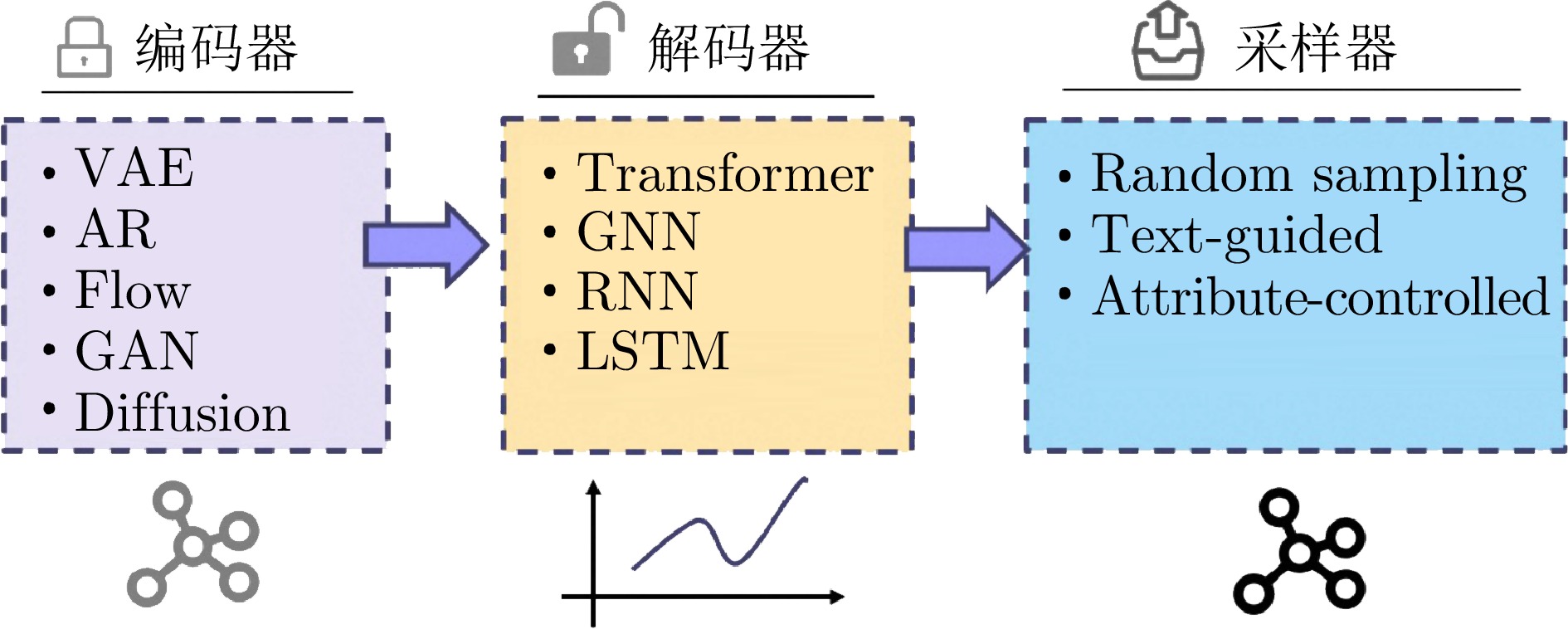
下载:
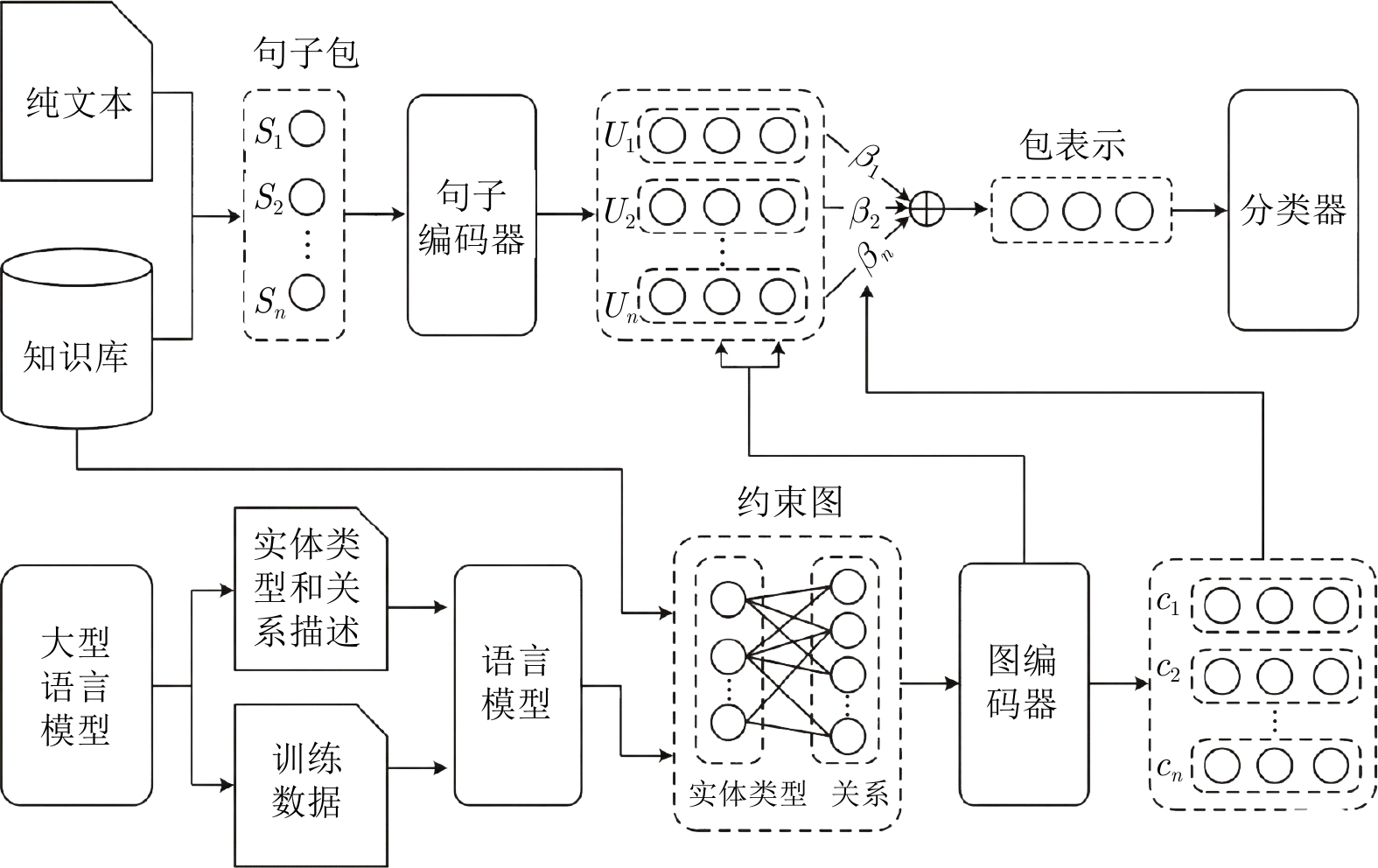
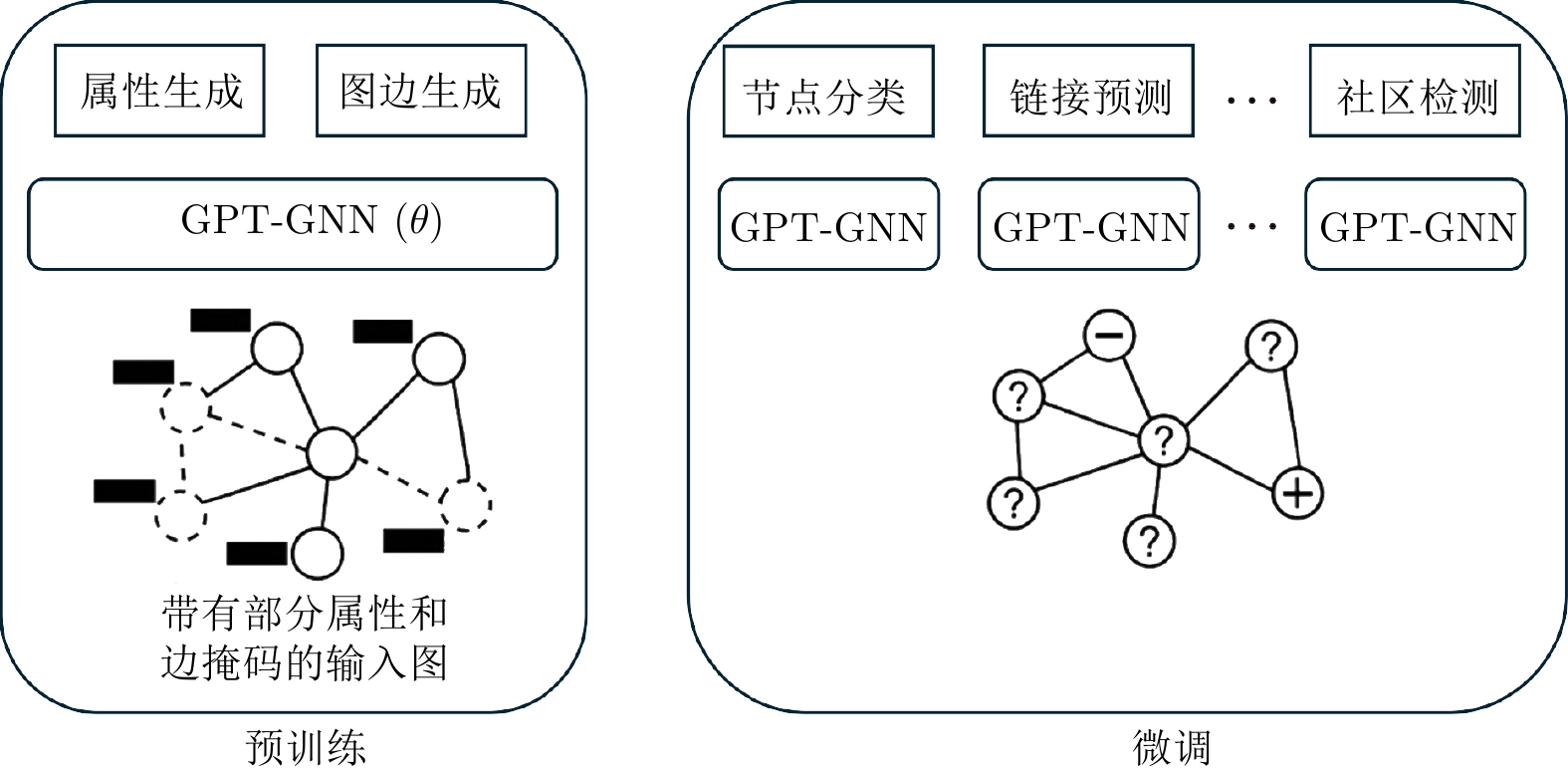

计量
- 文章访问数: 208
- HTML全文浏览量: 237
- PDF下载量: 7
- 被引次数: 0
