


Interval Prediction Method of Power Load Based on Metacognitive Type-2 Fuzzy Neural Network
-
摘要: 针对电力负荷呈现高度非线性和强不确定性等特征导致关键指标难以准确预测的问题, 提出一种基于元认知二型模糊神经网络的区间预测方法. 首先, 设计基于多值映射的二型模糊规则, 利用区间估计技术将规则后件由单值标量扩展为区间向量, 处理不确定性导致的负荷序列变量关联关系偏差并捕捉变量间的非线性关系. 其次, 构建基于误差补偿机制的二型模糊神经网络, 引入动态反馈结构实时感知并补偿累积误差和模型偏差, 实现关键指标高精度预测. 再次, 设计基于区间覆盖率和区间宽度的元认知学习算法, 通过实时评估区间可靠性自适应优化二型模糊神经网络边界估计值, 提高区间预测的置信度. 最后, 将提出的元认知二型模糊神经网络应用于城市电力负荷预测任务. 验证结果显示, 该方法能够提供高置信度且精确的预测区间.
-
关键词:
- 元认知二型模糊神经网络 /
- 区间预测 /
- 区间覆盖率 /
- 区间宽度
Abstract: The prediction of the key indicators is a challenging problem due to the high nonlinearity and strong uncertainties in power load data. To solve this problem, a metacognitive type-2 fuzzy neural network (MCT2FNN)- based interval prediction method is proposed. First, a type-2 fuzzy rule based on multi-value mapping is designed to extend rule consequents from scalar values to interval vectors by using interval estimation technology. It can handle the variable correlation bias caused by uncertainty and capture the nonlinear relationship between the variables in the load series. Second, a type-2 fuzzy neural network (T2FNN) with an error compensation mechanism is established. In this network, a dynamic feedback structure is introduced to perceive and compensate for cumulative errors and model biases in real time, which can achieve high precision prediction of key indicators. Then, an interval coverage probability and interval width-based metacognitive learning algorithm is designed to adaptively optimize the boundary estimates of T2FNN through the real-time assessment of interval reliability, which can improve the confidence level of interval predictions. Finally, the proposed MCT2FNN is applied to interval prediction tasks for the urban power system. The experimental results demonstrate that the method can provide high-confidence and precise prediction intervals for power systems. -
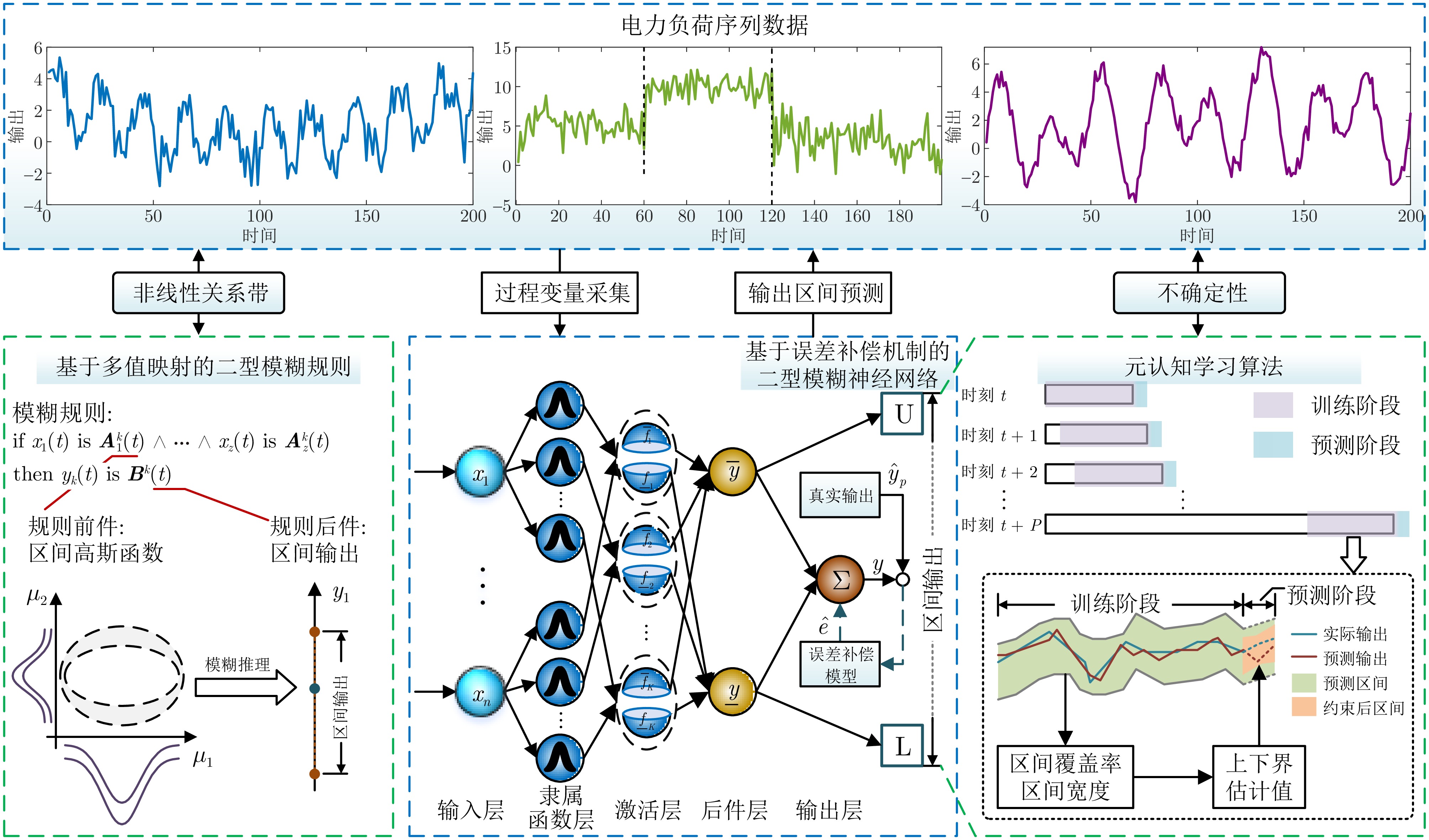
图 1 基于元认知二型模糊神经网络的电力负荷区间预测方法
注: μ1和μ2分别表示第1个输入和第2个输入对应的隶属函数, U和L分别表示区间上界和下界, 电力负荷序列数据的采样间隔为15 min.
Fig. 1 Interval prediction method of power load based on metacognitive type-2 fuzzy neural network
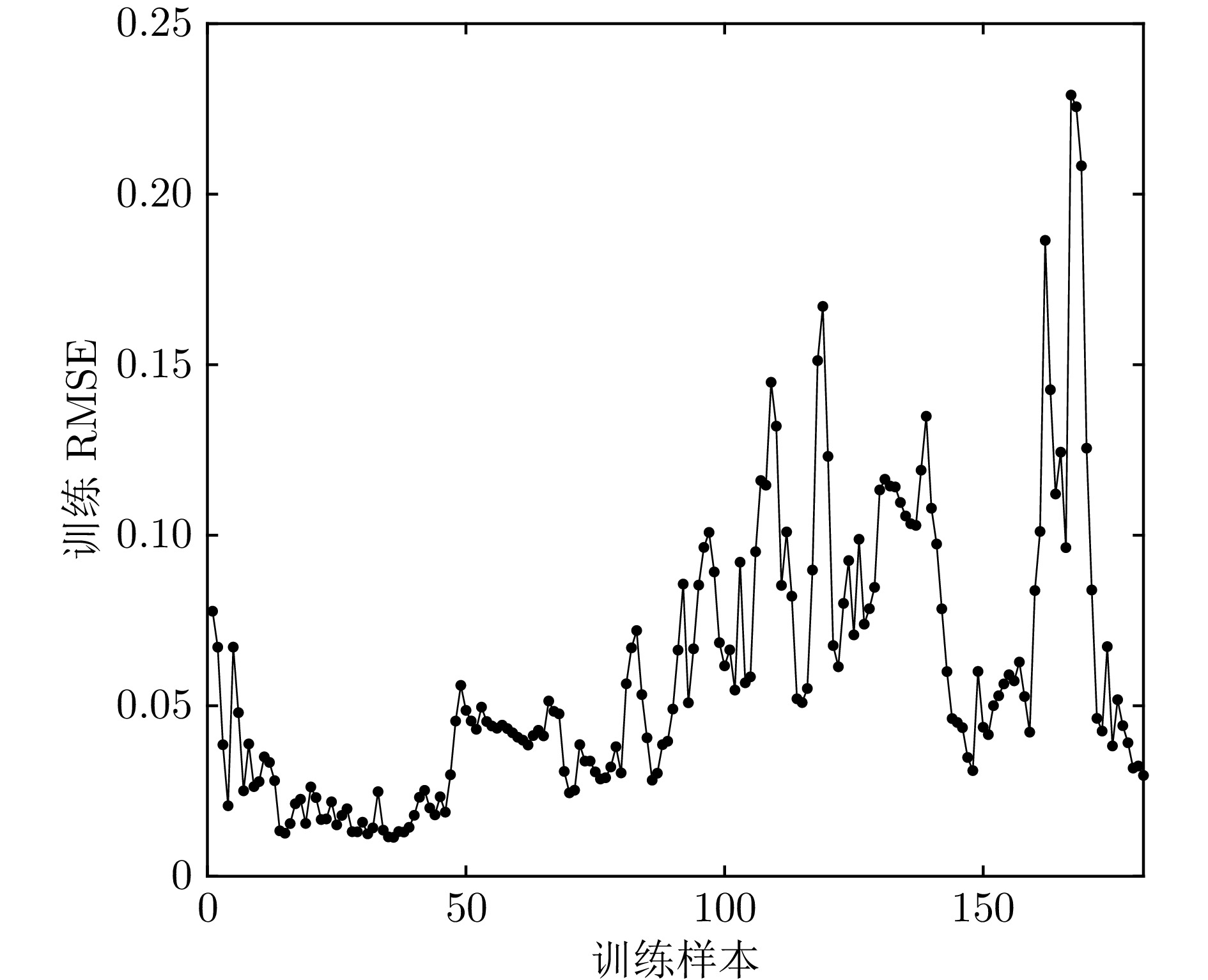
图 3 电力负荷点预测过程的训练RMSE
Fig. 3 The training RMSE of the point prediction process of power load
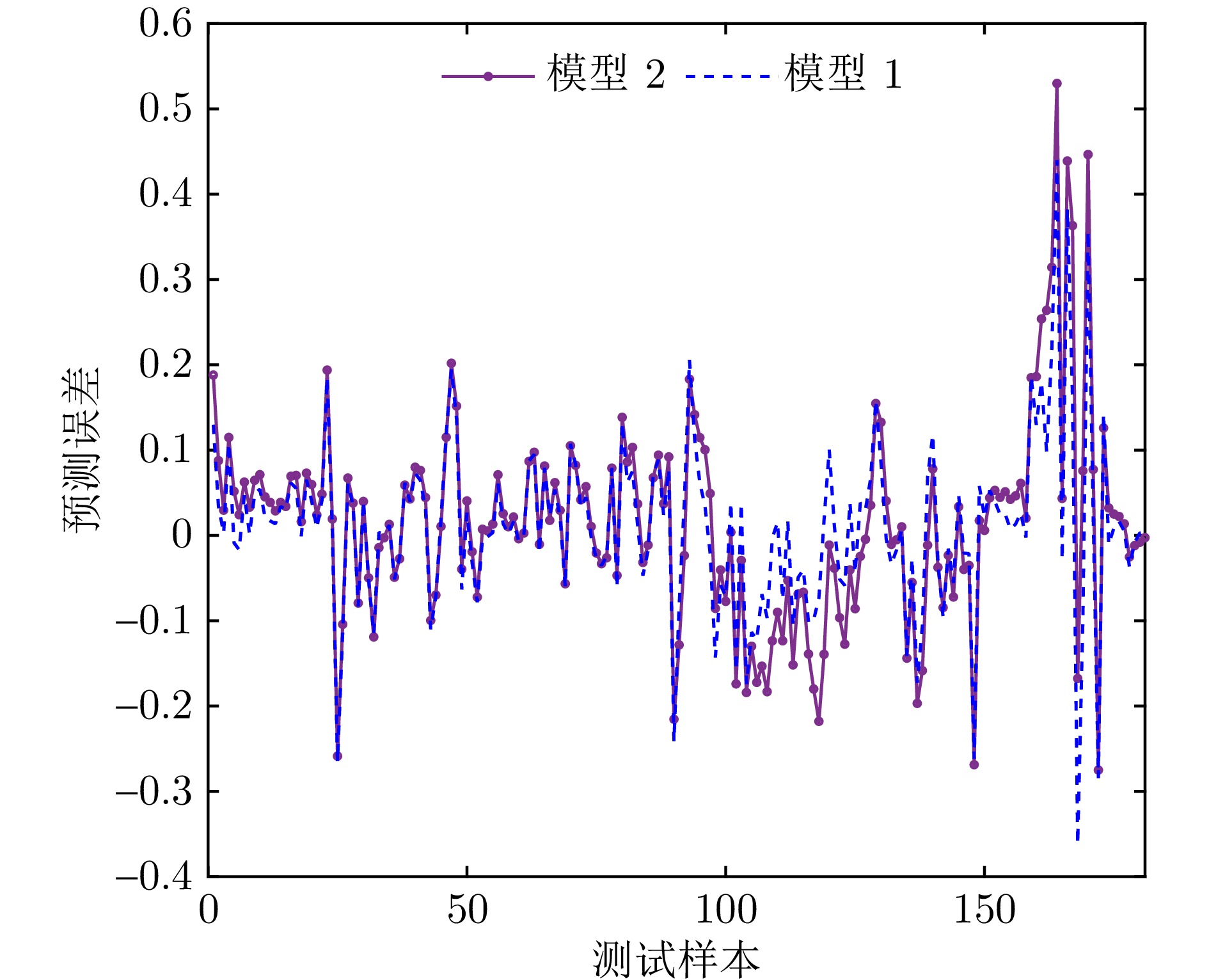
图 5 电力负荷点预测过程的测试预测误差
Fig. 5 The testing prediction error of the point prediction process of power load
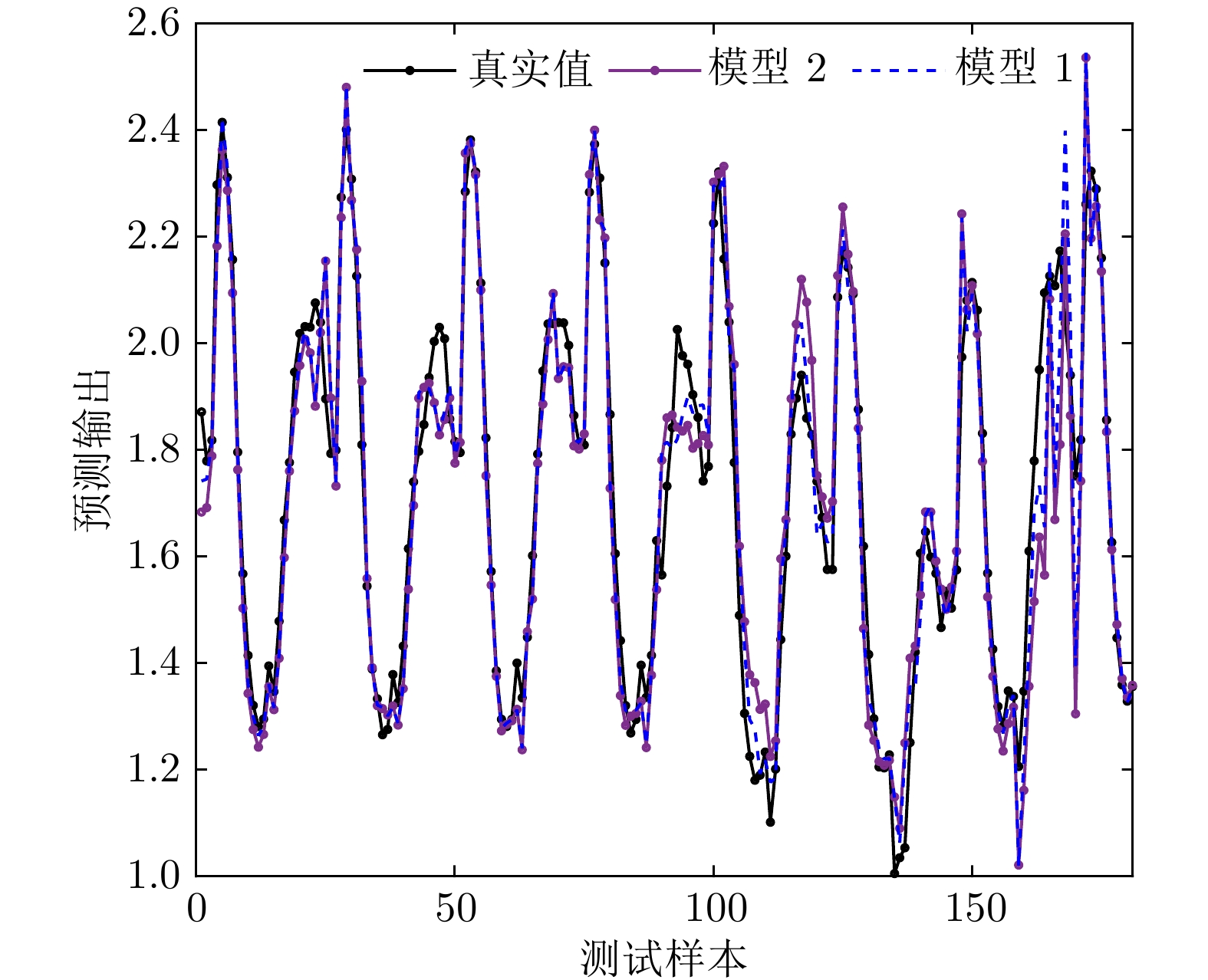
图 4 电力负荷点预测过程的测试预测输出
Fig. 4 The testing prediction output of the point prediction process of power load
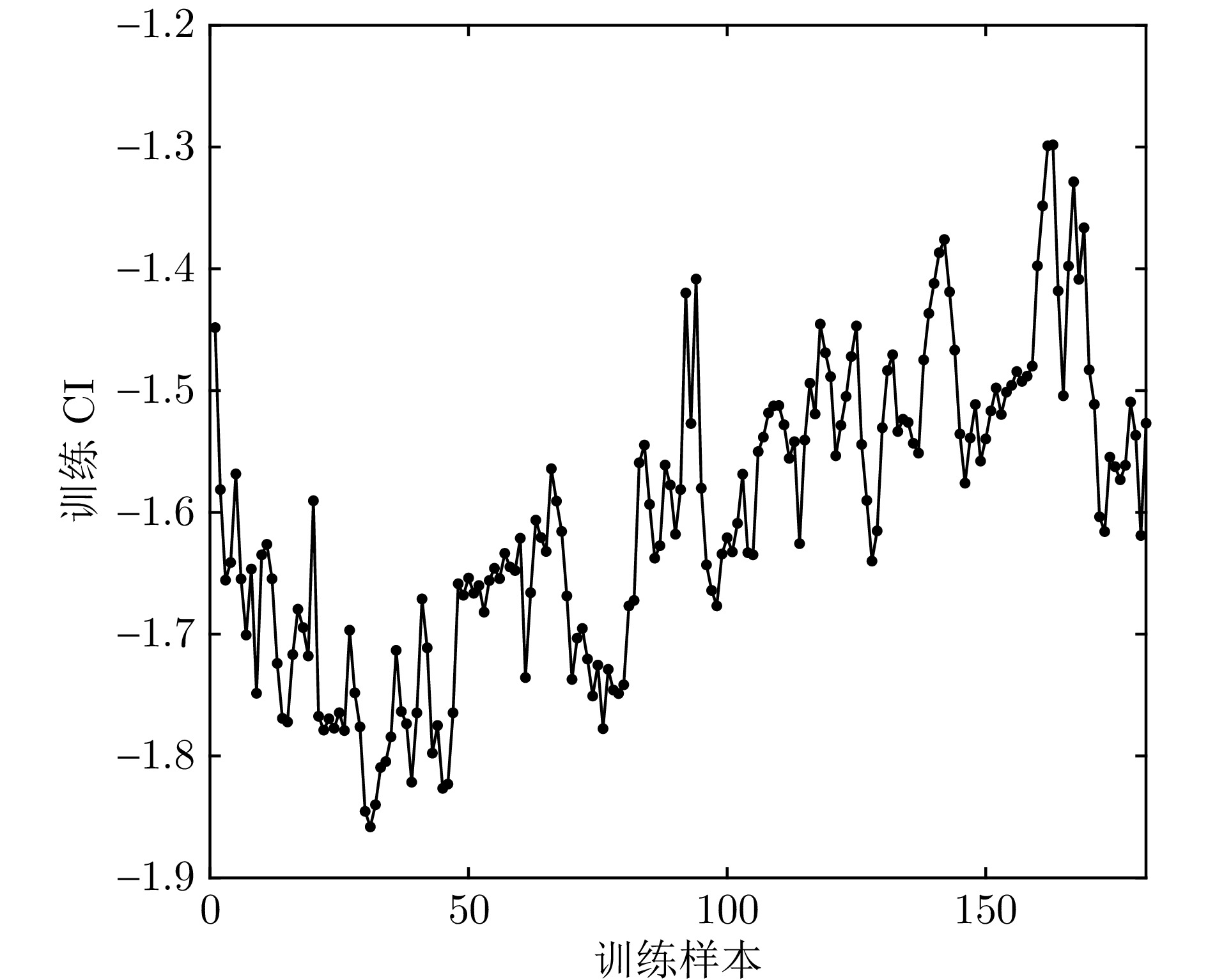
图 7 电力负荷区间预测过程的训练CI
Fig. 7 The training CI of the interval prediction process of power load
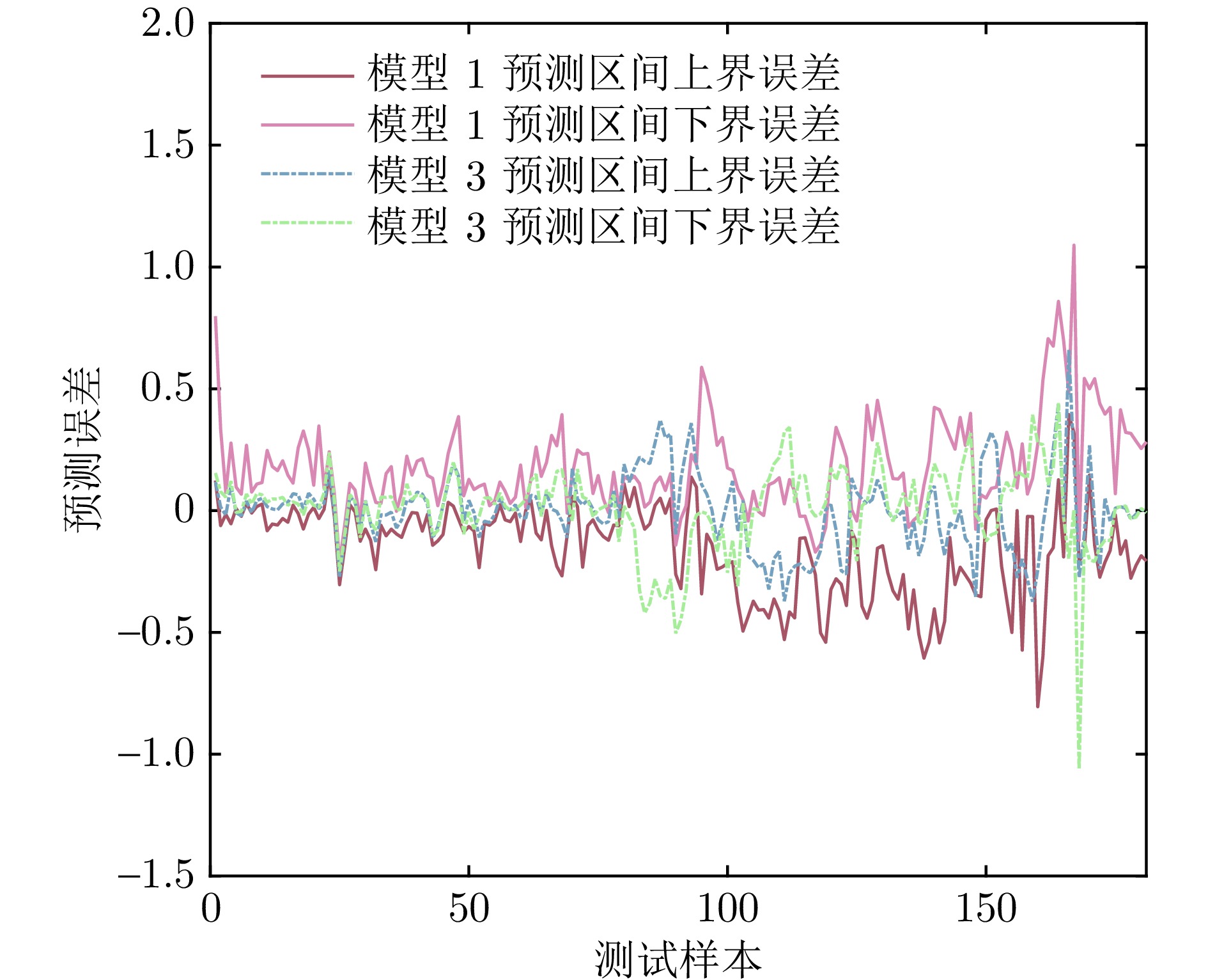
图 9 电力负荷区间预测过程的测试预测误差
Fig. 9 The testing prediction error of the interval prediction process of power load
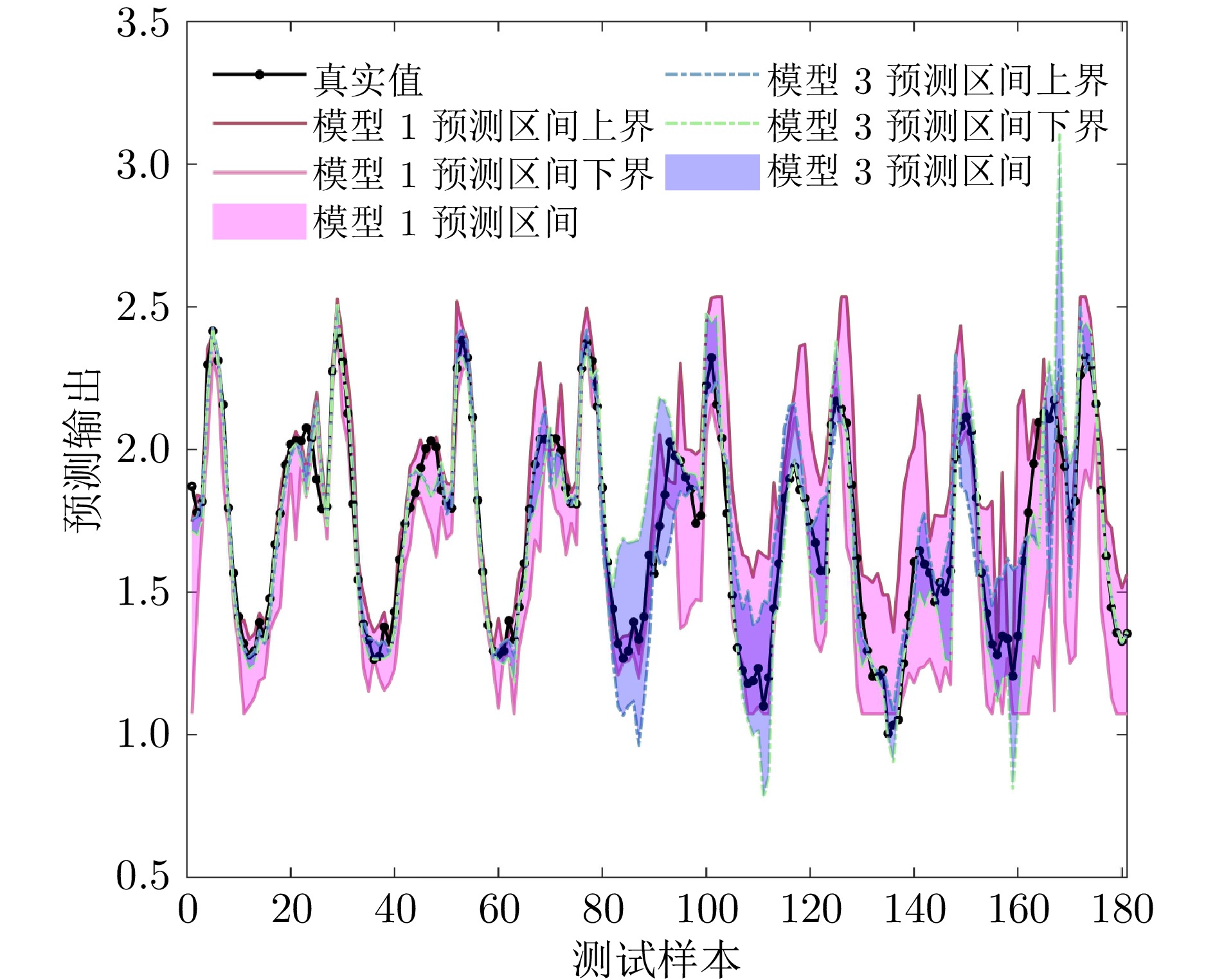
图 8 电力负荷区间预测过程的测试预测输出
Fig. 8 The testing prediction output of the interval prediction process of power load
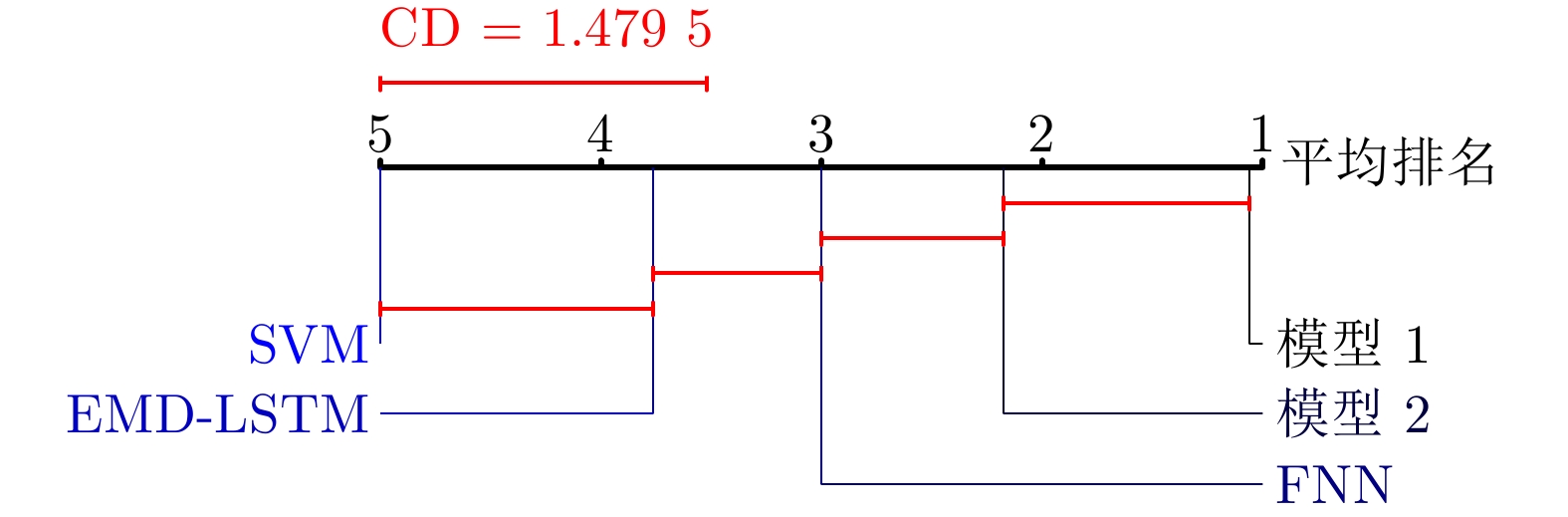
表 1 不同模型性能比较(点预测结果)
Table 1 The performance comparison of different models (Point prediction results)
模型 测试 RMSE 测试$ {\rm{R}}^2 $ 测试 MAPE Mean Dev. Max Mean Dev. Min Mean Dev. Max 模型1 0.1097 0.0141 0.1420 0.9002 0.0269 0.8356 0.0418 0.0022 0.0467 模型2 0.1291 0.0151 0.1646 0.8621 0.0334 0.7789 0.0510 0.0036 0.0570 FNN[32] 0.1526 0.0142 0.1748 0.8077 0.0351 0.7497 0.0561 0.0036 0.0624 EMD-LSTM[38] 0.1721 0.0111 0.1942 0.7575 0.0311 0.6923 0.0802 0.0065 0.0940 SVM[39] 0.2370 — 0.2370 0.5420 — 0.5420 0.1248 — 0.1248  下载: 导出CSV
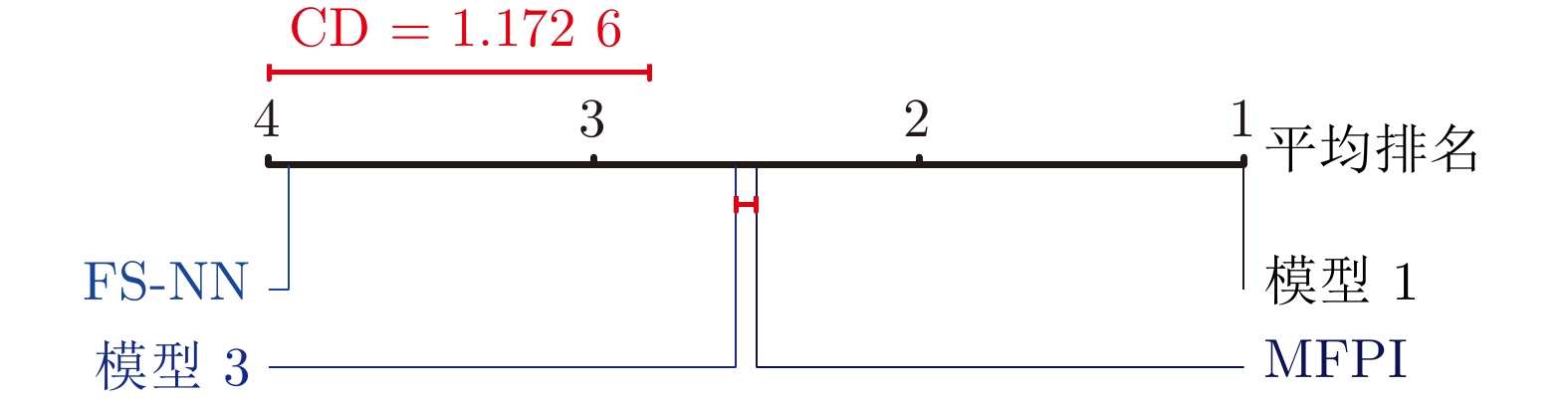
表 2 不同模型性能比较(区间预测结果)
Table 2 The performance comparison of different models (Interval prediction results)
模型 ICP IW CI IR2 Mean Dev. Mean Dev. Mean Dev. Mean Dev. 模型1 0.7835 0.0624 0.0014 0.0007 − 1.5652 0.1242 0.9676 0.0150 模型3 0.1228 0.0576 0.0011 0.0012 − 0.2456 0.1152 0.9166 0.0274 FS-NN[40] 0.5511 0.1363 0.0023 0.0010 − 1.1008 0.2719 0.8291 0.0772 MFPI[41] 0.8337 0.0601 0.0013 0.0004 − 1.6656 0.1192 0.9222 0.0361
下载: 导出CSV
-
[1] 曹力丰, 阎高伟, 肖舒怡, 董珍柱, 董平. 基于域适应物理信息神经网络的时间序列预测方法. 自动化学报, 2025, 51(6): 1329−1346 doi: 10.16383/j.aas.c240566Cao Li-Feng, Yan Gao-Wei, Xiao Shu-Yi, Dong Zhen-Zhu, Dong Ping. Time series prediction method based on domain adaptation physics-informed neural network. Acta Automatica Sinica, 2025, 51(6): 1329−1346 doi: 10.16383/j.aas.c240566 [2] Guo H Y, Wan M J, Wang L D, Liu X D, Pedrycz W. Weighted fuzzy clustering for time series with trend-based information granulation. IEEE Transactions on Cybernetics, 2024, 54(2): 903−914 doi: 10.1109/TCYB.2022.3190705 [3] Li X, Li L K, Zhang K S, Chen X M, Feng T, Zhao Y, et al. Multivariate correlation self-distillation transformer for time series forecasting with incomplete data. IEEE Transactions on Industrial Informatics, 2025, 21(6): 4734−4744 doi: 10.1109/TII.2025.3545099 [4] Drovtar I, Leinakse M, Tuttelberg K, Kilter J. Utilizing demand response in load modelling for voltage and reactive power control studies. IEEE Transactions on Power Systems, 2025, 40(2): 1389−1400 doi: 10.1109/TPWRS.2024.3425157 [5] Zhu C L, Ma X L, Ding W P, Zhan J M. Long-term time series forecasting with multilinear trend fuzzy information granules for LSTM in a periodic framework. IEEE Transactions on Fuzzy Systems, 2024, 32(1): 322−336 doi: 10.1109/TFUZZ.2023.3298970 [6] Ren G R, Liu J Z, Wan J, Wang W, Fang F, Hong F, et al. Investigating the complementarity characteristics of wind and solar power for load matching based on the typical load demand in China. IEEE Transactions on Sustainable Energy, 2022, 13(2): 778−790 doi: 10.1109/TSTE.2021.3131560 [7] He Y, Zhang H L, Dong Y C, Wang C, Ma P. Residential net load interval prediction based on stacking ensemble learning. Energy, 2024, 296: Article No. 131134 doi: 10.1016/j.energy.2024.131134 [8] Jiang F, Wu B, Wen S P, Tian T H. MSDIPN: Multi-scale deep interval prediction network for multivariate time series. IEEE Transactions on Knowledge and Data Engineering, 2025, 37(9): 5452−5466 doi: 10.1109/TKDE.2025.3579406 [9] Zhang C X, Fu Y. Probabilistic electricity price forecast with optimal prediction interval. IEEE Transactions on Power Systems, 2024, 39(1): 442−452 doi: 10.1109/TPWRS.2023.3235193 [10] Lv M Z, Wang J Z, Wang S, Wang K, Zhao Y, Gao J L. A multi-input and three-output wind speed point-interval prediction system based on constrained many-objective optimization problem. Information Sciences, 2025, 720: Article No. 122531 doi: 10.1016/j.ins.2025.122531 [11] Hu J M, Deng Y W, Che J X. A novel wind power interval prediction method based on neural ensemble search and dynamic conformalized quantile regression. Applied Soft Computing, 2025, 180(15): Article No. 113476 doi: 10.1016/j.asoc.2025.113476 [12] Palm B G, Bayer F M, Cintra R J. Prediction intervals in the beta autoregressive moving average model. Communications in Statistics-Simulation and Computation, 2023, 52(8): 3635−3656 doi: 10.1080/03610918.2021.1943440 [13] Pumi G, Valk M, Bisognin C, Bayer F M, Prass T S. Beta autoregressive fractionally integrated moving average models. Journal of Statistical Planning and Inference, 2019, 200: 196−212 doi: 10.1016/j.jspi.2018.10.001 [14] Acharki N, Bertoncello A, Garnier J. Robust prediction interval estimation for Gaussian processes by cross-validation method. Computational Statistics & Data Analysis, 2023, 178: Article No. 107597 doi: 10.1016/j.csda.2022.107597 [15] Zhang Y G, Zhao Y, Pan G F, Zhang J F. Wind speed interval prediction based on Lorenz disturbance distribution. IEEE Transactions on Sustainable Energy, 2020, 11(2): 807−816 doi: 10.1109/TSTE.2019.2907699 [16] Lu J, Ding J L, Liu C X, Chai T Y. Hierarchical-Bayesian-based sparse stochastic configuration networks for construction of prediction intervals. IEEE Transactions on Neural Networks and Learning Systems, 2022, 33(8): 3560−3571 doi: 10.1109/TNNLS.2021.3053306 [17] Wan X, Li X Y, Wang X Z, Yi X H, Zhao Y Z, He X Z, et al. Water quality prediction model using Gaussian process regression based on deep learning for carbon neutrality in papermaking wastewater treatment system. Environmental Research, 2022, 211: Article No. 112942 doi: 10.1016/j.envres.2022.112942 [18] 周平, 刘进进. 基于Stacking的高炉铁水质量区间预测. 控制与决策, 2021, 36(2): 335−344 doi: 10.13195/j.kzyjc.2019.0786Zhou Ping, Liu Jin-Jin. Prediction of blast furnace hot metal quality interval based on stacking. Control and Decision, 2021, 36(2): 335−344 doi: 10.13195/j.kzyjc.2019.0786 [19] Han Z Y, Pedrycz W, Zhao J, Wang W. Hierarchical granular computing-based model and its reinforcement structural learning for construction of long-term prediction intervals. IEEE Transactions on Cybernetics, 2022, 52(1): 666−676 doi: 10.1109/TCYB.2020.2964011 [20] Peng G Z, Cheng Y L, Wang H W, Shen W M. Industrial IoT-enabled prediction interval estimation of mechanical performances for hot-rolling steel. IEEE Transactions on Instrumentation and Measurement, 2022, 71: Article No. 3508010 [21] Chen C, Lu N Y, Jiang B, Xing Y, Zhu Z H. Prediction interval estimation of aeroengine remaining useful life based on bidirectional long short-term memory network. IEEE Transactions on Instrumentation and Measurement, 2021, 70: Article No. 3527213 doi: 10.1016/j.measurement.2022.112093 [22] Wang J, Zhou M, Zhang Q, Li N, Su R. Interval prediction of aeroengine remaining useful life based on BCT-Bayesian bidirectional LSTM network. IEEE Transactions on Aerospace and Electronic Systems, 2025, 61(5): 14344−14355 doi: 10.1109/TAES.2025.3584329 [23] Guan S P, Xu C Y, Guan T Y. Multistep interval prediction model with adjustable horizon for uncertain power load forecasting. Energy, 2025, 335: Article No. 137768 doi: 10.1016/j.energy.2025.137768 [24] He Y Y, Zhu J H, Wang S. A novel neural network-based multiobjective evolution lower upper bound estimation method for electricity load interval forecast. IEEE Transactions on Systems, Man, and Cybernetics: Systems, 2024, 54(5): 3069−3083 doi: 10.1109/TSMC.2024.3352665 [25] Guan S P, Xu C Y, Guan T Y. Multistep power load forecasting using iterative neural network-based prediction intervals. Computers and Electrical Engineering, 2024, 119: Article No. 109518 doi: 10.1016/j.compeleceng.2024.109518 [26] He X, Zhao W L, Gao Z J, Zhang Q S, Wang W. A hybrid prediction interval model for short-term electric load forecast using holt-winters and gate recurrent unit. Sustainable Energy, Grids and Networks, 2024, 38: Article No. 101343 doi: 10.1016/j.segan.2024.101343 [27] Zhu Q L, Xu Y J, Lin Q Z, Ming Z, Tan K C. Clustering-based short-term wind speed interval prediction with multi-objective ensemble learning. IEEE Transactions on Emerging Topics in Computational Intelligence, 2025, 9(1): 304−317 doi: 10.1109/TETCI.2024.3400852 [28] Xu Y, Li J, Dong Y, Du P. Power load combination forecasting system based on longitudinal data selection. Engineering Applications of Artificial Intelligence, 2024, 130: Article No. 107629 doi: 10.1016/j.engappai.2023.107629 [29] Tang G, Wu Y F, Li C S, Wong P K, Xiao Z H, An X L. A novel wind speed interval prediction based on error prediction method. IEEE Transactions on Industrial Informatics, 2020, 16(11): 6806−6815 doi: 10.1109/TII.2020.2973413 [30] Zhou M, Zhang Y Y, Wang J, Xue T L. LSTM-OBE based interval prediction of effluent BOD for wastewater treatment. IFAC-PapersOnLine, 2023, 56(2): 8488−8493 doi: 10.1016/j.ifacol.2023.10.1137 [31] Zhang Y F, Wen H L, Wu Q W, Ai Q. Optimal adaptive prediction intervals for electricity load forecasting in distribution systems via reinforcement learning. IEEE Transactions on Smart Grid, 2023, 14(4): 3259−3270 doi: 10.1109/TSG.2022.3226423 [32] Zhang L J, Shi Y, Chang Y C, Lin C T. Robust fuzzy neural network with an adaptive inference engine. IEEE Transactions on Cybernetics, 2024, 54(5): 3275−3285 doi: 10.1109/TCYB.2023.3241170 [33] Ran X H, Tay W P, Lee C H T. Uncertain interval-based risk dispatch approach of power systems under an unified framework of multiple uncertainties. IEEE Transactions on Industrial Informatics, 2025, 21(3): 2053−2063 doi: 10.1109/TII.2024.3485761 [34] Sun C X, Wu X L, Yang H Y, Han H G, Zhao D Z. Multimodal learning-based interval type-2 fuzzy neural network. IEEE Transactions on Fuzzy Systems, 2024, 32(11): 6409−6423 doi: 10.1109/TFUZZ.2024.3449325 [35] Khanesar M A, Branson D T. Prediction interval identification using interval type-2 fuzzy logic systems: Lake water level prediction using remote sensing data. IEEE Sensors Journal, 2021, 21(12): 13815−13827 doi: 10.1109/JSEN.2021.3067841 [36] Liu Y, Zhao J, Wang W, Pedrycz W. Prediction intervals for granular data streams based on evolving type-2 fuzzy granular neural network dynamic ensemble. IEEE Transactions on Fuzzy Systems, 2021, 29(4): 874−888 doi: 10.1109/TFUZZ.2020.2966172 [37] Salam A, El Hibaoui A. Comparison of machine learning algorithms for the power consumption prediction: Case study of Tetouan city. In: Proceedings of the 6th International Renewable and Sustainable Energy Conference. Rabat, Morocco: IEEE, 2018. 1−5 [38] Zhang Y T, Li C L, Jiang Y Q, Sun L, Zhao R B, Yan K F, et al. Accurate prediction of water quality in urban drainage network with integrated EMD-LSTM model. Journal of Cleaner Production, 2022, 354: Article No. 131724 doi: 10.1016/j.jclepro.2022.131724 [39] Waqas S, Harun N Y, Sambudi N S, Arshad U, Nordin N A H M, Bilad M R, et al. SVM and ANN modelling approach for the optimization of membrane permeability of a membrane rotating biological contactor for wastewater treatment. Membranes, 2022, 12(9): Article No. 821 doi: 10.3390/membranes12090821 [40] Niu Y B, Wang J Z, Zhang Z Y, Yu Y N, Liu J J. A combined interval prediction system based on fuzzy strategy and neural network for wind speed. Applied Soft Computing, 2024, 155: Article No. 111408 doi: 10.1016/j.asoc.2024.111408 [41] Rafique S F, Zhang J H, Rafique R, Guo J, Jamil I. Renewable generation (wind/solar) and load modeling through modified fuzzy prediction interval. International Journal of Photoenergy, 2018, 2018(1): Article No. 4178286 doi: 10.1155/2018/4178286 -

 下载:
下载:

计量
- 文章访问数: 629
- HTML全文浏览量: 290
- PDF下载量: 198
- 被引次数: 0
