


Vision-Based Keypoint Recognition Algorithms for Intelligent Acupoint Robots: A Survey
-
摘要: 腧穴定位精度直接影响针灸、艾灸和推拿等疗法的疗效. 传统定位依赖医师经验, 主观性强、稳定性差, 难以支撑标准化临床应用. 计算机视觉与具身智能的发展, 使基于视觉的腧穴关键点识别成为体表定位自动化、精准化的基础, 并推动智能腧穴机器人落地. 首次提出面向腧穴关键点识别的层级化分类框架, 系统梳理从人工先验规则到融合图像处理、深度学习及三维重建的定位范式, 并剖析RTMPose、HRNet、Faster R-CNN、YOLO-Pose等代表性算法在定位精度、实时性与计算效能上的适用边界. 针对数据集与评价指标不统一造成的性能对比偏差, 总结主流腧穴数据集与评估体系, 分析跨数据集横向对比的局限. 为弥合算法指标与机器人实际执行间的工程鸿沟, 提出将像素级误差转换为三维物理尺度误差的量化方法, 为临床规范化应用提供指引. 最后归纳动态遮挡、模型泛化瓶颈与实时性需求等落地挑战, 并结合具身智能与多模态感知展望智能腧穴机器人的发展趋势.Abstract: The accuracy of acupoint localization directly affects the efficacy of therapies such as acupuncture, moxibustion, and Tuina. Conventional localization relies on physician experience and suffers from high subjectivity and poor stability, making it difficult to support standardized clinical practice. Advances in computer vision and embodied intelligence have made vision-based acupoint keypoint recognition a foundation for automated and precise body-surface localization, and have promoted the deployment of intelligent acupoint robots. A hierarchical classification framework for acupoint keypoint recognition is first proposed. Localization paradigms are reviewed from heuristic prior rules to methods that combine image processing, deep learning, and 3D reconstruction. Representative algorithms such as RTMPose, HRNet, Faster R-CNN, and YOLO-Pose are then compared in localization accuracy, real-time performance, and computational efficiency. To address benchmarking bias caused by inconsistent datasets and evaluation metrics, mainstream acupoint datasets and evaluation protocols are summarized, and the limitations of cross-dataset comparison are analyzed. To bridge the engineering gap between algorithmic metrics and actual robotic execution, a quantitative method is proposed to convert pixel-level errors into 3D physical-scale errors, providing guidance for standardized clinical application. Finally, deployment challenges such as dynamic occlusion, model generalization bottlenecks, and real-time requirements are summarized, and future trends of intelligent acupoint robots are outlined in combination with embodied intelligence and multimodal perception.
-
Key words:
- acupoint recognition /
- computer vision /
- keypoint recognition /
- human pose estimation
-
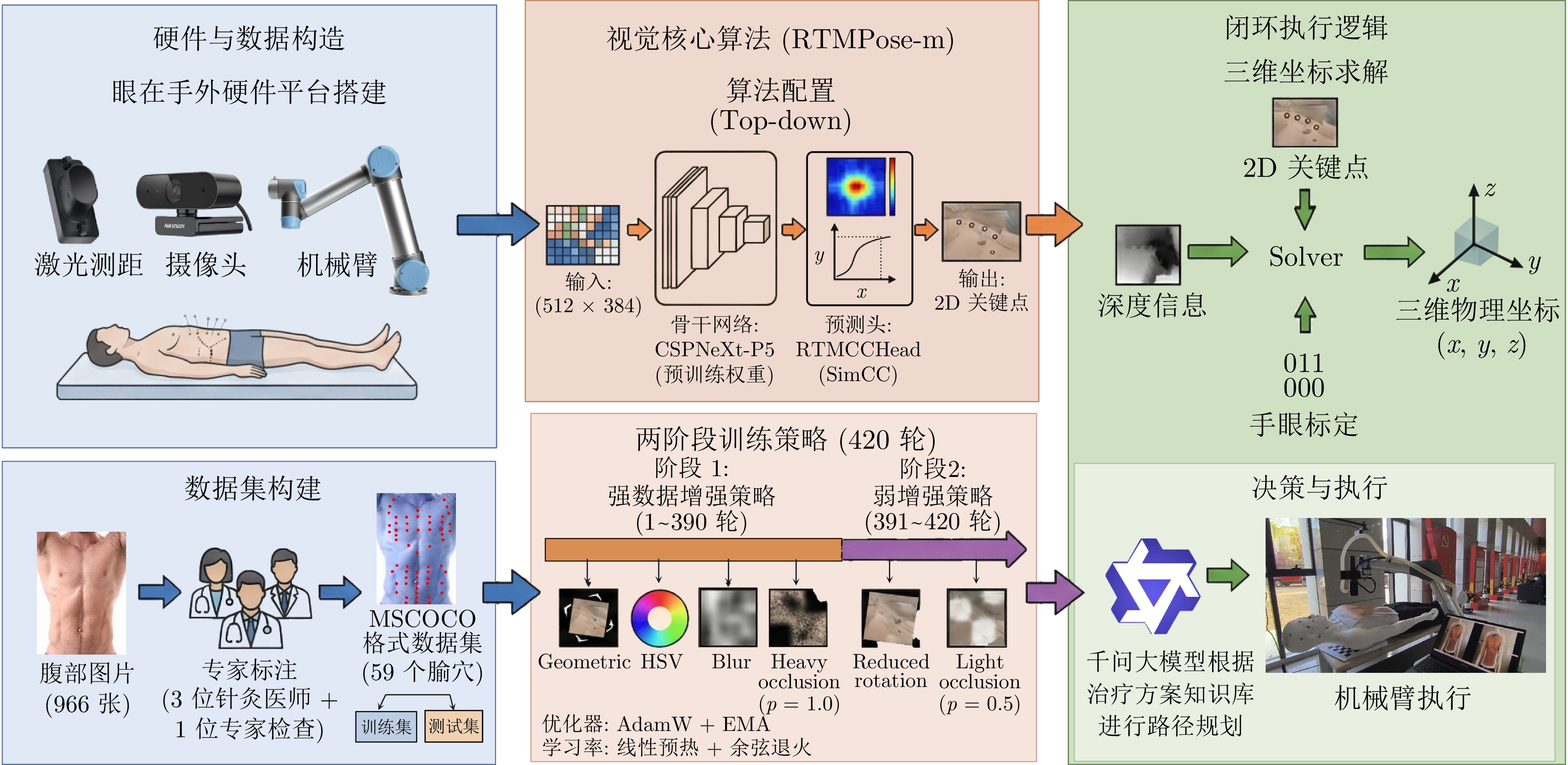
图 3 智能腧穴机器人实验系统总体架构
Fig. 3 Overall architecture of the intelligent acupoint robot experiment system
表 1 不同算法在MS COCO val2017数据集上的性能评估对比
Table 1 Performance evaluation comparison of different algorithms on the MS COCO val2017 dataset
模型名称 训练集名称 训练集数量(千张) AP(%) 参数量(百万) 计算量(GFLOPs) RTMPose-m[35] MS COCO + AI Challenger 328 75.3 13.59 1.93† HRNet-W48[36] MS COCO 118 76.3 63.60 32.90† OpenPose[66] MPII + COCO 143 61.8 25.90 160.00 YOLO-Pose-s[40] MS COCO 118 63.8 15.10 45.60 YOLO-Pose-m[40] MS COCO 118 67.4 41.40 132.60 YOLO-Pose-l[40] MS COCO 118 69.4 87.00 291.20 注: 1. 本表统计数据直接引用自各算法对应的原参考文献.MS COCO指Microsoft Common Objects in Context数据集, 测试基准统一为MS COCO val2017(OpenPose为test-dev).
2. 平均精度(average precision, AP)用于衡量关键点检测性能; 十亿次浮点运算(giga floating-point operations, GFLOPs)用于表征计算量; †标记表示自上而下(top-down)方法(RTMPose, HRNet)的计算量仅包含单人姿态估计网络, 不包含人体检测器开销; 其余为全图推理开销. 下载: 导出CSV
表 2 基于不同视觉算法的腧穴识别典型应用案例分析
Table 2 Analysis of typical application cases of acupoint recognition based on different visual algorithms
典型案例 使用算法 训练集数量 腧穴数量 评价指标 报告结果 适用性评价(优/劣势) 文献[61] RTMPose 1 000张 53个 PCK 98.2% 优势: 轻量高效, 适合特征密集的局部小区域
劣势: 小样本下跨场景泛化能力受限魏雨等[65] Faster R-CNN 2 000张 19个 mAP 92% 优势: 双阶段对“小目标”特征提取充分, 鲁棒性强
劣势: 推理速度较慢, 模型结构相对冗重况荣欣[11] HRNet 5 000张 43个 识别准确率、
平均像素误差96.3%(误差
1.95个像素)优势: 全程保持高分辨率, 对平坦躯干精细定位极强
劣势: 计算资源消耗大, 实时性稍弱王聪[67] OpenPose 200张 5个(大面积)
9个(复杂部位)准确率 大面积: 94.5%
复杂部位: 93.4%优势: 结合深度信息, 对复杂肢体形态的适应性较好
劣势: 密集点位下易出现关键点分组错误王甘红等[7] YOLOv8 660张 21个 mAP50、精确率、
召回率、F1召回率: 0.997
F1分数: 0.995优势: 单阶段极速推理, 易于移动端/工程侧部署
劣势: 对微小尺度或极度形变的回归精度有上限注: 1. 表中数据均引自对应参考文献的实验结果;
2. 由于各研究均采用自建私有数据集, 且应用部位与评价指标(PCK, mAP, 像素误差等)不统一, 表列数值仅代表该算法在特定场景下的可行性, 不具备直接横向可比性.
下载: 导出CSV
-
[1] Battaloğlu Inanç B. A new theory on the evaluation of traditional Chinese acupuncture mechanisms from the latest medical scientific point of view. Acupuncture & Electro-therapeutics Research, 2015, 40: 189−204 [2] Zhang Y. Interpretation of acupoint location in traditional Chinese medicine teaching: implications for acupuncture in research and clinical practice. The Anatomical Record, 2021, 304: 2372−2380 [3] Zhu J J, Li J C, Yang L J, et al. Acupuncture, from the ancient to the current. The Anatomical Record, 2021, 304: 2365−2371 [4] De Asis A. Acupuncture and modern medicine. Crossing the Border: International Journal of Interdisciplinary Studies, 2015, 3: 99−106 [5] Wang T Q, Wang Y J, Xu S T. Retesting conjecture of acupuncture in traditional Chinese medicine theory. Acupuncture & Electro-therapeutics Research, 2021, 47: 59−68 [6] Zheng C, Wu W, Chen C, et al. Deep learning-based human pose estimation: a survey. ACM Computing Surveys, 2024, 56: 1−37 [7] 王甘红, 张子豪, 夏开建, 等. 基于YOLO神经网络构建耳穴特征点辅助检测的人工智能辅助系统. 中国针灸, 2025, 45(4): 413−420Wang G H, Zhang Z H, Xia K J, et al. Construction of an artificial intelligence-assisted system for auxiliary detection of auricular point features based on the YOLO neural network. Chinese Acupuncture & Moxibustion, 2025, 45(4): 413−420 [8] Wang Y, Shi X, Efforth T, et al. Artificial intelligence-directed acupuncture: a review. Chinese Medicine, 2022, 17(1 [9] Hu W, Sheng Q, Sheng X. A novel realtime vision-based acupoint estimation for TCM massage robot. In: Proceedings of the 27th International Conference on Mechatronics and Machine Vision in Practice (M2VIP), 2021: 771-776 [10] 龚娜. 三维人体穴位配准系统研建[D]. 北京林业大学, 2023Gong N. Development of 3D Human Acupoint Registration System[D]. Beijing Forestry University, 2023 [11] 况荣欣. 基于深度学习的人体背部穴位的识别与定位[D]. 南昌大学, 2022Kuang R X. Recognition and localization of human back acupoints based on deep learning[D]. Nanchang University, 2022 [12] 李树佳. 中医热敏灸机器人的视觉建模及轨迹自动规划[D]. 广东工业大学, 2021Li S J. Visual Modeling and Automatic Trajectory Planning of TCM Heat-Sensitive Moxibustion Robot[D]. Guangdong University of Technology, 2021 [13] 朱文潋. 面向动态三维曲面跟踪的艾灸机械臂控制系统设计[D]. 电子科技大学, 2024Zhu W L. Design of Control System for Moxibustion Robotic Arm Oriented to Dynamic 3D Surface Tracking[D]. University of Electronic Science and Technology of China, 2024 [14] 鲁守银, 李臣. 中医按摩机器人关键技术研究进展. 山东建筑大学学报, 2017, 32(1): 60−68Lu S Y, Li C. Research progress on key technologies of TCM massage robot. Journal of Shandong Jianzhu University, 2017, 32(1): 60−68 [15] Wang G J, Ayati M H, Zhang W B. Meridian studies in China: a systematic review. Journal of Acupuncture and Meridian Studies, 2010, 3: 1−9 doi: 10.1016/s2005-2901(10)60001-5 [16] Matos L C, Machado J P, Monteiro F J, et al. Understanding traditional Chinese medicine therapeutics: an overview of the basics and clinical applications. Healthcare, 2021, 9: 257 doi: 10.3390/healthcare9030257 [17] Godson D R, Wardle J L. Accuracy and precision in acupuncture point location: a critical systematic review. Journal of Acupuncture and Meridian Studies, 2019, 12: 52−66 [18] Lim S. WHO standard acupuncture point locations. Evidence-based Complementary and Alternative Medicine, 2010, 7: 167−168 [19] 金洵, 丁曙晴, 时飞跃, 等. 基于CT三维重建的八髎穴骨度折量定位探析. 南京中医药大学学报, 2018(2): 143−146Jin X, Ding S Q, Shi F Y, et al. Analysis of Baliao acupoint bone-length measurement positioning based on CT 3D reconstruction. Journal of Nanjing University of Traditional Chinese Medicine, 2018(2): 143−146 [20] 黄涛. "同身寸"术语考证. 中国针灸, 2018(2): 195−197Huang T. Textual research on the term "tong-shen-cun". Chinese Acupuncture & Moxibustion, 2018(2): 195−197 [21] 楼新法, 蒋松鹤. 穴位的解剖学特征及其分类. 中国针灸, 2012(4): 319−323Lou X F, Jiang S H. Anatomical characteristics and classification of acupoints. Chinese Acupuncture & Moxibustion, 2012(4): 319−323 [22] Lugaresi C, Tang J, et al. MediaPipe: a framework for building perception pipelines. arXiv preprint arXiv: 1906.08172, 2019 [23] 高焕兵, 鲁守银, 王涛, 等. 中医按摩机器人研制与开发. 机器人, 2011, 33(5): 553−562Gao H B, Lu S Y, Wang T, et al. Development of TCM massage robot. Robot, 2011, 33(5): 553−562 [24] 张化凯, 鲁守银, 杜光月. 基于模板匹配的穴位定位与跟踪研究. 科技通报, 2011(5): 666−670Zhang H K, Lu S Y, Du G Y. Research on acupoint localization and tracking based on template matching. Bulletin of Science and Technology, 2011(5): 666−670 [25] Chan T W, Zhang C, Ip W H, et al. A combined deep learning and anatomical inch measurement approach to robotic acupuncture points positioning. In: Proceedings of the 43rd Annual International Conference of the IEEE Engineering in Medicine & Biology Society (EMBC), 2021: 2597-2600 [26] 常志强, 张杰, 彭科, 等. 基于深度学习的手部穴位定位研究. 传感技术学报, 2024, 37(11): 1893−1902Chang Z Q, Zhang J, Peng K, et al. Research on hand acupoint positioning based on deep learning. Chinese Journal of Sensors and Actuators, 2024, 37(11): 1893−1902 [27] 孔凡国, 王炜洲. 基于三维视觉定位穴位的艾灸系统设计. 机械工程与自动化, 2023(3): 13−15Kong F G, Wang W Z. Design of moxibustion system based on 3D visual positioning of acupoints. Mechanical Engineering & Automation, 2023(3): 13−15 [28] 赵海, 缪九男, 刘晓, 等. 基于模体PageRank算法识别穴位-疾病网络的关键节点. 东北大学学报(自然科学版), 2024, 45(5): 628−635Zhao H, Miao J N, Liu X, et al. Identification of key nodes in acupoint-disease network based on motif PageRank algorithm. Journal of Northeastern University (Natural Science), 2024, 45(5): 628−635 [29] 马蓓蓓, 胡志刚, 时鹏, 等. 艾灸机器人系统设计与实现. 计算机工程, 2024(2): 214−223Ma B B, Hu Z G, Shi P, et al. Design and implementation of moxibustion robot system. Computer Engineering, 2024(2): 214−223 [30] Zhang F, An Q, Song W, et al. Research on human acupoint detection by integrating key point information and acupoint theory. IEEE Access, 2024, 12: 181889−181898 [31] Malekroodi H S, Yi, et al. A computer vision approach for identifying acupuncture points on the face and hand using the MediaPipe framework. In: Proceedings of the Annual Conference of KIPS, 2023: 563-565 [32] Zheng Y, Zhang S, Zhang L, et al. Design and performance evaluation of a home-based automatic acupoint identification and treatment system. IEEE Access, 2024, 12: 25491−25500 [33] 韦哲, 张宇刚, 张秉玺, 等. 经穴电阻特异性在人体穴位识别中的应用研究进展. 中国医学装备, 2019, 16(3): 165−167Wei Z, Zhang Y G, Zhang B X, et al. Research progress on the application of specific resistance of meridian acupoints in human acupoint recognition. China Medical Equipment, 2019, 16(3): 165−167 [34] Li J, Fei Z, Xie Y, et al. A review of acupoint localization based on deep learning. Chinese Medicine, 2025, 20 [35] Jiang T, Lu P, Zhang L, et al. RTMPose: real-time multi-person pose estimation based on MMPose. 2023 [36] Sun K, Xiao B, Liu D, et al. Deep high-resolution representation learning for human pose estimation. In: Proceedings of the IEEE/CVF Conference on Computer Vision and Pattern Recognition (CVPR), 2019: 5686-5696 [37] Wei S E, Ramakrishna V, Kanade T, et al. Convolutional pose machines. 2016 [38] Cheng B, Xiao B, Wang J, et al. HigherHRNet: scale-aware representation learning for bottom-up human pose estimation. 2019 [39] Zhou X, Wang D, Krähenbühl P. Objects as points. 2019 [40] Maji D, Nagori S, Mathew M, et al. YOLO-Pose: enhancing YOLO for multi person pose estimation using object keypoint similarity loss. 2022 [41] Bazarevsky V, Grishchenko I, Raveendran K, et al. BlazePose: on-device real-time body pose tracking. 2020 [42] Wang H, Liu J, Zhao J, et al. Precision and speed: LSOD-YOLO for lightweight small object detection. Expert Systems with Applications, 2025, 269: 126440 [43] Liu Y, Sun P, Wergeles N, et al. A survey and performance evaluation of deep learning methods for small object detection. Expert Systems with Applications, 2021, 172: 114602 [44] Bao Y, Ding H, Zhang Z, et al. Intelligent acupuncture: data-driven revolution of traditional Chinese medicine. Acupuncture and Herbal Medicine, 2023, 3(4): 271−284 [45] 孙一民. 基于双目视觉的针灸机器人面部寻穴及轨迹规划的研究[D]. 哈尔滨理工大学, 2023Sun Y M. Research on facial acupoint finding and trajectory planning of acupuncture robot based on binocular vision[D]. Harbin University of Science and Technology, 2023 [46] Wang C Y, Yeh, et al. YOLOv9: learning what you want to learn using programmable gradient information. In: Proceedings of the European Conference on Computer Vision, 2024: 1-21 [47] Liu Y B, Qin J H, Zeng G F. Back acupoint location method based on deep learning. Research Square Platform LLC, 2022 [48] Seo S D, Madusanka N, Malekroodi H S, et al. Accurate acupoint localization in 2D hand images: evaluating HRNet and ResNet architectures for enhanced detection performance. Current Medical Imaging, 2024, 20 [49] Wang H, Liu L, Wang Y, et al. Hand acupuncture point localization method based on a dual-attention mechanism and cascade network model. Biomedical Optics Express, 2023, 14(11): 5965 [50] Zhang T, Yang H, Ge W, et al. An image-based facial acupoint detection approach using high-resolution network and attention fusion. IET Biometrics, 2023, 12(3): 146−158 [51] Sun X, Dong J, Li Q, et al. Deep learning-based auricular point localization for auriculotherapy. IEEE Access, 2022, 10: 112898−112908 [52] Li Q, Chen Y, Pang Y, et al. An AAM-based identification method for ear acupoint area. Biomimetics, 2023, 8(3): 307 [53] Zheng Y, Chen S, He Q. Deep learning approach for hand acupoint localization combining reflex zones and topological keypoints. Procedia Computer Science, 2024, 250: 30−36 [54] 黄凌风, 杨世龙, 谢耀钦. YOLO-PointMap: 基于轻量化动态特征融合的实时人体背部穴位识别. 集成技术, 2025, 14(2): 58−70Huang L F, Yang S L, Xie Y Q. YOLO-PointMap: real-time human back acupoint recognition based on lightweight dynamic feature fusion. Integration Technology, 2025, 14(2): 58−70 [55] Hampali S, Sarkar S D, Rad M, et al. Keypoint Transformer: solving joint identification in challenging hands and object interactions for accurate 3D pose estimation. In: Proceedings of the IEEE/CVF Conference on Computer Vision and Pattern Recognition (CVPR), 2022: 11080-11090 [56] Yang S, Zang Q, Huang L, et al. RT-DEMT: a hybrid real-time acupoint detection model combining Mamba and Transformer. Elsevier BV, 2024 [57] 王雪军, 徐天成, 张小强, 等. 基于双目视觉的穴位坐标测量. 电子测量技术, 2018, 41(22): 66−70Wang X J, Xu T C, Zhang X Q, et al. Acupoint coordinate measurement based on binocular vision. Electronic Measurement Technology, 2018, 41(22): 66−70 [58] Lin S, Yi P. Human acupoint positioning system based on binocular vision. IOP Conference Series: Materials Science and Engineering, 2019, 569(4): 042029 [59] 冀晓昀. 基于改进图卷积的艾灸机器人穴位检测方法研究[D]. 上海应用技术大学, 2023Ji X Y. Research on Acupoint Detection Method of Moxibustion Robot Based on Improved Graph Convolution[D]. Shanghai Institute of Technology, 2023 [60] He L, Yang H, Li K, et al. Research on acupuncture robots based on the OptiTrack motion capture system and a robotic arm. Journal of Traditional Chinese Medicine, 2025, 45(1): 201−212 [61] TommyZihao. PointWise Body, 2023 [62] Lyu C, Zhang W, Huang H, et al. RTMDet: an empirical study of designing real-time object detectors. 2022 [63] MMPose Contributors. OpenMMLab pose estimation toolbox and benchmark. 2020 [64] Ren S, He K, Girshick R, et al. Faster R-CNN: towards real-time object detection with region proposal networks. IEEE Transactions on Pattern Analysis and Machine Intelligence, 2017, 39(6): 1137−1149 [65] 魏雨, 马晓阳, 高志宇. 基于卷积神经网络的人体穴位识别研究. 中医药信息, 2024, 41(2): 39−43Wei Y, Ma X Y, Gao Z Y. Research on human acupoint recognition based on convolutional neural network. Information on Traditional Chinese Medicine, 2024, 41(2): 39−43 [66] Cao Z, Simon T, Wei S E, et al. Realtime multi-person 2D pose estimation using part affinity fields. In: Proceedings of the IEEE Conference on Computer Vision and Pattern Recognition (CVPR), 2017: 1302-1310 [67] 王聪. 激光针灸机器人视觉寻穴方法研究[D]. 北京邮电大学, 2020Wang C. Research on Visual Acupoint Finding Method of Laser Acupuncture Robot[D]. Beijing University of Posts and Telecommunications, 2020 [68] 马蓓蓓. 艾灸机器人系统设计与实现[D]. 河南科技大学, 2023Ma B B. Design and Implementation of Moxibustion Robot System[D]. Henan University of Science and Technology, 2023 [69] Lan K C, Lee C Y, Lee G S, et al. An initial study on automated acupoint positioning for laser acupuncture. Evidence-based Complementary and Alternative Medicine, 2022, 2022: 1−9 [70] Loper M, Mahmood N, Romero J, et al. SMPL. ACM Transactions on Graphics, 2015, 34: 1−16 [71] 常志强. 机器视觉背部穴位定位算法研究[D]. 杭州电子科技大学, 2024Chang Z Q. Research on Back Acupoint Positioning Algorithm Based on Machine Vision[D]. Hangzhou Dianzi University, 2024 [72] Sun L, Sun S, Fu Y, et al. Acupoint detection based on deep convolutional neural network. In: Proceedings of the 39th Chinese Control Conference (CCC), 2020: 7418-7422 [73] 曹莹瑜, 赵震玺, 包仁人, 等. 基于SK-UNet网络的背部腧穴自动定位方法[J]. 中国康复医学杂志, 2024, 39(11)Cao Y Y, Zhao Z X, Bao R R, et al. Automatic positioning method of back acupoints based on SK-UNet network. Chinese Journal of Rehabilitation Medicine, 2024, 39(11 [74] 杨腾达, 李明林, 陈志贵, 等. 按摩机器人智能控制方法研究进展. 机电工程技术, 2023, 52(1): 154−160Yang T D, Li M L, Chen Z G, et al. Research progress of intelligent control methods for massage robots. Mechanical & Electrical Engineering Technology, 2023, 52(1): 154−160 [75] Sun Q, Ma J, Craig P, et al. AcuSim: a synthetic dataset for cervicocranial acupuncture points localisation. Scientific Data, 2025, 12: 625 [76] 费红琳, 黄理杰, 陆东海, 等. 基于视觉的腰背部中医通络机器人穴位定位方法. 现代中医药, 2023, 43(5): 24−30Fei H L, Huang L J, Lu D H, et al. Vision-based acupoint positioning method for TCM collateral-dredging robot on waist and back. Modern Traditional Chinese Medicine, 2023, 43(5): 24−30 [77] Hughes J, Abdulali, et al. Embodied artificial intelligence: enabling the next intelligence revolution. IOP Conference Series: Materials Science and Engineering, 2022 [78] Ren L, Dong, et al. Embodied intelligence toward future smart manufacturing in the era of AI foundation model. IEEE/ASME Transactions on Mechatronics, 2024 [79] Harada N, Harato N, Kitazaki M, et al. Design and evaluation of a physically synchronized virtual therapist avatar to improve trust in a single-arm massage robot incorporating skilled massage techniques. IEEE Access, 2026 [80] Terashima K, Miyoshi T, Mouri K, et al. Hybrid impedance control of massage considering dynamic interaction of human and robot collaboration systems. Journal of Robotics and Mechatronics, 2009, 21: 146−155 [81] Duan S, Shi, et al. Multimodal sensors and ML-based data fusion for advanced robots. Advanced Intelligent Systems, 2022, 4(12 [82] Zhao F, Zhang, et al. Deep multimodal data fusion. ACM Computing Surveys, 2024, 56(9): 1−36 [83] Lan F, Zhao W, Zhu K, et al. Development of mobile manipulator robot system with embodied intelligence. Strategic Study of Chinese Academy of Engineering, 2024, 26(1): 139−148 [84] Zandigohar M, Han, et al. Multimodal fusion of emg and vision for human grasp intent inference in prosthetic hand control. Frontiers in Robotics and AI, 2024, 11 [85] Tan J. A method to plan the path of a robot utilizing deep reinforcement learning and multi-sensory information fusion. Applied Artificial Intelligence, 2023, 37(1 [86] Masood D, Qi J. 3D localization of hand acupoints using hand geometry and landmark points based on RGB-D CNN fusion. Annals of Biomedical Engineering, 2022, 50: 1103−1115 [87] Malekroodi H S, Seo S D, Choi J, et al. Real-time location of acupuncture points based on anatomical landmarks and pose estimation models. Frontiers in Neurorobotics, 2024, 18 [88] Yang X, Ye Y, Xia Y, et al. A precise and accurate acupoint location obtained on the face using consistency matrix pointwise fusion method. Journal of Traditional Chinese Medicine, 2015, 35(1): 110−116 [89] Dai Y, Shao X, Zhang J, et al. TCMChat: A generative large language model for traditional Chinese medicine. Pharmacological Research, 2024, 210: 107530 [90] Wang X Y, Yang T, Gao X Y, et al. Knowledge graph enhanced transformers for diagnosis generation of Chinese medicine. Chinese Journal of Integrative Medicine, 2024, 30: 267−276 [91] Qu X, Tian, et al. A review of knowledge graph in traditional Chinese medicine: analysis, construction, application and prospects. Computers, Materials & Continua, 2024, 81(3 [92] Hua R, Dong X, Wei Y, et al. Lingdan: enhancing encoding of traditional Chinese medicine knowledge for clinical reasoning tasks with large language models. Journal of the American Medical Informatics Association, 2024, 31: 2019−2029 [93] Ernst D, Louette, et al. Introduction to reinforcement learning. 2024 [94] Zhang C, Ya ng, et al. Multimodal intelligence: representation learning, information fusion, and applications. IEEE Journal of Selected Topics in Signal Processing, 2020, 14(3): 478−493 [95] Mehta S, Tu, et al. Matcha-TTS: a fast TTS architecture with conditional flow matching. In: Proceedings of the 2024 IEEE International Conference on Acoustics, Speech and Signal Processing (ICASSP), 2024: 11341-11345 [96] 徐天成, 杨成彪, 毛万玲, 等. 针灸智慧教育: 知识图谱的视角[J]. 中国针灸, 2025Xu T C, Yang C B, Mao W L, et al. Smart education of acupuncture and moxibustion: a perspective of knowledge graph. Chinese Acupuncture & Moxibustion, 2025 [97] Wang J, Shi E, Hu H, et al. Large language models for robotics: opportunities, challenges, and perspectives. Journal of Automation and Intelligence, 2025, 4: 52−64 [98] Chaudhari S, Aggarwal P, Murahari V, et al. RLHF deciphered: a critical analysis of reinforcement learning from human feedback for LLMs. ACM Computing Surveys, 2025 [99] Grasse L, Boutros S J, Tata M S. Speech interaction to control a hands-free delivery robot for high-risk health care scenarios. Frontiers in Robotics and AI, 2021, 8 [100] Enebuse I, F oo, et al. A comparative review of hand-eye calibration techniques for vision guided robots. IEEE Access, 2021, 9: 113143−113155 [101] Howard A G, Zhu M, Chen B, et al. MobileNets: efficient convolutional neural networks for mobile vision applications. 2017 [102] Adarsh P, Rathi P, Kumar M. YOLO v3-Tiny: object detection and recognition using one stage improved model. In: Proceedings of the 6th International Conference on Advanced Computing and Communication Systems (ICACCS), 2020 -

 下载:
下载:

计量
- 文章访问数: 9
- HTML全文浏览量: 4
- 被引次数: 0
