


From Signals to Semantics: Large Language Models with Temporal Analysis and Explainable Fault Diagnosis
-
摘要: 故障诊断是保障工业系统安全运行的关键环节. 传统的诊断模型通常输出抽象的结果,例如异常分数或故障类别,但无法回答"为何故障"或"如何维修"等关键问题. 尽管大语言模型为故障诊断展现了强大的潜力,但其在处理时间序列工业信号时面临语义鸿沟问题,即连续的时序数据难以编码为语言模型能够有效处理的离散词元. 与传统故障诊断"从信号到类别"的模式不同,本文提出一种全新的故障诊断框架,即"从信号到语义"的故障诊断框架(S2S-FDD). 首先,本文设计一种基于时序解析语义库的大模型转换模块,将抽象的时间序列信号转换为自然语言摘要,提取趋势、周期性和偏差等特征信息,这实现了从抽象信号空间到语义空间的映射. 其次,基于抽取的语义描述,设计一种对齐专家诊断逻辑的迭代推理方法. 该方法通过大模型将语义描述与历史维护文档进行比对,形成初步诊断假设,并在信息不足时主动规划并请求额外的传感数据以进行多轮求证,输出可追溯的故障诊断逻辑链. 多相流和实际火电过程的实验结果表明,该方法在无需故障样本的条件下达到了较高的诊断准确率. 更重要的是,它不局限于最终产出不是抽象的故障标签,而是生成人类专家可理解、可验证的推理过程和诊断报告,为实现智能诊断提供了新的范式.Abstract: Fault diagnosis is critical for ensuring the safe operation of industrial systems. Traditional diagnostic models typically produce abstract outputs, such as anomaly scores or fault categories, but fail to address key questions like “why did the fault occur” or “how should it be repaired”. Although large language models have shown great potential for fault diagnosis, they face a semantic gap when processing time-series industrial signals, as continuous temporal data are difficult to encode into discrete tokens that language models can effectively handle. Unlike the conventional “signal-to-category” paradigm, this paper proposes a novel framework for fault diagnosis, termed Signals-to-Semantics Fault Detection and Diagnosis (S2S-FDD). First, we design a LLM-based conversion module based on a temporal analysis semantic bank, which transforms abstract time-series signals into natural language summaries by extracting features such as trends, periodicity, and deviations, thereby mapping the abstract signal space to a semantic space. Second, based on the extracted semantic descriptions, an iterative reasoning method is developed to align with expert diagnostic logic. This method leverages LLMs to compare the semantic descriptions with historical maintenance documents, generating preliminary diagnostic hypotheses and actively planning additional sensor data acquisition for multi-round verification when information is insufficient, ultimately producing a traceable fault diagnosis reasoning chain. Experimental results on multiphase flow systems and real thermal power plant processes demonstrate that the proposed method achieves high diagnostic accuracy even in the absence of fault samples. More importantly, instead of merely outputting abstract fault labels, it generates a human-understandable and verifiable reasoning process and diagnostic report, offering a new paradigm for realizing true human-AI collaborative diagnosis.
-
Key words:
- Fault diagnosis /
- large language models /
- semantic gap /
- time series description
-
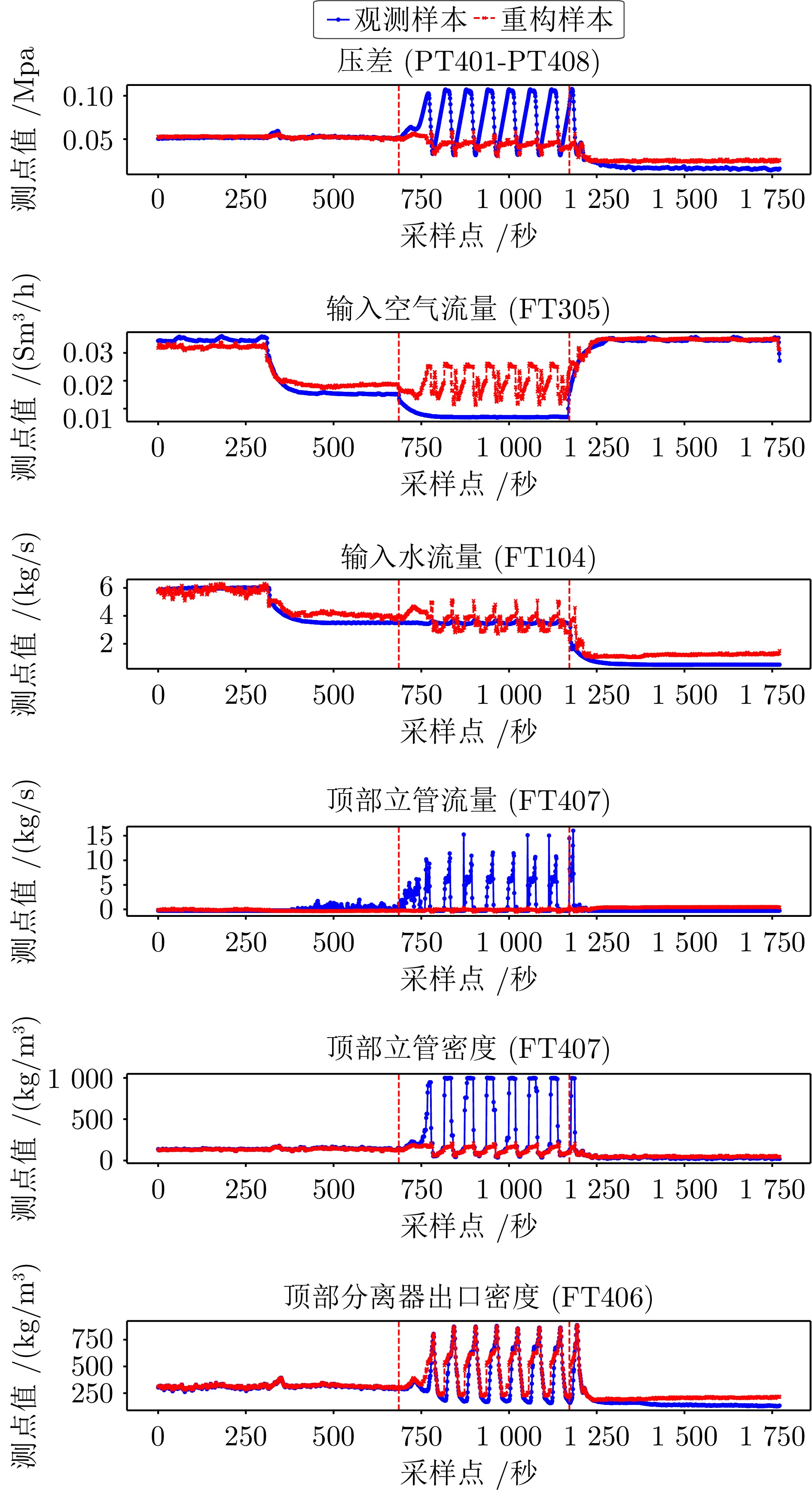
图 2 多相流过程案例10的重构结果
Fig. 2 Reconstruction results of case 10 in the multiphase flow process
表 1 时序解析语义库示例
Table 1 Example of the temporal analytic semantic library
层级 特征类型 精简语义描述 全局统计层 总体趋势 平稳、急升、高位震荡、下行. 极差与均值 极差114.11 (129.63$ \sim $15.52), 均值72.08. 极值 Max 129.63@ 1743 min; 次峰127.26@2019 min; Min 15.52@2999 min; 极值点3个.波动性 整体波动剧烈; 局部平稳段 1100 $ \sim $1300 、2000$ \sim $2200 min.阶段特征层 分段依据 初期0$ \sim $600 min; 中期600$ \sim $ 2270 min; 后期2270 $ \sim $3000 min.初期阶段 低温20$ \sim $30 ℃, 小幅波动. 中期阶段 多次急升急降, 均温≈80 ℃. 后期阶段 回落至15$ \sim $40 ℃, 高频震荡. 事件/局部层 拐点 显著拐点$ \ge $ 3:首升475$ \sim $506 min (25.34 $ \rightarrow $ 116.62)、首降989$ \sim $ 2999 min (116.34 $ \rightarrow $ 15.52)…突变点 475、989 min等多点突变. 急剧回落 存在, 次数$ \ge $ 2. 周期性/重复 多次升–降循环, 间隔≈500$ \sim $600 min.  下载: 导出CSV
表 2 提示词模板
Table 2 Prompt templates
时序描述提示词模板 你的任务是描述一个测量点的测量值与理想正常值之间的偏差, 重点关注时序解析语义库中的趋势、周期性模式、波动性以及关键异常情况. 背景信息: ● 工业流程说明: [PROCESS_INFO] ● 所有测点清单: [ALL_SENSORS] ● 目标测点: [TARGET_SENSOR] ● 时序解析语义库: [SEMANTIC_BANK] ● 数据表格: [TABLE] (包括测量值、理想正常值、偏差、随时间变化的偏差百分比, 以及正常情况下的平均偏差和偏差百分比) 请仅关注偏差或偏差百分比显著超过正常范围的时间段, 因为这些时间段可能表明存在故障. 对于偏差或百分比接近正常运行条件的时间段, 可忽略不计. 在这些显著偏差的时间段内, 请描述以下两点: 1) 测量值的趋势(上升、下降、稳定或周期性波动) 2) 测量值是高于还是低于理想值 如果整个时间段内的偏差都不显著, 请说明该变量没有明显的异常. 提供定量指标(例如时间间隔) 和定性见解, 描述在这些显著偏差时间段内测量值的变化情况. 重点关注可观察到的模式, 避免对故障根因进行推测和得出结论. 不要使用副标题或Markdown语法. 回答要简洁, 不超过100字. 故障诊断提示词模板 你是工业流程故障诊断领域的专家. 你的任务是分析以下信息以识别潜在故障: 背景信息: ● 工业流程介绍: [PROCESS_INFO] ● 测量点(可用传感器列表): [ALL_SENSORS] ● 故障知识(已知故障及其特征): [FAULT_KNOWLEDGE] ● 时间序列观测值: [TIME_DESP] (测量值与预测值之间偏差的描述; 绝对值越大表示故障越严重) 遵循步骤: 1) 识别关键传感器. 确定哪些传感器的测量值与预期值存在显著偏差. 2) 与故障知识进行交叉参考. 将观测到的模式与已知故障特征进行比较, 以推测可能的故障. 请注意, 不同故障可能在某些变量上表现出相似的模式, 因此不要仅依赖提供的故障知识; 结合故障原因和流程工作流, 合理推断不同变量的变化趋势. 3) 判断数据是否充足. ● 如果时间序列观测值提供了足够的信息来识别故障, 请按照以下格式输出故障编号: 格式: <reasoning>[逐步分析] </reasoning> <answer>故障编号 </answer> ● 如果时间序列观测值不充分或缺少关键变量, 请使用get_target_table工具查询特定传感器的详细数据. 在查询之前, 请确保传感器名称存在于测量点列表中. 格式: <reasoning>[逐步分析] </reasoning> <tool>get_target_table ("[SENSOR_1]") </tool> 重要说明: ● 优先考虑[ALL_SENSORS] 列表中的传感器. ● 仅在以下情况下调用get_target_table: –当时间序列观测值不足以确定故障时 –当观测值中缺少用于故障诊断的关键变量时
下载: 导出CSV
表 3 不同模型在多相流过程的性能对比
Table 3 Performance comparison of different models in the multiphase flow process
案例 Qwen2.5-7B-
InstructQwen2.5-72B-
InstructDeepSeek-
V3DeepSeek-R1-Distill-
Qwen-7BDeepSeek-R1-Distill-
Qwen-32BQwQ-
32BDeepSeek-
R1Qwen3-235B-
A22BDeepSeek-V3.2-
Exp案例1 100% 0% 0% 100% 100% 100% 100% 0% 0% 案例2 100% 100% 100% 100% 0% 100% 100% 100% 0% 案例3 100% 100% 100% 100% 100% 100% 100% 100% 100% 案例4 0% 0% 0% 100% 0% 100% 100% 100% 100% 案例5 0% 100% 100% 100% 100% 100% 100% 100% 100% 案例6 0% 100% 0% 100% 100% 100% 100% 100% 100% 案例7 0% 0% 0% 0% 100% 100% 100% 100% 100% 案例8 0% 0% 0% 0% 0% 0% 100% 100% 100% 案例9 0% 0% 0% 0% 0% 0% 0% 100% 0% 案例10 0% 0% 0% 0% 100% 0% 0% 0% 0% 案例11 0% 0% 0% 100% 0% 0% 0% 0% 100% 案例12 0% 0% 0% 0% 0% 0% 100% 0% 0% 案例13 0% 0% 0% 100% 100% 100% 100% 100% 100% 准确率 23.08% 30.77% 23.08% 61.54% 53.85% 61.54% 76.92% 69.23% 61.54%
下载: 导出CSV
表 4 LLM在多相流案例4下的诊断结果
Table 4 Diagnostic results of LLM under case 4 of the multiphase flow process
Qwen2.5-7B-Instruct的结果 <reasoning>基于传感器的显著偏差和已知的故障特征, 最可能的故障是故障1(空气管线堵塞), 因为PT312和PT401的偏差与空气管线堵塞的预期行为一致. </reasoning> <answer>1 </answer> DeepSeek-R1-Distill-Qwen-7B的结果 分步分析: 1. 识别关键传感器: 在PT312、PT401、PT408、FT305、FT104和FT406等传感器中观察到空气和水流量的显著偏差以及压力变化. 2. 与故障知识交叉引用: 观察到的空气和水流量下降趋势以及压力下降, 与水管线堵塞(故障2)的预期行为相匹配. 3. 确定数据充分性: 来自关键传感器的数据提供了足够的信息来推断故障. 结论: 最可能的故障是故障2:水管线堵塞. <answer>2 </answer> Deepseek-R1的结果 <reasoning> 1. 关键传感器偏差: - 输送空气压力(PT312): 下降趋势(158-200), 低于理想值. - 输入空气流量(FT305): 高于理想值, 与空气管线堵塞不一致. - 输入水流量(FT104): 降至零(156-185), 尽管VC101阀门开度更大(156-200偏差). - 立管压力(PT401/PT408): 下降趋势, 可能是由于水流量减少影响了混合物密度. - VC101位置: 超出理想值增加, 表明试图补偿受限的水流量. 2. 与故障知识交叉引用: - 故障1(空气管线堵塞): 与FT305(空气流量增加)矛盾.空气管线堵塞会减少FT305的读数. - 故障2(水管线堵塞): 与FT104(水流量降至零)和VC101(阀门开度增大以补偿)相匹配.VC101下游的物理堵塞解释了这些趋势. - 故障3(顶部(Top)分离器堵塞): 与FT406(输出流量急剧增加)不一致.堵塞的输入会减少输出流量. - 故障5(段塞流): 观测中未描述振荡的压力/流量模式. - 故障6(2英寸管线加压): 需要PT417数据, 此处未分析.主要偏差与水管线堵塞一致. 3. 结论: 水流量(FT104)的同时下降和VC101的过度补偿(开度超出正常范围)强烈表明存在水管线堵塞(故障2).空气系统的偏差(PT312, FT305)是次要影响或与主故障无关. </reasoning> <answer>2 </answer>
下载: 导出CSV
表 5 DeepSeek-R1在多相流案例10下的诊断结果
Table 5 Diagnostic results of DeepSeek-R1 under case 10 of the multiphase flow process
DeepSeek-R1的结果 <reasoning> 1. 关键传感器偏差: - FT305(空气流量): 显著减少, 表明空气流量减少. - PT312(空气压力): 初始下降(40$ \sim $69), 随后上升(70$ \sim $200), 表明由于气流受限导致压力积累. - PT401-PT408(压差): 上升趋势, 表明由于气体流量减少导致液体在提升管中积累. - FT407(密度): 峰值与液体含量增加(混合物中空气减少)相关. 2. 与故障知识交叉参考: - 故障1(空气管路堵塞)直接解释了空气流量减少(FT305)及随后的压力/密度变化. 阀门逐渐关闭与观测到的趋势一致: 初始压力下降(PT312)是由于气流受限, 随后压缩机驱动的压力上升. 提升管中压差(PT401-PT408)和密度(FT407)增加与气体流量不足导致的液体积累一致. - 故障5(段塞流)可以解释压力/流量波动, 但可能是空气堵塞(故障1)的次要影响. 段塞流不是根本故障. 3. 结论: 数据强烈支持故障1为主要原因, 观测到的偏差与空气供应受限直接相关. </reasoning> <answer>1 </answer>
下载: 导出CSV
表 6 不同多轮投票设定下的大模型性能对比
Table 6 Performance comparison of LLM under different multi-turn voting settings
方法 ACC@1 ACC@3 ACC@5 Qwen2.5-7B-Instruct 15.38% 15.38% 23.08% Qwen2.5-72B-Instruct 25.00% 25.00% 30.77% DeepSeek-V3 0.00% 23.08% 23.08% DeepSeek-R1-Distill-Qwen-7B 46.15% 53.85% 61.54% DeepSeek-R1-Distill-Qwen-32B 46.15% 69.23% 53.85% QwQ-32B 46.15% 61.54% 61.54% DeepSeek-R1 69.23% 76.92% 76.92%
下载: 导出CSV
表 7 部分模型在火电案例中的性能对比
Table 7 Performance comparison of selected models in thermal power cases
案例 DeepSeek-R1-Distill-Qwen-7B DeepSeek-R1 案例1 100% 100% 案例2 0% 100% 案例3 100% 100% 案例4 100% 100% 案例5 0% 100% 案例6 0% 100% 案例7 0% 100% 案例8 0% 100% 准确率 37.5% 100%
下载: 导出CSV
表 8 DeepSeek-R1在火电案例4下的诊断结果
Table 8 Diagnostic results of DeepSeek-R1 under Case 4 of the thermal power process
第一轮回复 <reasoning>根据时间序列观测数据, 关键异常点包括凝结水泵B的推力轴承温度持续偏高、闭冷水供水母管压力显著偏低, 以及发电机有功功率波动. 已知故障类型中, 故障3涉及凝结水泵电机轴承温度高, 但观测中推力轴承温度偏差未达5 ℃阈值, 且电机轴承温度2显示低于预期, 不符合故障3特征. 故障4与密封水压力相关, 但观测中未直接提及该传感器的异常. 闭冷水压力低可能导致冷却不足, 间接影响密封水压力或轴承温度, 但需要验证密封水压力数据. 由于现有数据未包含密封水压力的具体偏差, 需进一步查询该传感器以确认是否触发故障4. 同时, 轴承冷却水出水温度的缺失数据也阻碍了冷却系统问题的完整分析. </reasoning> <tool>get_target_table("凝结水泵B密封水压力"); get_target_table("凝结水泵B轴承冷却水出水温度") </tool> 工具调用结果 凝结水泵B密封水压力: 在时间点1至200之间, 凝结水泵B密封水压力与理想值存在显著偏差. 在此期间, 测量值总体呈下降趋势, 并伴有周期性波动. 测量值始终低于理想值. 在时间点1时, 偏差最大, 测量值与理想值的差值为-0.159 Pa (误差为-61.737%). 这表明在这一时间段内, 凝结水泵B密封水系统可能存在潜在故障. 凝结水泵B轴承冷却水出水温度: 在时间点1至10、13至20、32至39、40至49、84至93、122至131、140至149、158至184、189至200之间, 凝结水泵B轴承冷却水出水温度与理想值存在显著偏差. 在这些时段内, 测量值呈现下降趋势, 且测量值始终低于理想值. 在时间点158时, 偏差最大, 测量值与理想值的差值为-3.666 ℃, 误差百分比为-36.035%. 这表明在这些时间段内, 凝结水泵B轴承冷却水出水温度可能存在潜在故障. 基于工具调用的第二轮回复 <reasoning> 1. 密封水压力分析: 根据工具返回的数据, 凝结水泵B密封水压力在全部时间点持续低于理想值, 最大偏差达-61.737%, 完全符合故障4中"密封水压力连续低报警, 明显低于估计值"的特征. 2. 闭冷水压力与密封水系统的关联: 闭冷水供水母管压力的显著下降可能导致密封水系统压力不足, 进一步验证了故障4的触发条件. 3. 推力轴承温度升高的间接影响: 推力轴承温度升高可能是由于闭冷水压力不足导致冷却效率下降, 但这一现象属于次要表现, 已知故障库中无直接对应关系. 4. 排除其他故障: 故障3要求轴承温度超过估计值5 ℃以上, 但观测中推力轴承最大偏差仅2.333 ℃且属于不同轴承类型, 不符合条件; 其他故障类型与当前传感器异常无直接关联. </reasoning> <answer>4 </answer>
下载: 导出CSV
-
[1] 柴天佑. 工业人工智能发展方向. 自动化学报, 2020, 46(10): 2003−2012 doi: 10.16383/j.aas.c200796Chai Tian-You. Development directions of industrial artificial intelligence. Acta Automatica Sinica, 2020, 46(10): 2003−2012 doi: 10.16383/j.aas.c200796 [2] Isermann R. Supervision, fault-detection and fault-diagnosis methods — An introduction. Control Engineering Practice, 1997, 5(5): 639−652 doi: 10.1016/S0967-0661(97)00046-4 [3] 赵春晖, 胡赟昀, 郑嘉乐, 陈军豪. 数据驱动的燃煤发电装备运行工况监控——现状与展望. 自动化学报, 2022, 48(11): 2611−2633 doi: 10.16383/j.aas.c200993Zhao Chun-Hui, Hu Yun-Yun, Zheng Jia-Le, Chen Jun-Hao. Data-driven operating monitoring for coal-fired power generation equipment: The state of the art and challenge. Acta Automatica Sinica, 2022, 48(11): 2611−2633 doi: 10.16383/j.aas.c200993 [4] Chen Jia-Wei, Zhao Chun-Hui. Addressing Information Asymmetry: Deep Temporal Causality Discovery for Mixed Time Series. IEEE Transactions on Pattern Analysis and Machine Intelligence, 2025, 47(7): 5723−5741 doi: 10.1109/TPAMI.2025.3553957 [5] Chiang L. H., Kotanchek M. E., Kordon A. K. Fault diagnosis based on Fisher discriminant analysis and support vector machines. Computers & Chemical Engineering, 2004, 28(8): 1389−1401 doi: 10.1016/j.compchemeng.2003.10.002 [6] Deng Fang, Guo Su, Zhou Rui, Chen Jie. Sensor multifault diagnosis with improved support vector machines. IEEE Transactions on Automation Science and Engineering, 2017, 14(2): 1053−1063 doi: 10.1109/TASE.2015.2487523 [7] Cai Bao-Ping, Huang Lei, Xie Min. Bayesian Networks in Fault Diagnosis. IEEE Transactions on Industrial Informatics, 2017, 13(5): 2227−2240 doi: 10.1109/TII.2017.2695583 [8] Sinitsin V., Ibryaeva O., Sakovskaya V., Eremeeva V. Intelligent bearing fault diagnosis method combining mixed input and hybrid CNN-MLP model. Mechanical Systems and Signal Processing, 2022, 180: Article No. 109454 doi: 10.1016/j.ymssp.2022.109454 [9] Ding Yi-Fei, Jia Min-Ping, Miao Qiu-Hua, Cao Yu-Dong. A novel time–frequency Transformer based on self–attention mechanism and its application in fault diagnosis of rolling bearings. Mechanical Systems and Signal Processing, 2022, 168: Article No. 108616 doi: 10.1016/j.ymssp.2021.108616 [10] Zhao Chun-Hui. Perspectives on nonstationary process monitoring in the era of industrial artificial intelligence. Journal of Process Control, 2022, 116: 255−272 doi: 10.1016/j.jprocont.2022.06.011 [11] Wang Han, Wang Jing-Wei, Zhao Yu-Kai, Liu Qing, Liu Min, Shen Wei-Ming. Few-Shot Learning for Fault Diagnosis With a Dual Graph Neural Network. IEEE Transactions on Industrial Informatics, 2023, 19(2): 1559−1568 doi: 10.1109/TII.2022.3205373 [12] Guo Liang, Lei Ya-Guo, Xing Sai-Bo, Yan Tao, Li Nai-Ping. Deep convolutional transfer learning network: A new method for intelligent fault diagnosis of machines with unlabeled data. IEEE Transactions on Industrial Electronics, 2019, 66(9): 7316−7325 doi: 10.1109/TIE.2018.2877090 [13] 谢刚, 韩秦, 聂晓音, 石慧, 张晓红, 田娟. 基于两阶段域泛化学习框架的轴承故障诊断方法. 自动化学报, 2024, 50(11): 2271−2285 doi: 10.16383/j.aas.c230716Xie Gang, Han Qin, Nie Xiao-Yin, Shi Hui, Zhang Xiao-Hong, Tian Juan. A two-stage domain generalization learning framework for fault diagnosis of bearings. Acta Automatica Sinica, 2024, 50(11): 2271−2285 doi: 10.16383/j.aas.c230716 [14] Jang K., Pilario K. E. S., Lee N., Moon I., Na J. Explainable Artificial Intelligence for Fault Diagnosis of Industrial Processes. IEEE Transactions on Industrial Informatics, 2025, 21(1): 4−11 doi: 10.1109/TII.2023.3240601 [15] Yue Jia-Qi, Zhao Jian-Cheng, Zhao Chun-Hui. Similarity Makes Difference: SSHTN for Generalized Zero-Shot Industrial Fault Diagnosis by Leveraging Auxiliary Set. IEEE Transactions on Industrial Informatics, 2024, 20(5): 7598−7607 doi: 10.1109/TII.2024.3359460 [16] Feng Liang-Jun, Zhao Chun-Hui. Fault description-based attribute transfer for zerosample industrial fault diagnosis. IEEE Transactions on Industrial Informatics, 2021, 17(3): 1852−1862 doi: 10.1109/TII.2020.2988208 [17] Chang Yu-Peng, et al. A Survey on Evaluation of Large Language Models. ACM Transactions on Intelligent Systems and Technology, 2024, 15(3): 39: 1−39: 45 [18] Tao Lai-Fa, Liu Hai-Fei, Ning Guo-Ao, Cao Wen-Yan, Huang Bo-Hao, Lu Chen. LLM-based framework for bearing fault diagnosis. Mechanical Systems and Signal Processing, 2025, 224: Article No. 112127 doi: 10.1016/j.ymssp.2024.112127 [19] Li Bao-Xue, Zhao Chun-Hui. Federated Zero-Shot Industrial Fault Diagnosis With Cloud-Shared Semantic Knowledge Base. IEEE Internet of Things Journal, 2023, 10(13): 11619−11630 doi: 10.1109/JIOT.2023.3243401 [20] 秦龙, 武万森, 刘丹, 胡越, 尹全军, 阳东升, 王飞跃. 基于大语言模型的复杂任务自主规划处理框架. 自动化学报, 2024, 50(4): 862−872 doi: 10.16383/j.aas.c240088Qin Long, Wu Wan-Sen, Liu Dan, Hu Yue, Yin Quan-Jun, Yang Dong-Sheng, Wang Fei-Yue. Autonomous planning and processing framework for complex tasks based on large language models. Acta Automatica Sinica, 2024, 50(4): 862−872 doi: 10.16383/j.aas.c240088 [21] Zhao Jian-Cheng, Yue Jia-Qi, Zhao Chun-Hui, Chen Chen. Adjust to reality: LLM-driven test-time semantic adjustment for zero-shot fault diagnosis. Control Engineering Practice, 2025, 164: Article No. 106406 doi: 10.1016/j.conengprac.2025.106406 [22] Jin Ming, et al. Time-LLM: Time Series Forecasting by Reprogramming Large Language Models. In Proceedings of the International Conference on Learning Representations, 2024 [23] Liu Pei-Feng, Qian Lu, Zhao Xing-Wei, Tao Bo. Joint Knowledge Graph and Large Language Model for Fault Diagnosis and Its application in Aviation Assembly. IEEE Transactions on Industrial Informatics, 2024, 20(6): 8160−8169 doi: 10.1109/TII.2024.3366977 [24] Likas A., Vlassis N., Verbeek J. J. The global k-means clustering algorithm. Pattern Recognition, 2003, 36(2): 451−461 doi: 10.1016/S0031-3203(02)00060-2 [25] Xu Zheng-Yuan. Perturbation analysis for subspace decomposition with applications in subspace-based algorithms. IEEE Transactions on Signal Processing, 2002, 50(11): 2820−2830 doi: 10.1109/TSP.2002.804084 [26] Devlin J., et al. BERT: Pre-training of Deep Bidirectional Transformers for Language Understanding. Proceedings of NAACL-HLT, 20194171−4186 [27] Zhu Si-Jie, Yang Lin-Jie, Chen Chen, Shah M., Shen Xiao-Hui, Wang Heng. R2Former: Unified Retrieval and Reranking Transformer for Place Recognition. Proceedings of the IEEE/CVF Conference on Computer Vision and Pattern Recognition, 2023: 19370–19380 [28] Dong Qing-Xiu, et al. A Survey on In-context Learning. Proceedings of the 2024 Conference on Empirical Methods in Natural Language Processing, 2024: 1107–1128 [29] Ruiz-Cárcel C., Cao Y., Mba D., Lao L., Samuel R. T. Statistical process monitoring of a multiphase flow facility. Control Engineering Practice, 2015, 42: 74−88 doi: 10.1016/j.conengprac.2015.04.012 [30] Qwen, et al. Qwen2.5 Technical Report. Jan. 03, 2025, arXiv: arXiv: 2412.15115. doi: 10.48550/arXiv.2412.15115 [31] Guo Da-ya, et al. DeepSeek-R1 incentivizes reasoning in LLMs through reinforcement learning. Nature, 2025, 645: 633−638 doi: 10.1038/s41586-025-09422-z -

 下载:
下载:

计量
- 文章访问数: 6
- HTML全文浏览量: 5
- 被引次数: 0
