


Online Prediction of Chaotic Time Series Based on Correntropy Kernel Learning Evolving Fuzzy Systems
-
摘要: 演化模糊系统(EFSs)是在线学习领域中广泛应用的方法. 然而, 大部分EFSs往往隐含高斯噪声假设, 在重尾、偏态及强相关等非高斯扰动下易出现性能退化. 为此, 提出一种相关熵核学习演化模糊系统(CKL-EFS). CKL-EFS融合结构自组织与鲁棒递归学习两种机制, 以提升非高斯噪声环境下的在线建模能力. 在结构演化方面, 模型基于数据密度与激活度实现数据云的按需生成与效用驱动移除, 并通过在线归属更新维护数据云统计量, 从而抑制规则库无界膨胀并保持紧凑结构; 在参数更新方面, 采用核学习策略将输入映射至高维特征空间, 并引入改进相关熵准则对大误差样本自适应降权, 以增强对离群冲击与非高斯噪声的鲁棒性. 此外, 给出模型的计算复杂度分析. 在多个公开数据集上的实验结果表明, 所提CKL-EFS在预测精度与抗非高斯扰动稳定性方面均优于现有代表性方法.Abstract: Evolving fuzzy systems (EFSs) have been widely used in online learning. However, most existing EFSs implicitly rely on a Gaussian-noise assumption and may suffer performance degradation under non-Gaussian disturbances such as heavy-tailed, skewed, and strongly correlated noise. To address this issue, this paper proposes a correntropy kernel learning EFSs (CKL-EFS). CKL-EFS integrates structural self-organization and robust recursive learning mechanisms to enhance online modeling capability in non-Gaussian noise environments. For structural evolution, the model performs on-demand data-cloud generation and utility-driven pruning based on data density and activation, and maintains data-cloud statistics via online assignment updates, thereby preventing unbounded rule-base growth and preserving a compact structure; For parameter updating, a kernel learning strategy is employed to map inputs into a high-dimensional feature space, and an improved correntropy criterion is introduced to adaptively down-weight large-error samples, improving robustness against outlier perturbations and non-Gaussian noise. In addition, the computational complexity of the proposed model is analyzed. Experimental results on multiple public datasets demonstrate that CKL-EFS consistently outperforms representative existing methods in both predictive accuracy and stability against non-Gaussian disturbances.1)
1 1https://biendata.com/competition/kdd_2018 2)2 2https://www.kaggle.com/datasets/thomaswrightanderson/river-aire-discharge-time-series 3)3 3https://www.xjwind.com/ -
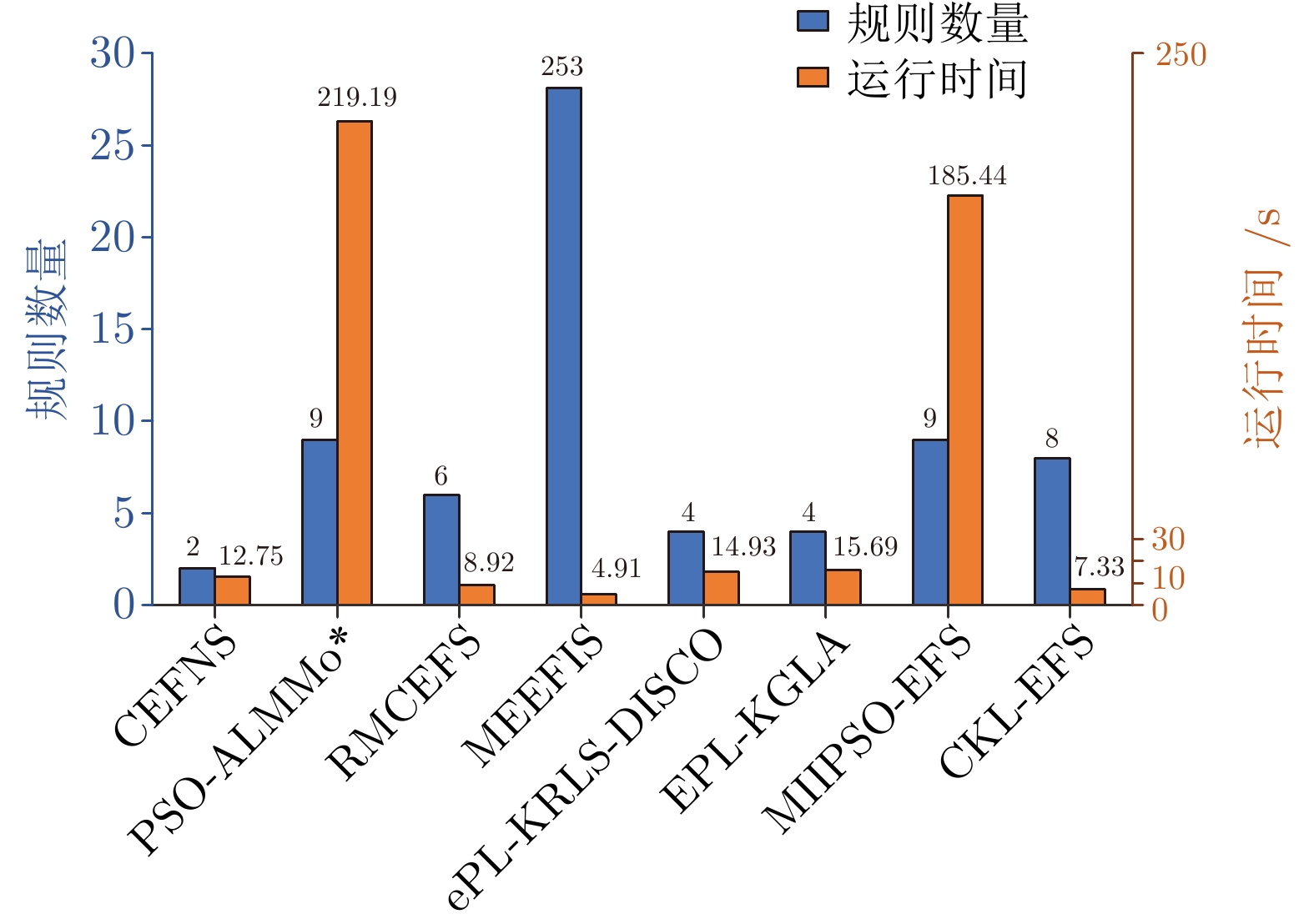
图 2 Lorenz-96数据集: 不同模型的规则数量和运行时间
Fig. 2 Lorenz-96 dataset: Number of rules and runtime for different models
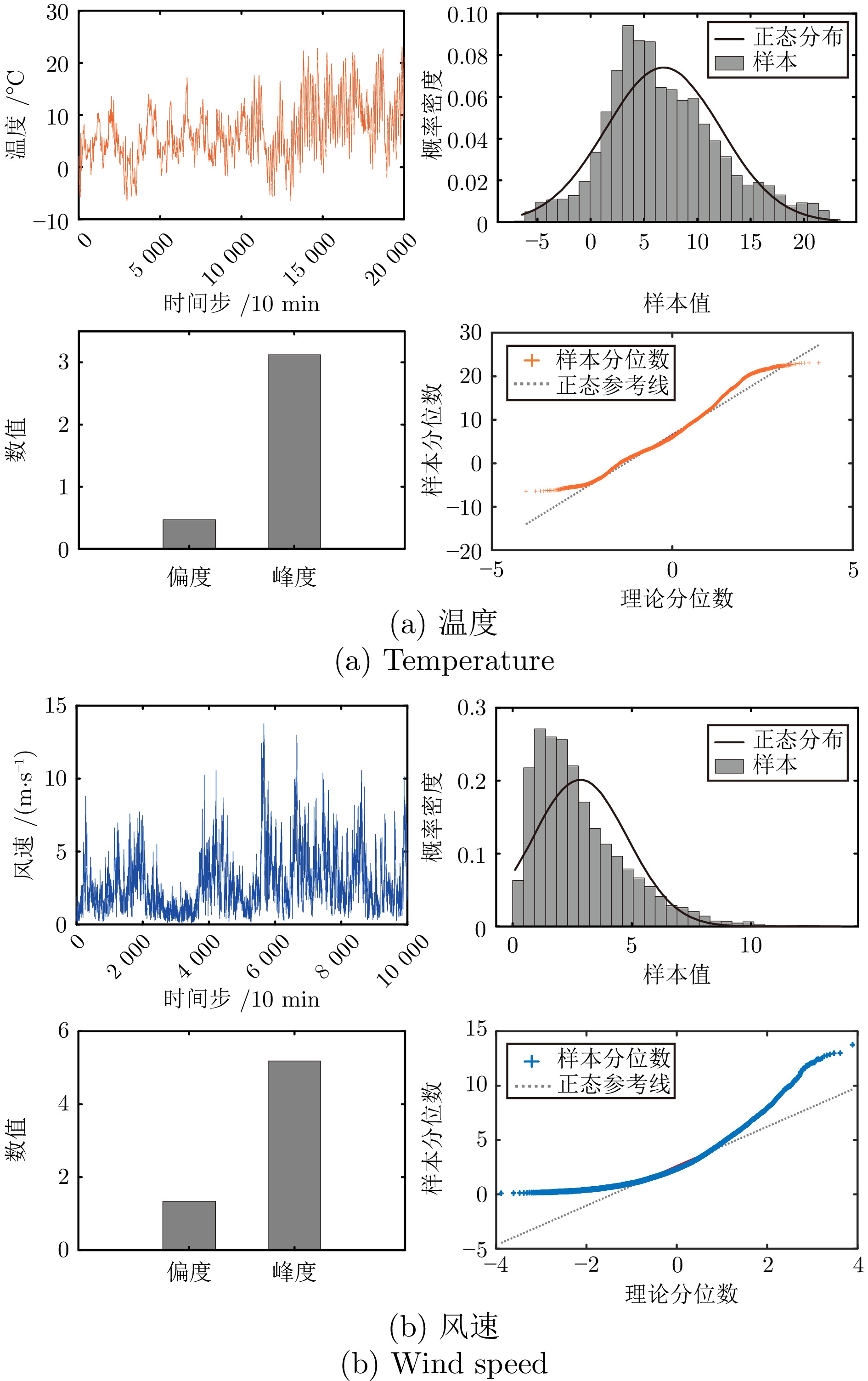
图 3 伦敦气象数据集: 不同预测因子的波动趋势和非高斯噪声分析
Fig. 3 London meteorological dataset: Fluctuation trend and non-Gaussian noise analysis of different predictors
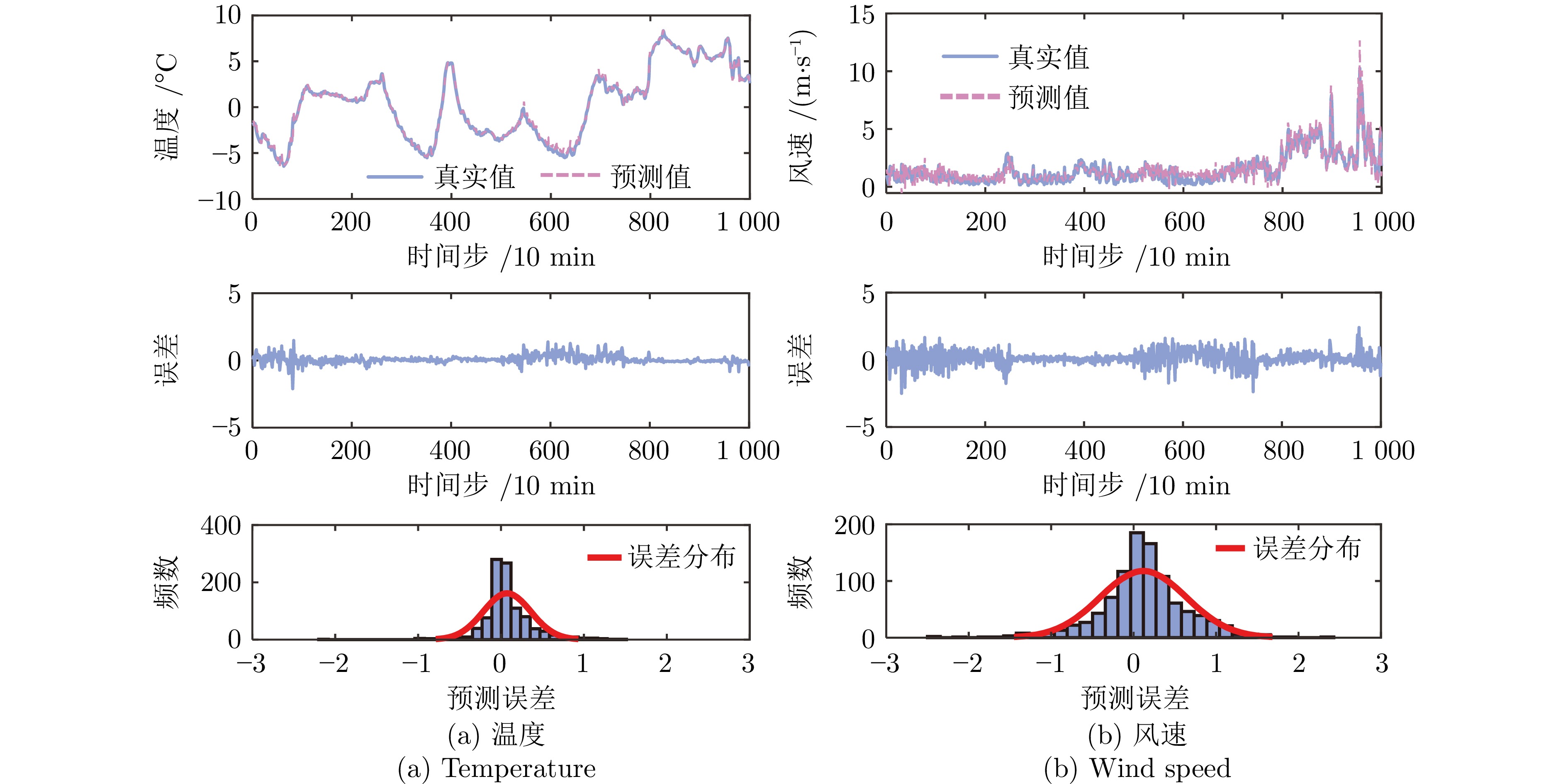
图 4 伦敦气象数据集: CKL-EFS的1步超前预测结果
Fig. 4 London meteorological dataset: 1-step-ahead prediction results of CKL-EFS
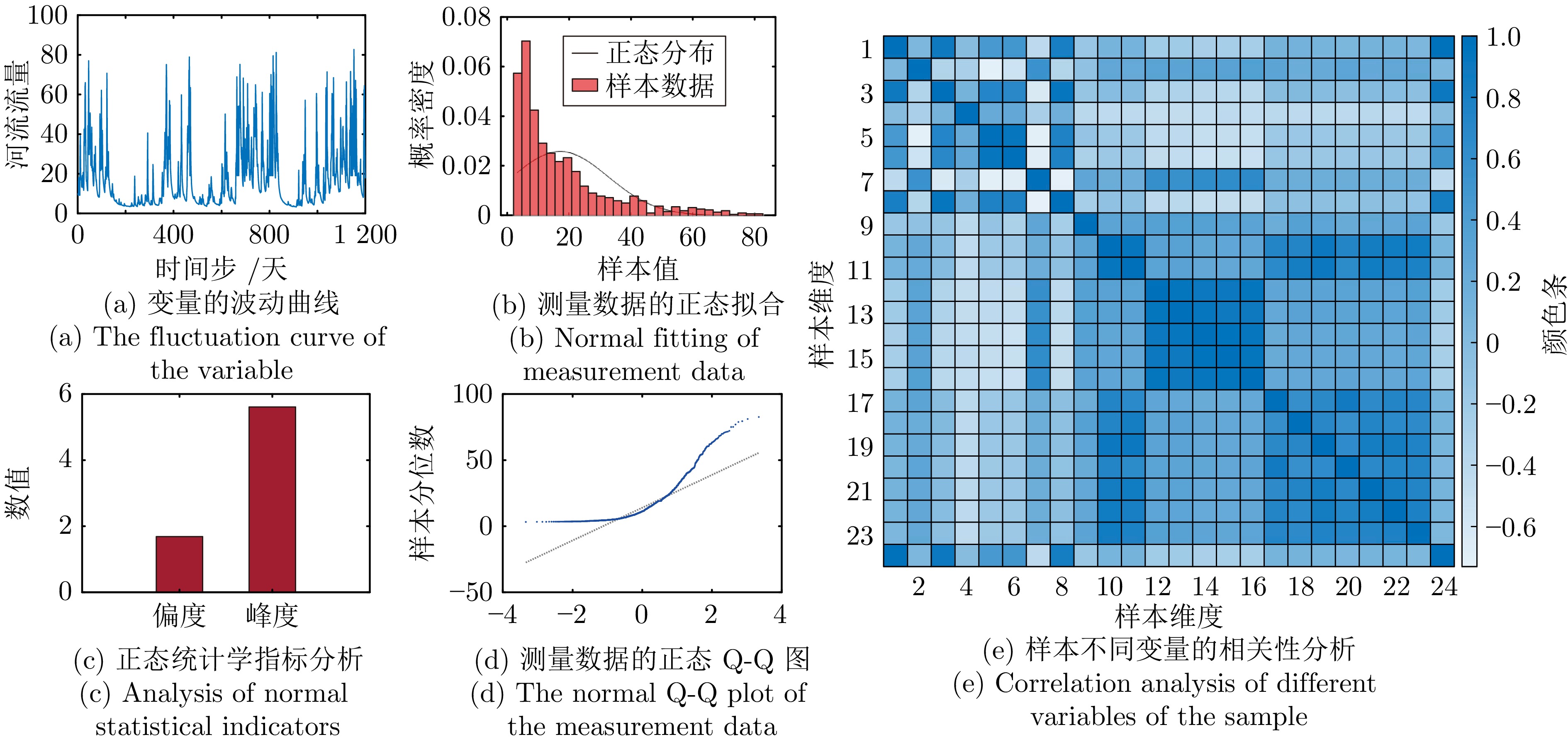
图 5 利兹水文数据集: 非高斯噪声强度分析和特征可视化分析
Fig. 5 Leeds hydrological dataset: Non-Gaussian noise intensity analysis and feature visualization analysis
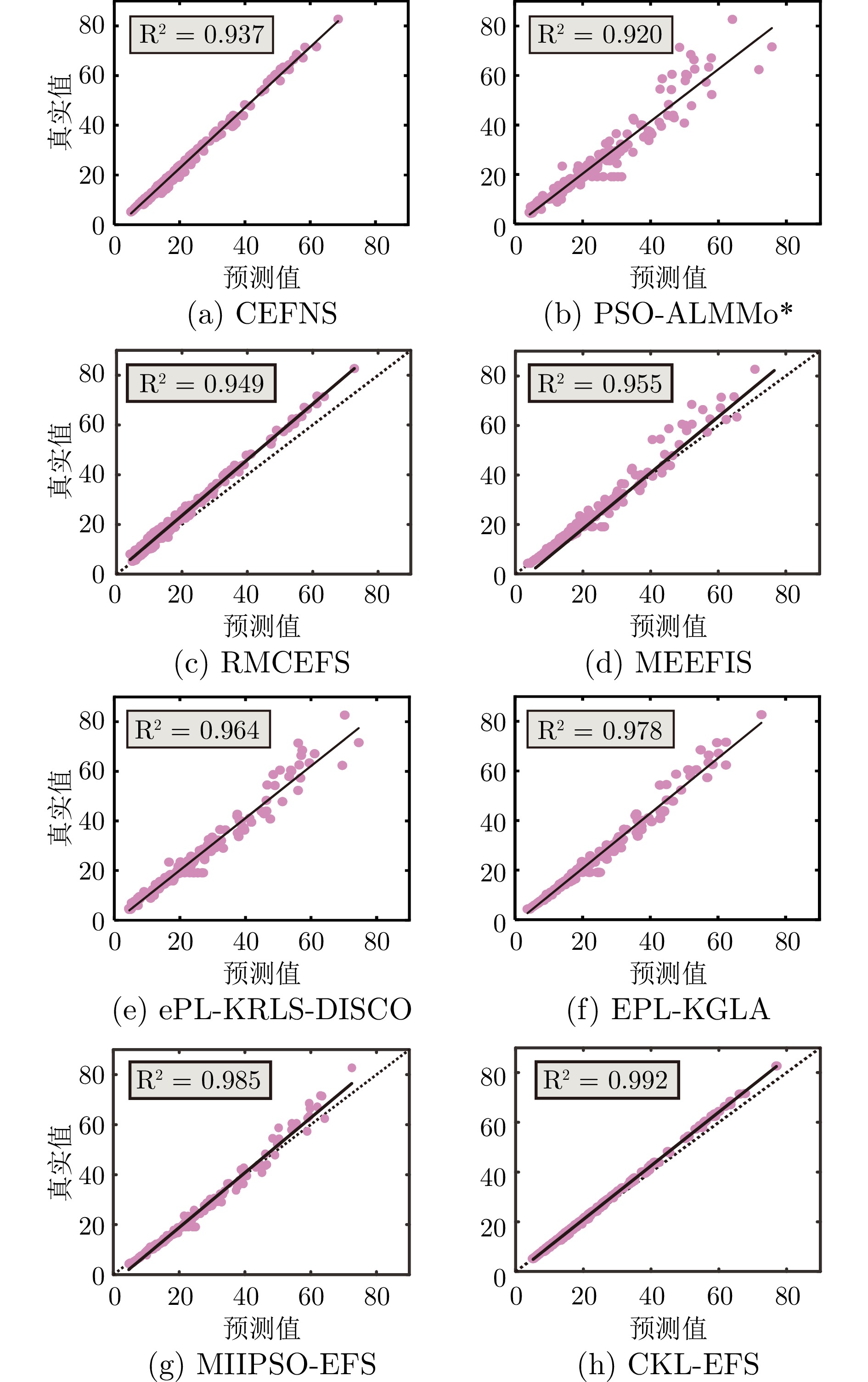
图 6 利兹水文数据集: 不同模型的1步超前预测散点图
Fig. 6 Leeds hydrological dataset: 1-step-ahead prediction scatter plot by different models
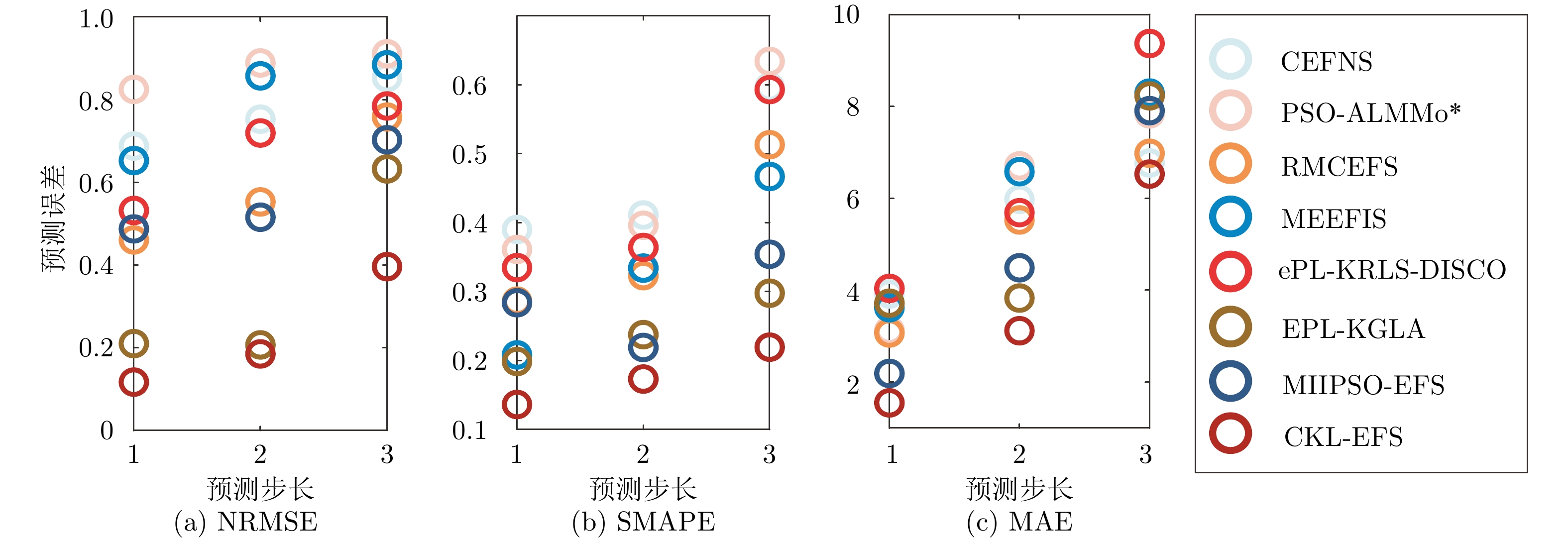
图 7 利兹水文数据集: 多步超前预测的NRMSE、SMAPE和MAE
Fig. 7 Leeds hydrological dataset: NRMSE, SMAPE and MAE of multi-step-ahead prediction
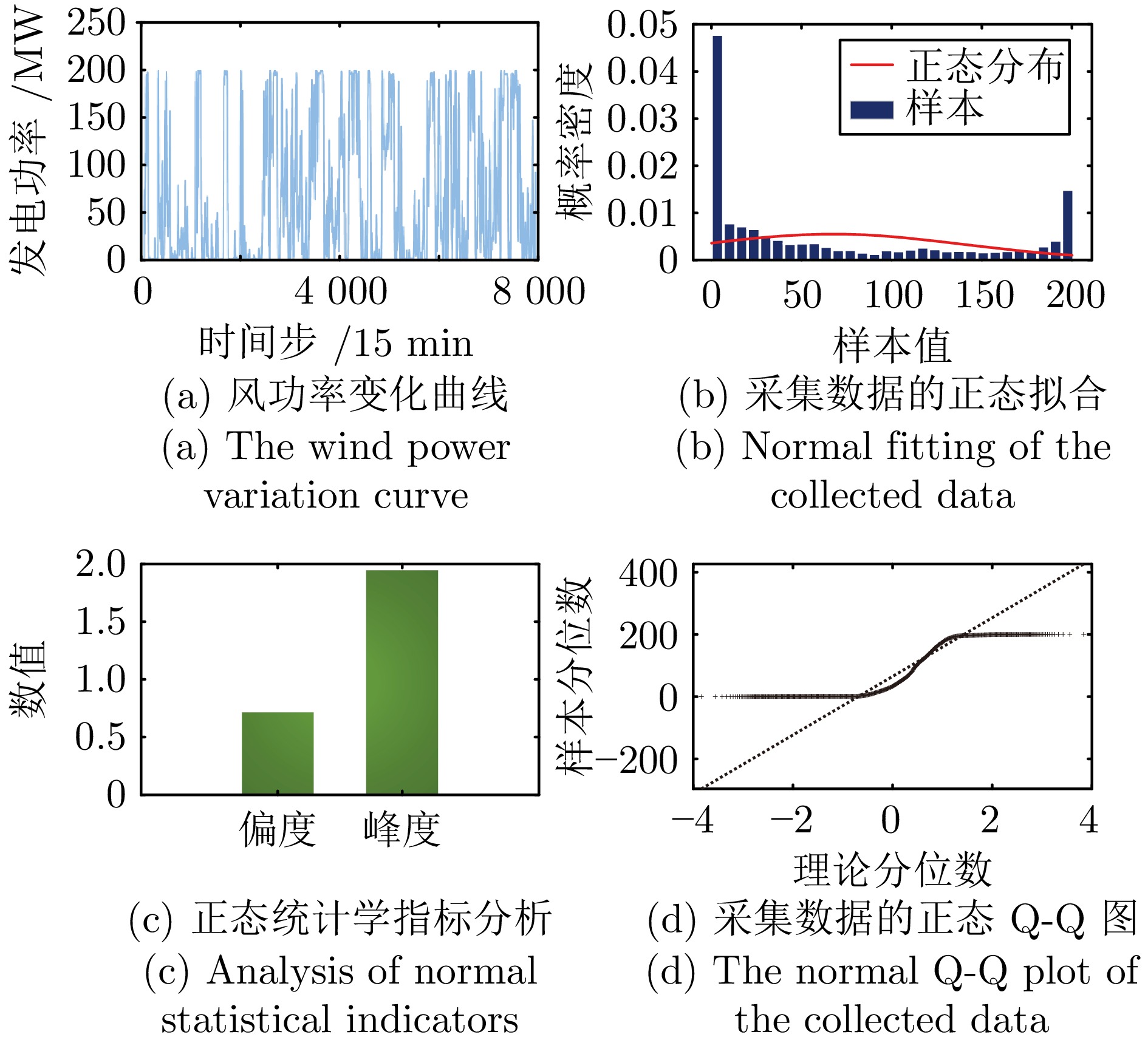
图 8 新疆风电数据集: 风功率波动及非高斯噪声强度分析
Fig. 8 Xinjiang wind power dataset: Analysis of wind power fluctuations and non-Gaussian noise intensity
表 1 数据集的参数设置
Table 1 Parameter settings of datasets
数据集 维度 样本数 训练集样本数 测试集样本数 Lorenz-96混沌系统 40 2 400 1 800 600 伦敦气象数据集 15 4 000 3 000 1 000 利兹水文数据集 24 1 200 1 000 200 新疆风电数据集 15 3 000 2 500 500  下载: 导出CSV
表 2 Lorenz-96数据集: 在不同非高斯扰动下的预测性能(度量标准: MAE)
Table 2 Lorenz-96 dataset: Prediction performance under various non-Gaussian disturbances (metric: MAE)
噪声类型 模型 值($ \times \; 10^{-1} $) 理想观测
(无噪声)CEFNS[29] 5.88 PSO-ALMMo*[40] 5.01 RMCEFS[25] 5.45 MEEFIS[21] 3.01 ePL-KRLS-DISCO[22] 3.15 EPL-KGLA[30] 4.36 MIIPSO-EFS[18] 3.75 CKL-EFS 3.59 重尾脉冲型非高斯扰动
(加$\alpha $-稳定噪声)CEFNS[29] 5.92 PSO-ALMMo*[40] 7.48 RMCEFS[25] 5.73 MEEFIS[21] 6.61 ePL-KRLS-DISCO[22] 6.47 EPL-KGLA[30] 5.29 MIIPSO-EFS[18] 6.41 CKL-EFS 3.72 强相关低频非高斯扰动
(加粉红噪声)CEFNS[29] 6.13 PSO-ALMMo*[40] 7.98 RMCEFS[25] 5.77 MEEFIS[21] 6.85 ePL-KRLS-DISCO[22] 7.32 EPL-KGLA[30] 5.41 MIIPSO-EFS[18] 7.13 CKL-EFS 3.97
下载: 导出CSV
表 3 Lorenz-96数据集: 非高斯性增强时的性能变化规律(以$ \alpha $-稳定噪声为例, 度量标准: MAE ($ \times \; 10^{-1} $))
Table 3 Lorenz-96 dataset: Performance trend as non-Gaussianity increases (via $ \alpha $-stable noise, metric: MAE ($ \times \; 10^{-1} $))
模型 稳定性指数$ \alpha_0 $ 2.0 1.8 1.6 1.4 1.2 CEFNS[29] 5.57 5.92 6.44 7.11 8.15 PSO-ALMMo*[40] 5.35 7.48 8.35 9.22 10.31 RMCEFS[25] 5.60 5.73 6.10 6.72 7.54 MEEFIS[21] 4.15 6.61 7.25 8.12 9.05 ePL-KRLS-DISCO[22] 4.02 6.47 7.05 7.88 8.96 EPL-KGLA[30] 4.95 5.29 5.70 6.22 6.95 MIIPSO-EFS[18] 4.40 6.41 7.20 8.05 9.28 CKL-EFS 3.62 3.72 3.85 4.10 4.45
下载: 导出CSV
表 4 伦敦气象数据集: 不同模型的1步超前预测结果
Table 4 London meteorological dataset: 1-step-ahead prediction results by different models
性能指标 模型 温度(°C) 风速(m/s) NRMSE ($ \times \; 10^{-1}$) CEFNS[29] 2.53 3.11 PSO-ALMMo*[40] 1.71 8.03 RMCEFS[25] 1.86 2.91 MEEFIS[21] 0.75 3.47 ePL-KRLS-DISCO[22] 1.68 4.35 EPL-KGLA[30] 1.13 2.80 MIIPSO-EFS[18] 1.39 4.52 CKL-EFS 0.54 2.13 SMAPE ($\times \; 10^{-1} $) CEFNS[29] 4.32 2.19 PSO-ALMMo*[40] 5.03 5.13 RMCEFS[25] 3.93 2.21 MEEFIS[21] 1.84 3.02 ePL-KRLS-DISCO[22] 2.28 2.87 EPL-KGLA[30] 2.12 1.43 MIIPSO-EFS[18] 2.75 2.52 CKL-EFS 0.87 0.74 规则数量 CEFNS[29] 3 5 PSO-ALMMo*[40] 9 9 RMCEFS[25] 6 10 MEEFIS[21] 379 329 ePL-KRLS-DISCO[22] 2 4 EPL-KGLA[30] 2 4 MIIPSO-EFS[18] 12 8 CKL-EFS 15 10 运行时间(s) CEFNS[29] 28.77 35.12 PSO-ALMMo*[40] 527.69 172.41 RMCEFS[25] 8.61 14.03 MEEFIS[21] 11.26 6.59 ePL-KRLS-DISCO[22] 50.73 64.32 EPL-KGLA[30] 13.36 19.65 MIIPSO-EFS[18] 363.21 81.05 CKL-EFS 30.42 22.97
下载: 导出CSV
表 5 利兹水文数据集: 不同模型的1步超前预测结果
Table 5 Leeds hydrological dataset: 1-step-ahead prediction results by different models
下载: 导出CSV
表 6 新疆风电数据集: 不同模型的1步超前预测结果
Table 6 Xinjiang wind power dataset: 1-step-ahead prediction results by different models
下载: 导出CSV
表 7 新疆风电数据集: CKL-EFS在不同超参数扰动下的SMAPE变化
Table 7 Xinjiang wind power dataset: SMAPE variation of CKL-EFS under different hyperparameter disturbances
设置 SMAPE ($ \times \; 10^{-1} $) SMAPE差值 相对变化 最优参数 2.11 — — 核带宽$ \sigma \uparrow 20 \% $ 2.17 0.06 +2.8% 正则化因子$ \gamma \uparrow 20\% $ 2.14 0.03 +1.4% 形状参数$ \alpha \uparrow 20\% $ 2.18 0.07 +3.3% 尺度参数$ \beta \uparrow 20\% $ 2.16 0.05 +2.4% 核带宽$ \sigma \downarrow 20\% $ 2.15 0.04 +1.9% 正则化因子$ \gamma \downarrow 20\% $ 2.13 0.02 +0.9% 形状参数$ \alpha \downarrow 20\% $ 2.18 0.07 +3.3% 尺度参数$ \beta \downarrow 20\% $ 2.16 0.05 +2.4%
下载: 导出CSV
-
[1] Alley R B, Emanuel K A, Zhang F Q. Advances in weather prediction: Better weather and environmental forecasting will continue to improve well-being. Science, 2019, 363(6425): 342−344 [2] Li D C, Han M, Wang J. Chaotic time series prediction based on a novel robust echo state network. IEEE Transactions on Neural Networks and Learning Systems, 2012, 23(5): 787−799 doi: 10.1109/TNNLS.2012.2188414 [3] Chen Y S, Yu S S, Lim C P, Shi P. Multi-objective estimation of optimal prediction intervals for wind power forecasting. IEEE Transactions on Sustainable Energy, 2024, 15(2): 974−985 doi: 10.1109/TSTE.2023.3321081 [4] Li K, Príncipe J C. Transfer learning in adaptive filters: The nearest instance centroid-estimation kernel least-mean-square algorithm. IEEE Transactions on Signal Processing, 2017, 65(24): 6520−6535 doi: 10.1109/TSP.2017.2752695 [5] Han M, Zhang S H, Xu M L, Qiu T, Wang N. Multivariate chaotic time series online prediction based on improved kernel recursive least squares algorithm. IEEE Transactions on Cybernetics, 2018, 49(4): 1160−1172 doi: 10.1109/icist.2017.7926807 [6] Zanin M, Olivares F. Ordinal patterns-based methodologies for distinguishing chaos from noise in discrete time series. Communications Physics, 2021, 4(1): Article No. 190 doi: 10.1038/s42005-021-00696-z [7] Wang Y S, Xu X H, Hu L, Fan J C, Han M. A time series continuous missing values imputation method based on generative adversarial networks. Knowledge-Based Systems, 2024, 283: Article No. 111215 doi: 10.1016/j.knosys.2023.111215 [8] Dubayan M R, Ershadi-Nasab S, Zomorodi M, Plawiak P, Tadeusiewicz R, Roui M B. Automated classification of thyroid disease using deep learning with neuroevolution model training. Engineering Applications of Artificial Intelligence, 2025, 146: Article No. 110209 doi: 10.1016/j.engappai.2025.110209 [9] Luo T Y, Liu M, Shi P, Duan G R, Cao X B. A hybrid data preprocessing-based hierarchical attention BiLSTM network for remaining useful life prediction of spacecraft lithium-ion batteries. IEEE Transactions on Neural Networks and Learning Systems, 2024, 35(12): 18076−18089 doi: 10.1109/TNNLS.2023.3311443 [10] Xu X H, Ren W J. A hybrid model of stacked autoencoder and modified particle swarm optimization for multivariate chaotic time series forecasting. Applied Soft Computing, 2022, 116: Article No. 108321 doi: 10.1016/j.asoc.2021.108321 [11] Angelov P P, Filev D P. An approach to online identification of Takagi-Sugeno fuzzy models. IEEE Transactions on Systems, Man, and Cybernetics, Part B (Cybernetics), 2004, 34(1): 484−498 doi: 10.1109/TSMCB.2003.817053 [12] Yu H, Lu J, Zhang G Q. Topology learning-based fuzzy random neural networks for streaming data regression. IEEE Transactions on Fuzzy Systems, 2022, 30(2): 412−425 doi: 10.1109/TFUZZ.2020.3039681 [13] Gu X W, Han J G, Shen Q, Angelov P P. Autonomous learning for fuzzy systems: A review. Artificial Intelligence Review, 2023, 56(8): 7549−7595 doi: 10.1007/s10462-022-10355-6 [14] Pratama M, Lu J, Lughofer E, Zhang G Q, Er M J. An incremental learning of concept drifts using evolving type-2 recurrent fuzzy neural networks. IEEE Transactions on Fuzzy Systems, 2017, 25(5): 1175−1192 doi: 10.1109/TFUZZ.2016.2599855 [15] Ge D J, Zeng X J. A self-evolving fuzzy system which learns dynamic threshold parameter by itself. IEEE Transactions on Fuzzy Systems, 2019, 27(8): 1625−1637 doi: 10.1109/TFUZZ.2018.2886154 [16] Hu L, Xu X H, Ren W J, Han M. Hierarchical evolving fuzzy system: A method for multidimensional chaotic time series online prediction. IEEE Transactions on Fuzzy Systems, 2024, 32(6): 3329−3341 doi: 10.1109/TFUZZ.2023.3348847 [17] Angelov P P, Gu X W, Príncipe J C. Autonomous learning multimodel systems from data streams. IEEE Transactions on Fuz-zy Systems, 2018, 26(4): 2213−2224 doi: 10.1109/TFUZZ.2017.2769039 [18] Hu L, Xu X H, Liu J W, Yan X H, Han M. MIIPSO-EFS: Learning system with self-optimized parameters for chaotic time series online prediction. Knowledge-Based Systems, 2025, 310: Article No. 112878 doi: 10.1016/j.knosys.2024.112878 [19] Pratama M, Lu J, Zhang G Q. Evolving type-2 fuzzy classifier. IEEE Transactions on Fuzzy Systems, 2016, 24(3): 574−589 doi: 10.1109/TFUZZ.2015.2463732 [20] Mei Z, Zhao T, Gu X W. A dynamic evolving fuzzy system for streaming data prediction. IEEE Transactions on Fuzzy Systems, 2024, 32(8): 4324−4337 doi: 10.1109/TFUZZ.2024.3395643 [21] Gu X W. Multilayer ensemble evolving fuzzy inference system. IEEE Transactions on Fuzzy Systems, 2021, 29(8): 2425−2431 doi: 10.1109/TFUZZ.2020.2988846 [22] Alves K S T R, de Aguiar E P. A novel rule-based evolving fuzzy system applied to the thermal modeling of power transformers. Applied Soft Computing, 2021, 112: Article No. 107764 doi: 10.1016/j.asoc.2021.107764 [23] Shi L, Zhao H Q, Zakharov Y. An improved variable kernel width for maximum correntropy criterion algorithm. IEEE Transactions on Circuits and Systems II: Express Briefs, 2020, 67(7): 1339−1343 doi: 10.1016/j.sigpro.2020.107589 [24] Duarte M S, Barreto G A. Fully adaptive dictionary for online correntropy kernel learning using proximal methods. Expert Systems With Applications, 2021, 178: Article No. 114976 doi: 10.1016/j.eswa.2021.114976 [25] Rong H J, Yang Z X, Wong P K. Robust and noise-insensitive recursive maximum correntropy-based evolving fuzzy system. IEEE Transactions on Fuzzy Systems, 2020, 28(9): 2277−2284 doi: 10.1109/TFUZZ.2019.2931871 [26] Wang F, He Y C, Wang S Y, Chen B D. Maximum total correntropy adaptive filtering against heavy-tailed noises. Signal Processing, 2017, 141: 84−95 doi: 10.1016/j.sigpro.2017.05.029 [27] Shi L, Shen L, Chen B D. An efficient parameter optimization of maximum correntropy criterion. IEEE Signal Processing Letters, 2023, 30: 538−542 doi: 10.1109/LSP.2023.3273174 [28] Wang J, Lu L, Shi L, Zhu G Y, Yang X M. Euclidean direction search algorithm based on maximum correntropy criterion. IEEE Signal Processing Letters, 2023, 30: 1032−1036 doi: 10.1109/LSP.2023.3301808 [29] Bao R J, Rong H J, Angelov P P, Chen B D, Wong P K. Correntropy-based evolving fuzzy neural system. IEEE Transactions on Fuzzy Systems, 2018, 26(3): 1324−1338 doi: 10.1109/TFUZZ.2017.2719619 [30] Han M, Xia H J, Ren W J. Kernel general loss algorithm based on evolving participatory learning for online time series prediction. Engineering Applications of Artificial Intelligence, 2023, 124: Article No. 106600 doi: 10.1016/j.engappai.2023.106600 [31] Shen T Y, Ren W J, Han M. Quantized generalized maximum correntropy criterion based kernel recursive least squares for online time series prediction. Engineering Applications of Artificial Intelligence, 2020, 95: Article No. 103797 doi: 10.1016/j.engappai.2020.103797 [32] Wu Z Z, Shi J H, Zhang X, Ma W T, Chen B D. Kernel recursive maximum correntropy. Signal Processing, 2015, 117: 11−16 doi: 10.1016/j.sigpro.2015.04.024 [33] Lv S H, Zhao H Q, Zhou L J. Maximum mixture total correntropy adaptive filtering against impulsive noises. Signal Processing, 2021, 189: Article No. 108236 doi: 10.1016/j.sigpro.2021.108236 [34] He J C, Wang G, Zhang X, Wang H W, Peng B. Maximum total generalized correntropy adaptive filtering for parameter estimation. Signal Processing, 2023, 203: Article No. 108787 doi: 10.1016/j.sigpro.2022.108787 [35] Shen P C, Li C G. Minimum total error entropy method for parameter estimation. IEEE Transactions on Signal Processing, 2015, 63(15): 4079−4090 doi: 10.1109/TSP.2015.2437836 [36] Zhu Y Y, Zhao H Q, Zeng X P, Chen B D. Robust generalized maximum correntropy criterion algorithms for active noise control. IEEE/ACM Transactions on Audio, Speech, and Language Processing, 2020, 28: 1282−1292 doi: 10.1109/TASLP.2020.2982030 [37] Angelov P. Fuzzily connected multimodel systems evolving autonomously from data streams. IEEE Transactions on Systems, Man, and Cybernetics, Part B (Cybernetics), 2011, 41(4): 898−910 doi: 10.1109/TSMCB.2010.2098866 [38] Angelov P P, Gu X W, Príncipe J C. A generalized methodology for data analysis. IEEE Transactions on Cybernetics, 2018, 48(10): 2981−2993 doi: 10.1109/TCYB.2017.2753880 [39] Gu X W, Ni Q, Tang G L. A novel data-driven approach to autonomous fuzzy clustering. IEEE Transactions on Fuzzy Systems, 2022, 30(6): 2073−2085 doi: 10.1109/TFUZZ.2021.3074299 [40] Gu X W, Shen Q, Angelov P P. Particle swarm optimized autonomous learning fuzzy system. IEEE Transactions on Cybernetics, 2021, 51(11): 5352−5363 doi: 10.1109/TCYB.2020.2967462 [41] Wang Q X, Jiang L, Yan L S, He X C, Feng J C, Pan W, et al. Chaotic time series prediction based on physics-informed neural operator. Chaos, Solitons & Fractals, 2024, 186: Article No. 115326 doi: 10.1016/j.chaos.2024.115326 -

 下载:
下载:

计量
- 文章访问数: 460
- HTML全文浏览量: 214
- PDF下载量: 100
- 被引次数: 0
